
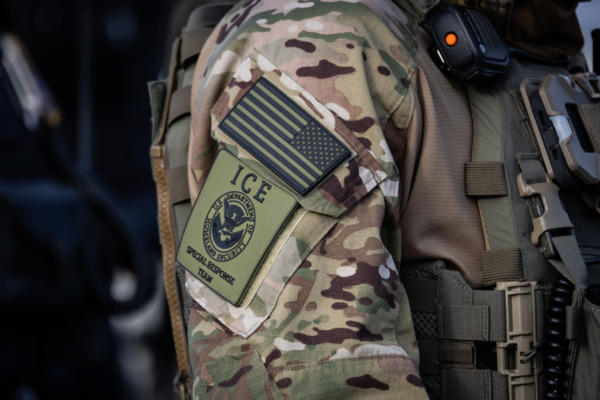
The Central District of California Federal Court publicly released a recent ruling on Wednesday indicating that federal immigration enforcement officers must obtain arrest warrants before conducting arrests. This ruling directly impacts the actions of the U.S. Immigration and Customs Enforcement (ICE) in California, offering some relief to foreign individuals awaiting identity confirmation.
Judge Maame Ewusi-Mensah Frimpong’s ruling on September 2 states that immigration enforcement officers cannot carry out arrests within the court’s jurisdiction unless there is individualized reasonable cause to believe the arrestee may escape before receiving an arrest warrant. Mere violation of immigration laws cannot be the sole basis for determining possible escape before obtaining the warrant. The ruling prohibits the use of the escape risk standard or analysis methods established in former ICE Acting Director Todd Lyons’ memo from January this year, which implied that illegal status alone constitutes a likelihood of escape.
The court also rejected the defendants’ request to temporarily suspend the enforcement of this order.
The plaintiffs in this lawsuit include the Los Angeles Workers’ Center Network (LAWCN), the United Farm Workers Union (UFW), and the Coalition for Humane Immigrant Rights (CHIRLA). The latest ruling applies to various locations such as Los Angeles, Orange County, Riverside County, San Bernardino County, Ventura County, Santa Barbara County, and San Luis Obispo County.
Upon seeing this ruling, Mr. F, a Chinese resident in Los Angeles, expressed relief. He is seeking asylum in the U.S. to escape persecution from the Chinese Communist Party and is awaiting approval. Recent ICE activities in Los Angeles have kept him anxious, and he hopes the court’s new injunction will be effective.
However, during an interview, legal expert Mr. Y from Southern California mentioned that the court’s restrictions apply only to specific arrest methods and are not a blanket limitation on all immigration enforcement. He emphasized that the order primarily addresses whether the government met statutory conditions and made necessary judgments when making arrests without warrants.
Mr. Y stressed that the regional court injunction carries legal binding force, and government agencies and officials cannot decide not to comply simply because they disagree with the ruling, are preparing to appeal, or find the judgment unreasonable.
Furthermore, various states or regions across the U.S. have rulings or legislation limiting ICE from conducting arrests without warrants, including the Eastern District of California, Colorado, Washington, D.C., and Portland.
Regarding the preliminary injunction from the Central District of California, the Department of Homeland Security stated in a comment to the media outlet, “ICE has the authority to make lawful arrests under the authorization of Title 8 of the U.S. Code. Enforcement officers investigate immigration status under ‘reasonable suspicion’ and make arrests based on ‘probable cause,’ which is in compliance with the statute and the Fourth Amendment of the U.S. Constitution. The Supreme Court has confirmed the legality of these practices.”
According to explanations of the “Introduction to Immigration Arrests in the United States” released last year by Congress.gov, arrest warrants issued by immigration enforcement agencies differ from judicial arrest warrants in criminal cases and do not require magistrate approval.
Title 8 of the U.S. Code §1226 states that immigration-related arrests typically require administrative arrest warrants. However, §1357(a)(2) of the law indicates two scenarios in which immigration enforcement officers can arrest foreign individuals suspected of violating immigration laws without administrative arrest warrants: 1. If the individual is unlawfully present or attempting to unlawfully enter the U.S. in the presence or within sight of immigration officers, and 2. If immigration officers have “reason to believe” the individual is unlawfully present in the U.S. and likely to escape before receiving an arrest warrant.