
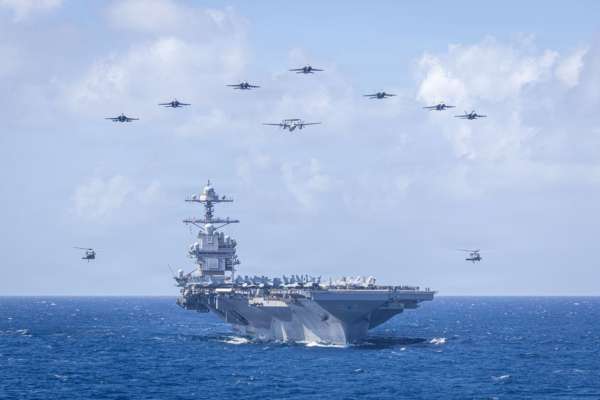
The Center for Strategic and International Studies (CSIS) in the United States has proposed a new perspective on the carrier competition between the U.S. and China. They suggest a strategy of deterring China by shifting focus from protecting American aircraft carriers to targeting Chinese aircraft carriers.
The report introduces a deterrence strategy centered around high-value assets of the opponent: making Beijing believe that deploying aircraft carriers to the Taiwan Strait, South China Sea, or beyond the First Island Chain may result in unacceptable military losses and political consequences.
According to CSIS’ latest report titled “Flip the Script,” the Chinese Communist Party (CCP) has long considered American aircraft carriers as potential targets and has been building a system consisting of submarines, anti-ship ballistic missiles, long-range strike, and reconnaissance systems to threaten U.S. carriers. The report suggests that the U.S. and its Pacific allies should take an offensive posture to deter Chinese aircraft carriers.
Rather than viewing American aircraft carriers as prey and focusing on defending U.S. assets, the report argues that the U.S. and its allies should adopt an aggressive stance to become hunters instead of prey in this evenly matched competition.
Chinese aircraft carriers hold military, political, and symbolic value, making the cost of their loss extremely high. Beijing has historically targeted U.S. aircraft carriers, even constructing a full-size model of an American carrier in the Taklamakan Desert.
From the Liaoning, Shandong to the Fujian carriers equipped with electromagnetic catapult systems, the carrier fleet has become a crucial symbol for Beijing to showcase its naval modernization, maritime power status, and national strength.
Should large carriers like the Fujian vessel suffer sinking or severe damage, it could have significant impacts on Beijing’s political credibility and domestic public opinion.
CSIS believes that carrier construction can also be considered a potential strategic weakness for the CCP, not only a challenge faced by the U.S. As U.S. decision-makers must carefully deploy carriers in areas vulnerable to submarine attacks, Chinese naval leaders must also consider similar factors.
China currently operates three active aircraft carriers. A 2025 Pentagon study estimated that the Chinese navy could build an additional six carriers by 2035.
Experts suggest that the loss of carriers could lead the CCP to avoid risks further due to the potential domestic political consequences.
A U.S. expert on China issues interviewed by Defense News stated, “The potential political fallout from losing a carrier might make the CCP more risk-averse.”
The expert explained, “The CCP has invested a significant amount of political capital in justifying the necessity of building a carrier fleet. Continuous public campaigns aim to garner public support as part of larger efforts to shape China’s ‘maritime power’ image. The CCP has utilized naval nationalism, mobilizing resources for carrier fleet construction.”
Throughout history, powerful and prestigious warships have been double-edged swords. For instance, during World War I and II, some German warships and battlecruisers remained in ports for extended periods due to the high cost of losses. In 1941, the German battleship Bismarck’s first sortie ended in sinking by the British Royal Navy, marking a significant defeat for the German navy.
CSIS proposes a concept where the risk of Chinese large surface vessels like the Fujian or Sichuan entering the Philippine Sea facing intensive land-based anti-ship firepower supported by allied intelligence, surveillance, and reconnaissance (ISR) systems would increase the risks of using them as frontline coercion tools.
CSIS advocates for establishing a deterrence framework focused on Chinese high-value maritime assets rather than solely on sinking Chinese carriers.
The report suggests deploying manned and unmanned submarines to ambush Chinese aircraft carriers, including U.S. nuclear submarines and quiet diesel-electric submarines and unmanned underwater vehicles from allies like Australia, Japan, and South Korea, to establish a persistent “underwater threat belt” in areas where Chinese carriers might operate.
“The key is to transform the underwater domain into a continuous threat area, forcing Beijing to invest heavily in escort vessels, anti-submarine aircraft, and fixed sensor networks to push away the underwater threats from its near seas,” stated the report.
CSIS states that, similar to China possessing “carrier-killer” ballistic missiles, the U.S. and its allies will deploy land-based ballistic missiles to attack Chinese vessels.
The report notes the long-standing consideration for U.S. policymakers on the vulnerability of carrier groups to Chinese submarine, missile, and long-range strike system threats when entering high-threat waters. The same logic applies to the Chinese navy, as when their carriers leave the protection of near-seas and enter broader waters, they become susceptible to threats from submarines, land-based missiles, aerial reconnaissance, and long-range firepower.
Under the new concept, these weapons would be launched from bases stretching from Japan to the Philippines to intercept Chinese aircraft carriers as they traverse critical chokepoints.
The aim of such actions is not necessarily immediate conflict but to compel China to invest more in escort vessels, anti-submarine aircraft, and fixed underwater sensing systems, increasing the operational costs for their carriers.
CSIS further recommends that the U.S. military employs integrated air, space, electronic, and cyber warfare to disrupt Chinese military command, communications, and information networks.
Additionally, drawing from Ukraine’s experience of using unmanned surface vessels to pressure the Russian Black Sea Fleet, the U.S. military can apply a similar strategy by leveraging a fleet of unmanned surface vessels to apply pressure on Chinese ports, bases, and anchored vessels, increasing the risk for Chinese carriers even in non-wartime or routine deployments.
Simultaneously, the U.S. military needs to adjust its current shipbuilding, unmanned systems, and ammunition production models.
CSIS suggests that the U.S. shipbuilding industry may not significantly increase the production of nuclear attack submarines immediately. Therefore, in the interim, there should be accelerated procurement of unmanned underwater vehicles, expansion of torpedo stockpiles, construction of allied bases, and a shift in the planned fleet of 350 manned vessels plus 150 unmanned surface and underwater vessels to approximately 300 manned vessels and 300 unmanned vessels. Additionally, the U.S. should engage with Indo-Pacific allies in joint production of long-range anti-ship missiles and precision ammunition to ensure that the Western Pacific conflict does not solely rely on the U.S. mainland supply lines.