
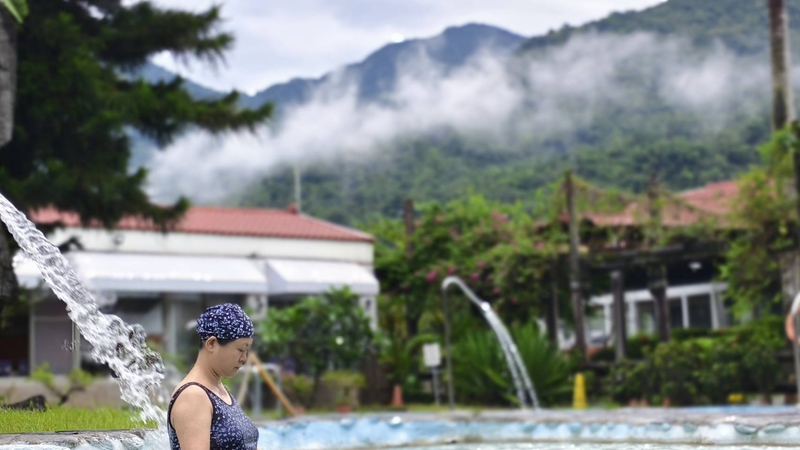
Taiwanese photographer Song Yongtai said that taking advantage of the cool weather in southern Taiwan in September, coupled with domestic travel discounts, they drove from their home in Kaohsiung along the Southern Cross-Island Highway to Taitung Zhiben. They organized a light travel trip focused on hot springs, sightseeing, and slowing down the pace. They stayed at the Zhiben Hongquan Hot Spring Resort in Taitung Zhiben, where they could enjoy quality hot springs and service. Just a 5-minute drive from the resort, they could reach the Double Waterfall, with the main attraction being the Baiyu Waterfall. They also explored other attractions along the Southern Cross-Island Highway, allowing them to enjoy a relaxing and pleasant trip through Taitung.
In Kaohsiung, it often rains in July and August due to typhoons and the southwest monsoon season, making these two months the rainiest periods of the year. Song Yongtai mentioned that by avoiding the typhoon season and heavy rains, they took advantage of the domestic travel discounts in September to visit Zhiben in Taitung for a hot spring experience and a light travel journey. The stunning mountain and sea landscapes in eastern Taiwan, along with the excellent air quality, left a deep impression on them. The cooler weather in September, combined with the fresh scenery after the rain, made the journey from Kaohsiung to Taitung along the Southern Cross-Island Highway very pleasant.
On August 20, the Tourism Bureau of the Ministry of Transportation and Communications of the Republic of China announced that the domestic travel subsidy would gradually be implemented from September 1. Director Chen Yuxiu stated that it is expected to attract around 4 million domestic and international tourists, generating an estimated value of around 18 billion New Taiwan Dollars (NTD).
Song Yongtai, who frequently visits hot springs in Japan and Taiwan, mentioned that there are diverse accommodation options in Zhiben Hot Spring in Taitung, divided into indoor and outdoor hot spring areas. The indoor hot spring area is close to the mountains, adjacent to the Zhiben National Forest Recreation Area, while the outdoor area is a lively region familiar to most people. Accommodation choices range from high-end options like the Zhiben Hotel to more budget-friendly places like the Dongtai Hot Spring Hotel. During their stay at the Hongquan Hot Spring Resort, they were impressed by the hot spring known as the “First Well of Zhiben”, sourced from a private well dug during the Japanese colonial period, reaching a depth of 1,460 meters and offering beautiful surroundings.
When selecting a hot spring hotel, Song Yongtai emphasized the importance of the staff’s quality and safety in the hot springs. Despite being an affordable resort, the Hongquan Hot Spring Resort provided clean and comfortable rooms, affordable prices, breakfast services, wooden cabins for hot spring baths, and mountain stream views. They chose to check in on a Wednesday and found that even with fewer guests in the evening at the hot spring pool, the lifeguards maintained a presence, demonstrating their attentive service and safety management. This attention to detail in maintaining hygiene and facilities at the resort was commendable, even though it was an older establishment.
“The hot spring pool at the Hongquan Hot Spring Resort offers views of the mountains and mist, surpassing some other well-known mountain hot springs,” he added. Song also shared that the Baiyu Waterfall is only about a 5-minute drive from the Hongquan Hot Spring, or visitors can take the Taiwan Railways to Zhiben Station, transfer to the Dongtai Bus 8129 (heading to the Zhiben National Forest Recreation Area), and get off at the “Baiyu Waterfall Station”. It is a gentle 15-minute walk uphill to the waterfall, suitable for easy hiking. He pointed out that the Baiyu Waterfall Scenic Area, with its main Baiyu Waterfall and an unnamed branch waterfall, forming a double waterfall landscape, is a popular photography spot worth visiting.
In September, the “Baiyu Waterfall” has a spectacular and impressive flow of water. Standing beneath the waterfall, the mist made him feel refreshed, with his body cooling down pleasantly. The therapeutic feeling of the phytoncides and negative ions emanating from the waterfall adds to the charm of the “Baiyu Waterfall”.
Taiwan’s four major famous hot springs include Beitou Hot Spring in Taipei, Yangmingshan (Caoshan) Hot Spring, Guanziling Hot Spring in Tainan City, and Sihgang River Hot Spring in Pingtung County. Song Yongtai mentioned that they often visit the Guanziling Hot Spring and the Sihgang River Hot Spring in the south, as well as the Jinlun Hot Spring and the Zhiben Hot Spring in the east. Additionally, there is the Jhihzuhe Hot Spring in Yilan County known for its cypress wood hot springs and low-lying mountain views, where visitors can enjoy a tranquil atmosphere, especially when there are fewer people.
Song Yongtai highlighted the geothermal development value of the Hongquan Hot Spring, utilizing the hot spring water from the park for power generation. Through a collaboration between the Hongquan Hot Spring and the “Kaishan Anbao Energy Service Company,” they have established Taiwan’s first 30kW mini geothermal power generation system. After a 3-year application process, they obtained the Energy Bureau’s equipment registration certificate in 2018, successfully integrating excess energy into the Taiwan Power Company’s grid. This initiative not only helps generate electricity but also assists in cooling down the overheated hot spring water efficiently.
“The Zhiben Hot Spring in Taitung, Taiwan, offers a particularly pleasant and moisturizing soaking experience,” Song Yongtai said. He believes that a good hot spring experience is worth sharing, and the Hongquan Hot Spring, being a privately owned hot spring well, boasts excellent water quality. After prolonged hot spring baths, visitors find their hands and feet less dry, with skin feeling protected as if naturally moisturized.
Comparing his experiences in hot springs between Japan and Taiwan, Song Yongtai noted that in some Japanese hot springs, the water quality may not be as pure, often diluted with additional water, resulting in wrinkled skin after soaking. He recommended choosing Taiwan’s high-quality hot springs and visiting on weekdays to avoid crowds. The approximately 2-hour drive from Kaohsiung to Taitung for a hot spring experience allows for stops at scenic spots such as the “Da Wu Heart” to enjoy the sea view and coffee. The journey along the Southern Cross-Island Highway provides abundant seasonal scenery and supplies, making it a day trip where one can relax with hot springs, admire waterfalls, and indulge in coastal views. Traveling to hot springs in northern Taiwan usually requires specific planning, but with the current domestic travel discounts, accommodation with hot springs becomes more enticing.
The Tourism Bureau of the Ministry of Transportation and Communications of the Republic of China introduced the domestic travel discount program “115 Tourism Bureau Weekday Accommodation and Birthday Voucher Incentive Activity,” offering discounts of up to 2,000 NTD for two consecutive nights in general areas and up to 2,500 NTD in outlying islands. Song Yongtai suggested that a 4-day 3-night itinerary could be arranged for a leisurely trip to Taitung. By taking advantage of the domestic travel discounts for accommodation for two nights, coupled with the additional subsidy from the Taitung County government (valid from September to November), visitors could extend their stay to three nights at the Hongquan Hot Spring Resort (reservations need to be made by phone in advance), allowing them to fully enjoy the hot springs and explore the attractions in Taitung.
Song Yongtai recommended various tourist attractions in Taitung, including the Seaside Park, suggesting renting electric bicycles for a more leisurely tour lasting two to three hours. Visitors could also take a stroll in the Zhiben National Forest Recreation Area to absorb phytoncides and enjoy the scenic flower sea of the Jhuci Mountain in Taimali Township, Taitung County. For those seeking vibrant dining experiences in Taitung, the all-you-can-eat restaurant “The Noble Family” is a worthy choice, offering a variety of cooked foods, beverages, and fruits.
Furthermore, the Tourism Bureau of the Ministry of Transportation and Communications of the Republic of China held the launch ceremony for the “Taiwan Hot Springs Healing in Four Seasons” event in the Guanlian area of the Heping District in Taichung City on October 4. The series of activities will run until June 2027, connecting 19 major hot spring areas across Taiwan. Special activities and travel discounts have been rolled out to change the notion that hot springs are only for winter, creating five major domestic travel discount packages along with the Taiwan Hot Springs general vouchers, making hot spring experiences available throughout the year.
Chairman Li Haowei of the Taiwan Hot Springs Tourism Association pointed out that soaking in hot springs is no longer limited to leisure activities in winter but has become a holistic travel experience combining nature, health, culture, cuisine, and accommodation. The 19 major hot spring areas throughout Taiwan offer various spring qualities, terrains, and cultural characteristics, expanding the hot spring tourism industry chain and transforming soaking in a pool into exploring a location.
Aside from the “Mountain Forest Hot Spring Tour,” the “Taiwan Good Soup” event also collaborates with surrounding businesses near various hot spring areas to offer point deduction consumption activities, encouraging travelers to venture out beyond hot spring resorts and delve into local neighborhoods. The “Taiwan Good Soup 299 NTD General Voucher” was to be available for purchase from October 1, allowing people to experience the unique hot springs across Taiwan at a great value, reducing the travel threshold for cross-district hot spring visitations.