
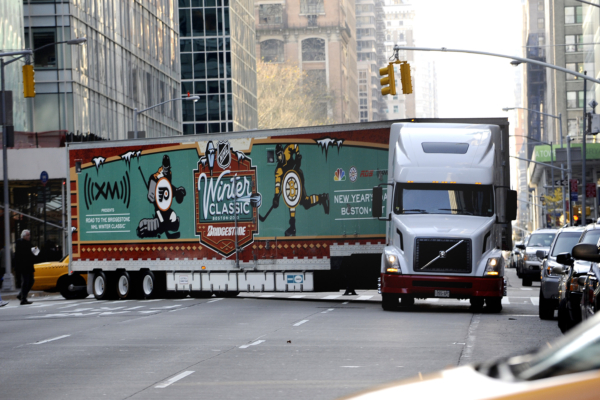
Nearly 90% of consumer goods in New York City rely on trucks for transportation, from food and restaurant ingredients to online shopping packages. Trucks play a vital role in the city’s daily operations. The routes taken by trucks do not only impact business deliveries but also affect residents by contributing to traffic congestion, pollution, and pedestrian safety concerns. The current truck route network, which has been in place for about half a century, is set to undergo adjustments on October 4th, with changes affecting several Chinese communities in the city.
The existing truck route network, established in the 1970s, has struggled to keep up with the expansion of residential areas and the surge in online shopping demands. The New York City Department of Transportation is planning to redirect more truck traffic towards highways and industrial zones. The new truck route network will allocate 45% of routes to highways or direct connections to highways and 42% to existing industrial and commercial areas, aiming to reduce trucks traveling through residential streets.
In the rapidly expanding logistics hub of Queens, approximately 16.28 miles of new truck routes will be added, while about 1.78 miles of existing routes will be removed. These changes will extend from Long Island City to surrounding areas such as Flushing, Jamaica, and John F. Kennedy International Airport (JFK). For instance, 141st Street from Main Street to Union Turnpike will become a truck route, while a segment of Willets Point Blvd from 127th Street to Roosevelt Avenue will be removed from the network.
In Manhattan’s Chinatown, Canal Street from Forsyth Street to Allen Street, as well as East Broadway from Chatham Square to Pike Street, will be included in the truck route network. Due to changes related to the construction of a median on Allen Street, parts of Division Street, Forsyth Street, and Allen Street will have their current truck routes canceled.
Sunset Park will see the addition of 2nd Avenue from 29th Street to 58th Street and 29th Street connecting 2nd and 3rd Avenues to the truck route network. The city government claims that this move will help keep trucks in industrial areas; however, residents are concerned that having two parallel truck routes may increase noise, pollution, and traffic risks. Additionally, sections of Bensonhurst’s New Utrecht Avenue and 18th Avenue will also become part of the truck route network.
It is important to note that being included in the truck route network does not necessarily mean an increase in truck traffic, as some segments already have a significant volume of truck traffic. Local delivery trucks will still be able to take the most direct routes to their destinations. The Department of Transportation plans to install over 600 new road signs and monitor road conditions after the new routes are implemented.
During previous public hearings, the Brooklyn Community Board 7, Council Member Alexa Avilés, and residents of Sunset Park criticized the plan for only adjusting truck routes without implementing concurrent street safety improvements and effective enforcement. There are concerns that this approach may continue to concentrate air pollution and traffic risks in communities that have long been exposed to the impacts of freight transportation, leading to doubts about whether the plan is simply shifting problems from one street to another.