
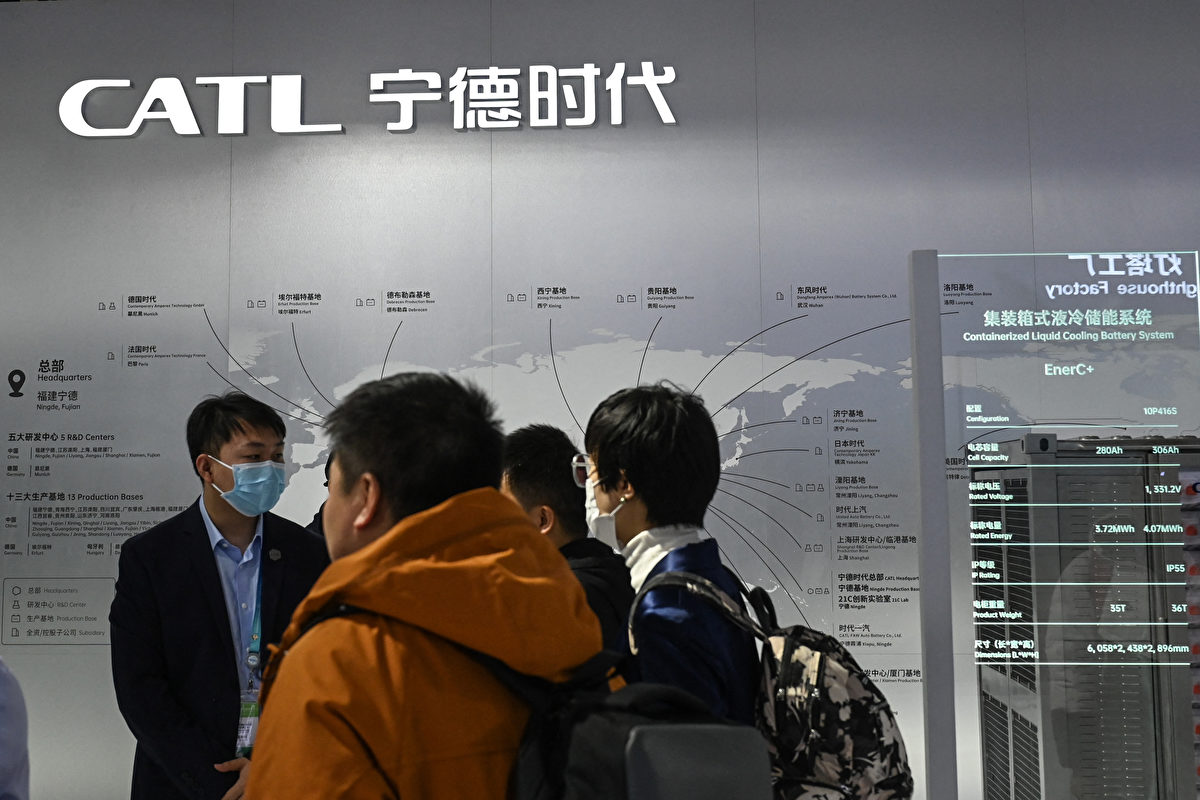
Ningde Times, the leading power battery manufacturer in China, saw its stock price plummet continuously, breaking below 300 yuan in the A-share market on September 16, marking a decline of over 36% in more than four months and hitting a new low in nearly a year. Concerns have risen in the market over Ningde Times’ future orders, product pricing, and bargaining power as companies like Li Auto and Xiaomi have been adding more battery suppliers to their lists.
According to the report by “Daily Economic News” on September 16, the lowest price of Ningde Times A-shares reached 299 yuan, dropping by over 5% at one point, and closing the day at 305.48 yuan, a decrease of 3.44%. This followed a 6.16% drop in the previous trading day.
The stock price of Ningde Times reached 468.75 yuan on May 7. Based on the lowest price on September 16, the maximum decline in more than four months is approximately 36%.
“21st Century Business Herald” reported that as of September 15, the total market value of Ningde Times’ A-shares and H-shares had decreased by about 700 billion yuan from their peak, with the stock price continuing to decline on September 16.
Ningde Times’ Hong Kong shares also experienced consecutive declines, dropping to 486.4 Hong Kong dollars on September 16, a decrease of nearly 40% from the peak in June.
Chinese new energy vehicle manufacturer, Li Auto, announced in early September its plan to invest 2.65 billion yuan in battery company Xingwangda Power. After the transaction is completed, Li Auto-related companies will collectively hold 11.17% of the company’s shares, becoming its second-largest shareholder.
According to “21st Century Business Herald,” the new generation Li Auto L8, which was listed in June this year, has fully adopted Xingwangda battery cells while Ningde Times has been removed from the supply list for this car model. Li Auto has started introducing Xingwangda and Contemporary Amperex Technology (CATL) batteries in its other new car models.
Xiaomi Auto has designated CATL and Xingwangda as “Dragon Prime Battery” partners. Currently, Xiaomi Auto’s battery suppliers include Ningde Times, Fudi Battery under BYD, CATL, and Xingwangda.
According to a recent report by “China Newsweek,” several car companies are turning to self-developing batteries or adding suppliers to gain more leverage in battery procurement.
Power batteries are one of the most expensive components in new energy vehicles. Cui Dongshu, Secretary-General of the China Passenger Car Market Information Joint Conference, previously stated that in the first seven months of this year, the profit margin of the mainland automotive industry was only 3.6%, indicating significant operational pressure on car companies.
Muke, founder of the Chinese lithium battery industry research institution “True Lithium Research,” mentioned that car companies hope to pressure Ningde Times to lower prices by developing their own batteries or switching to other suppliers, in an effort to reallocate the benefits between car companies and battery manufacturers.
Data from SNE Research, a South Korean market research institution, showed that in the first half of this year, Ningde Times accounted for 39.9% of the global power battery shipments, higher than 38.2% in the same period last year.
Ningde Times’ half-year report revealed that in the first half of this year, the company’s operating income was 276.917 billion yuan, a year-on-year increase of 54.8%; net profit was 43.284 billion yuan, up by 41.98%. However, its power battery system gross margin has dropped from 26.9% in the first half of 2024 to 20.63% in the first half of this year.
“21st Century Business Herald” analysis suggests that Ningde Times has not yet lost its fundamental support, but car companies are actively seeking alternative suppliers. The real pressure lies in the transformation from being the “must-have option” for car companies to becoming a “may-choose option.”