
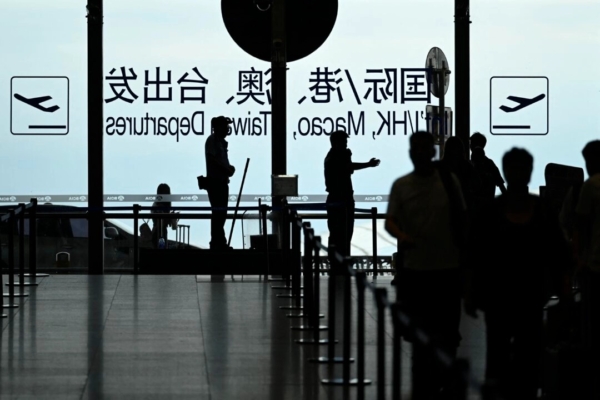
The latest exit management law of the Chinese Communist Party is set to be formally implemented in mid-September, causing increasing concern among overseas Chinese. Many people who have returned to China and then tried to exit again have been sharing their experiences of being subject to strict customs inspections online. This confirms that the authorities’ high level of control has already been put into effect, making it more difficult for Chinese people to travel abroad.
In Los Angeles, Ms. M has also noticed the changes in the strict checks on outbound travelers by the Chinese Customs. She told reporters that this is not a recent development as her family experienced it last year.
Last year, her husband returned to China to visit family and was suddenly inspected and detained when he tried to depart back to the U.S. Customs claimed that his previously owned company owed a significant amount of taxes. In fact, they had already paid their taxes in full when they immigrated to the U.S. over twenty years ago, so they couldn’t understand where this money owed had come from. Her husband was forced to pay a hefty sum of interest and penalty fees before finally being allowed to pass.
Her husband was falsely accused of owing taxes and was pursued for a large amount of “taxes”, making this experience a nightmare for Ms. M’s family, leaving her unable to let go of the trauma. She sees that now the Chinese Customs inspections are not limited to just business people, stating, “When you enter the country, it won’t stop you; but if you try to leave the country again afterwards, it becomes difficult”.
According to insider information, since the announcement of the new exit regulations by the Chinese Communist Party last month, even before formal implementation, the policies have already noticeably tightened.
On platform X, blogger “罗翔~破幕推墙” recently exposed that at Shanghai Hongqiao Airport Customs, half of Chinese people were refused departure. He further revealed that a Chinese person with cooperative projects in both the U.S. and China was invited to the U.S. for negotiations at the company’s headquarters but was restricted from departing at the airport because their phone had a VPN installed.
User “一个新人” on X also disclosed on the 22nd that a friend who had just arrived from mainland China was questioned and had their phone scanned by a machine upon leaving customs.
A Chinese student in California, Mr. Zhang, stated that some of his friends who frequently travel between the U.S. and China are now more concerned about encountering troubles upon returning to China. The new regulations have expanded the scope of exit enforcement agencies, including public security, procuratorates, courts, cultural tourism, market supervision, commerce, education, and other departments.
Many retired individuals in major Chinese cities enjoy traveling to countries like Japan, South Korea, Europe, and the U.S., or visiting relatives abroad. However, under the new regulations, this may become a distant dream. Mr. Zhang feels that outbound trips have now entered a state of “heightened control”.
“Traveling and visiting family is a basic right of citizens, but Chinese people are losing this right,” according to Mr. Zhang. He learned that many people are starting to “frantically” apply for passports out of fear that they won’t be able to post-September 15th.
Reflecting back, Mr. Zhang mentioned that the 1986 “Law on the Entry and Exit of Citizens” was the Communist Party’s first time explicitly outlining the rights of Chinese people to visit family, travel, study abroad, etc. However, despite this, ordinary citizens traveling abroad still face various restrictions and approvals.
In 2003, some major cities in China began allowing Chinese people to apply for private passports without requiring a unit’s certification; the 2006 “Passport Law” allowed Chinese people to apply for passports with just their ID cards and household registration books; and in 2019, regular passports and Taiwan and Hong Kong and Macao Travel Permits officially started “nationwide approval”.
“Chinese people have been able to travel abroad freely in just over twenty years. Now we see that the right of Chinese people to freely visit other countries is gradually narrowing,” he said.
Some mainland internet users claim that overseas Chinese are “overreacting”, to which Mr. Zhang responded that such cognitive disparities are normal, stating, “For the same event, some people can sensitively detect political crises, while others cannot feel the crisis, depending on the differing perceptions of China”.
“The regression of a country is not something that happens overnight; unless it’s a war, freedom can be destroyed overnight. The retreat of freedom in most countries involves gradually tightening freedoms,” Mr. Zhang said. “Chinese people should recognize that this is actually a crisis of freedom.”