
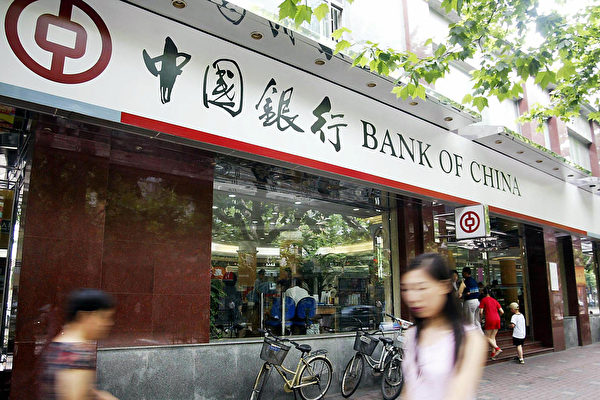
China’s loan growth continues to decline, with a negative growth of household loans in the first half of the year. Informed sources from state-owned banks disclosed that the four major state-owned banks have reduced employee salaries for the third consecutive year, with significant cuts to employee benefits. Some subsidies have been canceled, and branch profits that were previously used for year-end bonuses have now been centralized. The pressure from the Chinese Communist Party (CCP) for state-owned banks to support the real estate market, resolve local debt, and provide policy loans has trickled down to affect grassroots employees.
Mr. Fang, who works at a state-owned bank in China, recently told reporters that the four major state-owned banks in China have implemented three salary cuts over the past three years. The first cut was around 20%, followed by a 10% reduction, and another 10% cut in March of this year. Employee benefits have been significantly reduced, and some subsidies have been canceled.
Fang expressed, “The reduction was 20% the first time, then it decreased by 10%, and in March of this year, there was another 10% cut. The bank used to have some welfare subsidies, which are now also canceled. Business profits that branches used to generate from loans could be distributed to employees as bonuses at the end of the year, but now all of that money has to be turned in, leaving the branches with no funds and no bonuses for employees.”
The four major state-owned banks mentioned by Mr. Fang include Industrial and Commercial Bank of China, Agricultural Bank of China, Bank of China, and China Construction Bank. He did not disclose the specific bank or branch location to avoid internal scrutiny.
Data released by the CCP’s central bank on July 15th showed that RMB loans increased by 10.72 trillion yuan in the first half of the year, about 2.2 trillion yuan less than the same period last year. By the end of June, RMB loan balance increased by 5.2% year-on-year. Household loans decreased by 366.8 billion yuan, while short-term household loans decreased by 588.1 billion yuan. Demand for buying houses, consumption, and personal loans by residents continues to decline.
Fang noted that bank employee benefits have been reduced as bad debts increased. He stated, “In the past three years, household loans have decreased by 30% to 40% annually. This year, it decreased by 40% in the first half of the year compared to last year, and some banks have seen even larger reductions, according to internal data.”
Income for state-owned bank employees generally includes basic salary, performance-based pay, business bonuses, and various subsidies. Fang pointed out that recent income adjustments have mainly involved performance, bonuses, and benefits. While the basic salary of some employees did not drop by 40% all at once, after continuous adjustments, their take-home pay has significantly decreased.
According to a Reuters report in May, the CCP’s central bank had previously instructed some large state-owned banks to increase lending. At that time, due to weak demand for loans from households and businesses, RMB loans decreased by 10 billion yuan in April, marking the first monthly decline in nine months, with household loans decreasing by 786.9 billion yuan.
Mr. Zhang from a loan department at a branch of Agricultural Bank mentioned that the head office continuously assigns lending quotas to lower-level branches each year. Failure to meet these quotas results in performance award deductions. However, frontline employees are finding it increasingly challenging to find qualified and willing loan customers. Companies with repayment capacity are unwilling to expand investments, while small and medium-sized enterprises in need of funds struggle to meet the bank’s risk control requirements.
He explained, “Lending tasks are still being assigned, but there aren’t as many qualified loan applicants as before. Frontline employees can only seek out customers and entertain them at their own expense. Some loan interest rates are already very low, so even if we proceed with the loans, the returns are minimal, or they might not make sense at all. It’s a difficult situation for us now.”
According to CCP central bank governor Pan Gongsheng, the decrease in loan growth is attributed to changes in financing structures as enterprises shift towards bond and stock market financing. However, the prolonged slump in China’s real estate sector, reduced household consumption, and declining investment desire from private enterprises continue to weaken the demand for bank loans. In 2025, new bank loans in China dropped to 16.27 trillion yuan, the lowest in seven years.
Financial statistics for the first half of 2026 released by the CCP central bank showed that corporate loans increased by 11.13 trillion yuan. Short-term loans increased by 4.59 trillion yuan, while medium to long-term loans rose by 5.55 trillion yuan, and bill financing saw an increase of 814.3 billion yuan.
Zhang mentioned that bill financing within the banking industry is usually viewed as a means to meet lending targets when demand is insufficient. He noted, “Some of the data released by the central bank is tailored to align with the government’s description of the macroeconomy and its growth, making it hard to believe they represent the actual situation. In the first half of the year, there were only a few billion yuan in new loans at certain city-level and county-level branches, but I can’t provide specifics on the regions.”
Salary cuts in banks are widening, with employees bearing the brunt of operational pressures. In 2024, China Construction Bank was reported to have required a 10% minimum salary reduction for head office employees, with larger cuts for some senior staff and employees in subsidiary companies. Bank of China had also adjusted salaries nationwide. It was reported that Beijing branch of Minsheng Bank saw the highest salary reduction of up to 50%, with some work-related expenses and employee benefits canceled.
In March this year, it was revealed that some department heads at two large state-owned banks experienced a 30% to 50% decrease in their previous year’s bonuses. Some banks even retroactively adjusted the income already distributed. Bank executives, department heads, and grassroots employees have all been included in the CCP’s financial system’s salary reduction measures.