
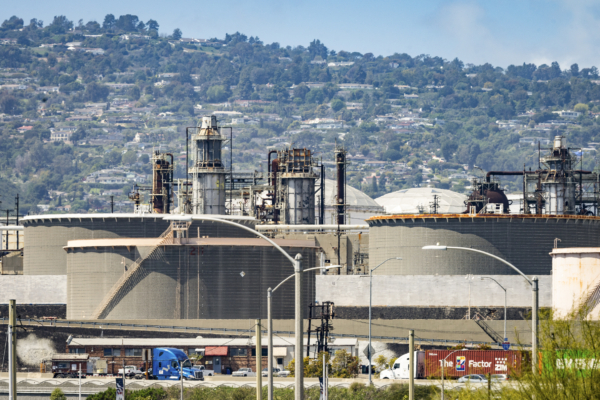
As two major refineries in California are shutting down one after another, concerns are rising about the future of oil prices and whether California will face gasoline shortages or even a situation where there is no oil available for use.
Skip York, Chief Energy Strategist at Turner, Mason Co., an energy consulting firm, stated that California has not experienced significant fuel shortages so far. However, the bad news is that the recent increase in supply costs may already be on the way. Additionally, with reduced production capacity, California is increasingly reliant on imported fuel, making it more vulnerable to global energy supply contractions.
The impact of refinery closures seems to be much more widespread than anticipated. C.J. Nord, a supply chain expert in California, mentioned that refineries produce not only fuel but also a vast array of other products. “Many people are not aware of how seriously the closure of two refineries can affect the entire supply chain,” Nord said. The cost of living for the public could further be impacted.
Recently, two experts appeared on Epoch TV’s “California Insider” program to discuss the new challenges facing California’s fuel supply with host Siyamak Khorrami.
Regarding the most pressing concern for residents – oil prices, York observed that the current oil prices partly reflect previous supply costs, and the recent increase in costs may still be forthcoming.
He explained that international fuel transportation takes time, from loading the ship to reaching the port, and then entering the market, usually taking several weeks.
“While consumers have already seen gasoline prices rise by over $1 per gallon, wholesale prices are increasing even faster,” he stated. “The profit margin between retail prices at gas stations and wholesale costs is being squeezed.”
He estimated that oil prices will continue to rise, but that doesn’t necessarily mean there will be a gasoline shortage. At least, California’s current gasoline inventory is sufficient for the time being.
“I also don’t think we will see the long lines at gas stations like in the 1970s (oil crisis),” York said, adding that the market typically adjusts supply and demand through pricing: when supply decreases and costs rise, prices go up.
In the past year, two major refineries in California have closed, including Phillips 66’s refinery in Los Angeles and Valero’s Benicia refinery in the San Francisco Bay Area. Together, these two companies accounted for nearly one-fifth of California’s gasoline supply.
York noted that with reduced production capacity, California now needs to purchase more gasoline from other regions, particularly from overseas markets.
“The second issue is that California has lost supply flexibility,” he pointed out. The gasoline specifications used in California are particularly unique and not easily produced by refineries elsewhere in the world. Therefore, losing local refineries not only increases transportation distances but also complicates the entire supply process, making it more susceptible to external disruptions.
Currently, some of California’s fuel comes from Asia and other overseas markets, where refineries are similarly affected by global crude oil supply fluctuations.
Addressing the supply chain, Nord highlighted another issue – California has some transportation bottlenecks that prevent easily ramping up fuel truck transport. And her biggest question is: has California already found new suppliers to fill the gap left by the two refinery closures?
“My research shows that there are currently no other suppliers significantly increasing production to make up for the gap,” she mentioned some unknowns: how will future increases in fuel transport volumes be allocated? Can ports and transportation systems handle more imports? How to distribute more fuel to various parts of the state?
For ordinary people, the series of energy changes brought about by refinery closures may ultimately manifest in everyday life – from car refueling costs to logistics expenses, and even in commodity prices.
Nord pointed out that refineries not only produce fuel but also large quantities of petrochemical raw materials widely used in manufacturing, products people use every day but may not visibly see. Examples include adhesive raw materials, asphalt for road construction, and many industrial products, all closely tied to the oil refining industry. The reduction in gasoline supply also affects the production of diesel, jet fuel, and propane.
Experts suggest that while energy supply issues may seem distant from daily life, changes in fuel prices often gradually appear in the day-to-day expenses of every household.
According to data from the American Automobile Association (AAA) on July 23, the average price of regular gasoline in California was $5.57 per gallon, nearly $1.5 higher than the national average of $4.09. The current trend in California’s fuel supply still awaits further observation. ◇