
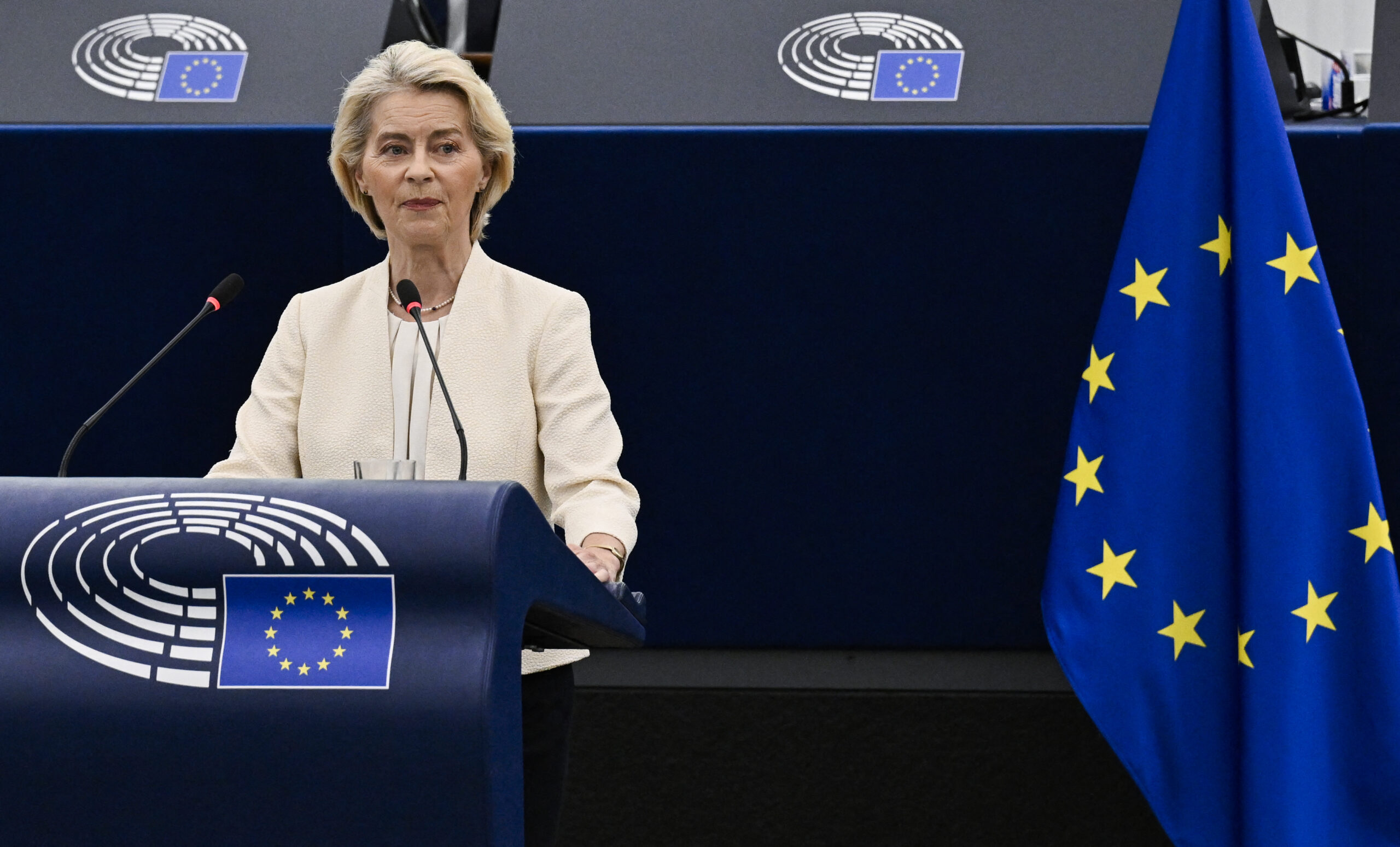
The European Commission President Ursula von der Leyen stated on Wednesday (September 16) that the European Union will use “all available tools” to rebalance its economic and trade relationship with China. She pointed out that the EU’s trade deficit with China averaged €1 billion per day last year, reaching a “critical point,” with Europe facing the impact of “China shock 2.0” due to deindustrialization.
Von der Leyen addressed the European Parliament in Strasbourg, France, during her annual State of the European Union speech, highlighting the issues of trade imbalance with China, critical raw material supply, and European strategic autonomy.
She emphasized that while the EU and China are working together to find solutions that are mutually beneficial, the EU is also prepared to take action.
“I want to be clear: we will use all available tools to rebalance our relationship,” von der Leyen said.
The EU’s trade deficit with China averaged €1 billion per day last year, according to von der Leyen. She stated that this imbalance has reached a “critical point,” and Europe is experiencing the effects of the “second China shock” caused by deindustrialization.
“We need to purchase and establish reserves urgently.” Von der Leyen mentioned that the EU will create a new European Critical Raw Materials company to assist its 27 member states in obtaining and storing the necessary critical raw materials, especially rare earth minerals.
In addition to the trade deficit, von der Leyen also highlighted the EU’s dependence on key minerals from China, particularly rare earths. She stressed the need for the EU to maintain greater autonomy in areas such as energy, raw materials, and clean technologies.
Describing the current world as “an openly hostile world,” von der Leyen emphasized the importance of unity among EU member states in facing external challenges.
“Our path is clear: to establish an independent Europe capable of taking action,” von der Leyen said.
The EU is also planning to deepen its relations with Canada to reduce its reliance on raw materials from China.
Canadian Prime Minister Mark Carney attended von der Leyen’s speech in Strasbourg. Von der Leyen expressed the EU’s desire to elevate its relationship with Canada to the “highest possible level.”
“We hope to work together to open the doors for Canada to become the first associate member of the EU,” she said.
The concept of an “associate member” does not currently exist in EU treaties, and its specific form and operation are still to be determined.
Von der Leyen highlighted the wide range of common interests between the EU and Canada and proposed further deepening economic, trade, and security cooperation between the two.
“From the EU-Canada Comprehensive Economic and Trade Agreement (CETA) to the ‘Alliance for the Future,’ we aim to create a space of shared prosperity and economic security,” von der Leyen stated. “We view the world with the same perspective: from AI to climate change, from the Arctic to geopolitics. We stand together in Ukraine, defense, raw materials, and supply chain issues.”
From trade negotiations with China to securing critical minerals reserves and enhancing cooperation with Canada, von der Leyen’s speech not only outlined the “policy direction” but also enumerated specific strategies. These include utilizing trade tools, strengthening material security, expanding supply chain cooperation to reduce dependencies in critical areas, and enhancing Europe’s economic and supply chain resilience.
As von der Leyen wisely put it, “Words are important, but actions are even more important.”