
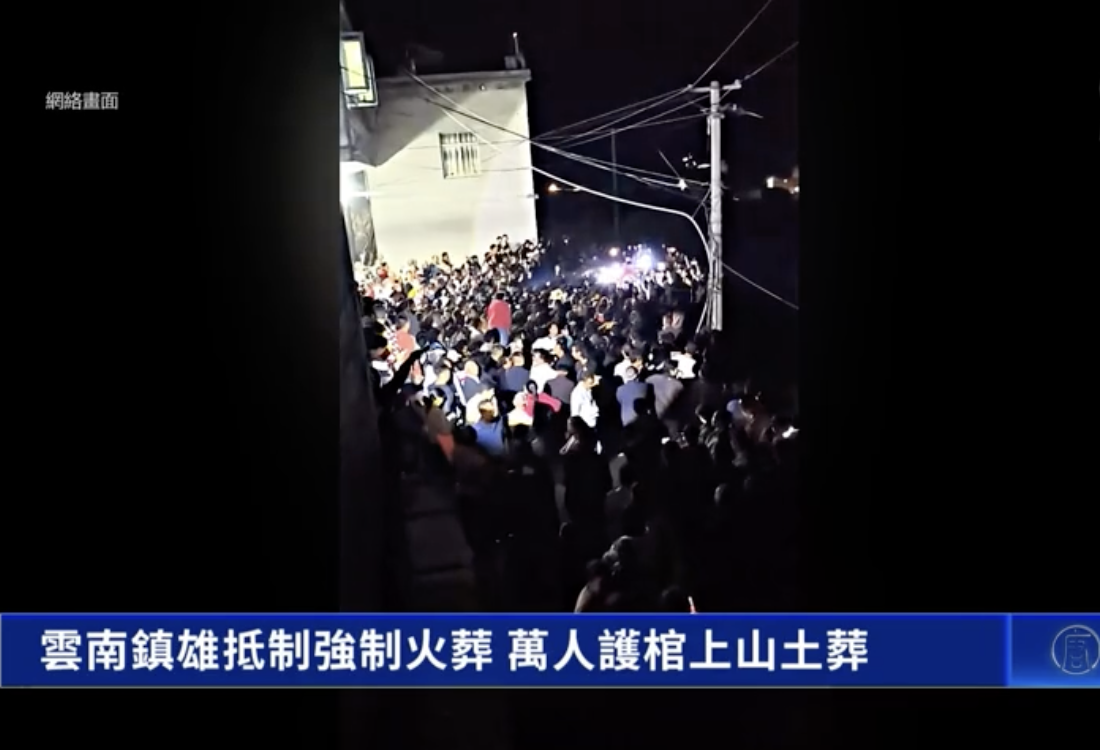
In Yunnan Province, Zhongxiong County, 14 townships were forced by the Chinese Communist Party to implement cremation, which sparked public resistance. Following the successful mountain burial of a 16-year-old boy’s coffin escorted by thousands of people on September 12, on the evening of September 14, tens of thousands gathered in Jianshan Township to successfully guard the coffin of two elderly people for mountain burial. The policy of compulsory cremation pushed by the CCP leader Xi Jinping has caused public resentment. Previously, villagers had shouted: “The Communist Party wants to dig up ancestral graves, so dig up Xi Jinping’s family’s ancestral graves first.”
On the evening of September 14, tens of thousands of people gathered in Zhongxiong County’s Jianshan Township to resist the official forced cremation, guarding the body of a 93-year-old man, and burying him in the mountain at midnight. Subsequently, people immediately rushed to Anjiapo a few kilometers away to guard the coffin of another elderly person for mountain burial.
Mr. Wang, a villager in Zhongxiong County, Yunnan, told Dajiyuan: “We oppose cremation and insist on burial. We have united 14 towns in Zhongxiong. Tonight, we bid farewell to two elderly people in Jianshan and Anjiapo, with at least 20,000 people. Many people couldn’t get in, it was too crowded, and hundreds even came from Guizhou.”
According to participating residents, the scene was packed with people, and hundreds of police were deployed by the authorities but dared not take action lightly.
Mr. Chen, a villager in Zhongxiong County, Yunnan, said, “It is said that one should rest in peace in the earth, return to one’s roots. Zhongxiong has nearly 30 townships, but only 14 townships enforce compulsory cremation, which is unfair.”
To prevent the local government from secretly digging graves and seizing bodies for cremation, many people stayed behind to guard the graves.
Ms. Zhang, a villager in Zhongxiong County, Yunnan, said that they had two to three hundred fellow villagers guarding the graves, not sleeping all night. She expressed, “The government is going too far. They bury them, but it wants to dig them up for cremation.”
Earlier on September 1, Zhongxiong County designated 14 townships as cremation areas and enforced the policy, sparking strong resistance from the public.
In Maoba Village, Yile Township, a 16-year-old boy named He Guoqiang died of leukemia on September 6, originally scheduled for burial on the 12th. The day before, residents of surrounding villages learned that the local government would send 200 people to seize the body, so they rushed to resist. On September 12, thousands escorted the coffin up the mountain for burial, and due to the large number of supporters, the authorities dared not act rashly.
Wang, a member of the supporting public, revealed that the local government wanted to exploit He Guoqiang’s burial to set an example. Local residents now voluntarily bring tents to guard the graves during the day and night, to prevent the local government from possibly sending people to dig up the graves.
According to supporting residents, the local government had resorted to rogue methods such as seizing bodies and secretly digging up bodies to promote cremation. Some people had been buried for one or two months and were still dug up for cremation, causing strong dissatisfaction among the public, but the authorities blocked the information. Many internet influencers who livestreamed from the scene were banned, and their signals were jammed.
Some supporting residents also stated that local tradition called for burial, and compulsory cremation was for extorting money from the common people. He Guoqiang had been undergoing treatment for two years and had already exhausted his family’s savings, owing tens of thousands of yuan to relatives and friends, making it impossible to afford cremation costs.
Zhongxiong, Yunnan, has a deep traditional funeral culture. “Rest in peace in the earth” signifies the final dignity after death. Villagers generally believe that traditional burials passed down from ancestors are sacrosanct and that cremation is regarded as disrespectful in traditional beliefs, which they find emotionally unacceptable.
Public information shows that the CCP has advocated for cremation under the guise of “eliminating superstition” and saving land since coming into power. By 1997, the official “Funeral Management Regulations” were promulgated, but the policy still allowed for areas to be designated as “cremation zones” and “burial reform zones” based on geographical and transportation conditions.
Since Xi Jinping took office, “ecological civilization” and “changing customs” have been used as assessment indicators for local officials, leading to the forced promotion of cremation. However, until 2020, in remote areas like Zhongxiong County nestled in the Wumeng Mountains, apart from the central streets of the county seat, traditional burials still predominated due to inconvenient transportation, lack of funeral parlors, and crematoriums, among other reasons.
In January 2013, following a landslide disaster in Zhongxiong, the local government forcibly cremated the remains of the victims to maintain stability, triggering protests. Such resistance events have intensified in recent years.
Starting in 2020, Zhongxiong began enforcing regulations that “bodies must be cremated, and ashes must be placed in public cemeteries.” Since the end of 2024, the local government had even abolished the previous practice of “administrative punishment in place of management” for traditional burials, with government personnel intercepting coffins in villages and conducting midnight raids to seize bodies for cremation. In locations such as Linkou Township and Zhongtun Town, official “grave digging and body snatching” for cremation has sparked protests among residents.
In November 2025, the “protect the coffin” event erupted in Qingshan Village, Zhongtun Town, Zhongxiong County, where thousands of villagers confronted the government’s “body-snatching teams.”
By September 2026, the official-public contradictions in Zhongxiong County had further escalated due to the issue of forced cremation.
The CCP’s mandatory cremation policies have also sparked protests in multiple provinces including Guizhou, Jiangxi, and Hubei. On November 22, 2025, in Xifeng County, Guiyang City, Guizhou Province, the policy of mandatory cremation and “grave digging and body snatching” policies sparked fierce protests among local ethnic minorities such as the Miao and farmers. At the protest site, villagers angrily shouted at officials: “If the Communist Party wants to dig up ancestral graves, dig up Xi Jinping’s family’s ancestral graves first!”
[Click to watch the video]