
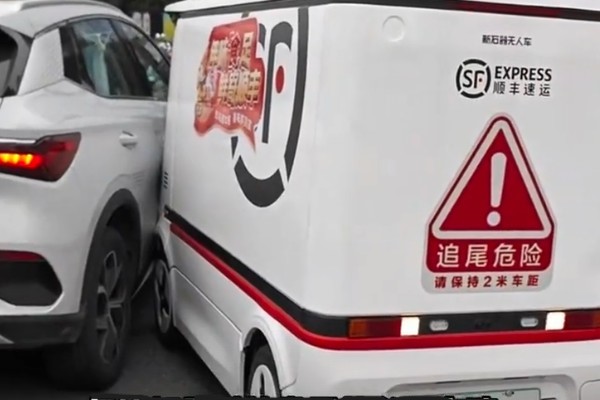
With the increasing number of unmanned delivery vehicles on the mainland, issues such as sudden braking, abrupt turns, and stop-and-go at intersections have been causing traffic jams, sparking growing dissatisfaction among the public. Taxi drivers have expressed that unmanned delivery vehicles are not very “clever”; traffic police have mentioned that many regulatory gaps make it difficult to penalize unmanned delivery vehicles. This news became a hot topic on September 16.
According to reports from mainland media outlets like “Dahe Net,” Mr. Lou, a taxi driver in Luoyang City, Henan Province who has been driving for 20 years, told “Dahe Net”: “Several times at intersections, I’ve seen unmanned delivery vehicles trying to turn, but they take a step, stop, hesitate for a long time, and eventually just stand still, ‘contemplating’ for nearly a minute, causing a traffic backlog.” Especially on narrow roads during peak traffic hours, the judgment of unmanned delivery vehicles is dulled, leading to localized congestion.
Mr. Lou’s evaluation of unmanned delivery vehicles is: not very “clever.”
The person in charge of a postal delivery point in Jiaxi District, Luoyang City, stated that the on-site response speed of unmanned delivery vehicles on the road cannot currently be compared to that of humans. When encountering complex urban road traffic scenarios with more surrounding vehicles and interference, they are unable to handle the situation due to being overwhelmed, and can only wait in place for the danger to pass. Two instances of “system failure” caused by emergency braking of vehicles on the road have occurred at this site, requiring personnel to resolve the issues on-site.
Mr. Liu, the head of the Traffic Management Brigade in a county in eastern Henan, mentioned that issues such as prolonged stops at intersections leading to congestion and whimsical lane changes while driving often occur with unmanned delivery vehicles. Especially during peak hours when students are going to and from school, unmanned delivery vehicles disregard the commands and instructions of traffic police, simply “pushing forward head-on” without heeding any warnings. “The machine doesn’t understand human speech, it simply doesn’t listen to your commands,” Liu said.
Liu stated that unmanned delivery vehicles are a new phenomenon, and many related enforcement regulations are still in a blank state. Are they motor vehicles or non-motor vehicles? Unmanned delivery vehicles with no driver’s cab or driver fail to meet the rigid requirements for motor vehicle registration and licensed drivers, yet their weight and power generally exceed standards for non-motor vehicles. Traffic enforcement departments often have no basis for penalties and can only let them pass.
Industry experts point out that current unmanned delivery vehicles are unable to handle various sudden road scenarios, such as unexpected construction areas, irregular occurrences of children and pets entering the scene, and various adverse weather conditions, posing significant challenges to safe operations.
On September 15, the mainland’s Weibo account “This World Will Be Fine” commented that unmanned delivery vehicles causing traffic disruptions is not just a technical issue, but a regulatory and accountability problem. Vehicles without “identity” running on the road, vehicles without a “driver” involved in accidents with no one held responsible, and a machine that “doesn’t understand human speech” make it difficult for traffic police to intervene. Until these issues are resolved, “ordinary people stuck on the road can only continue to wait.”