
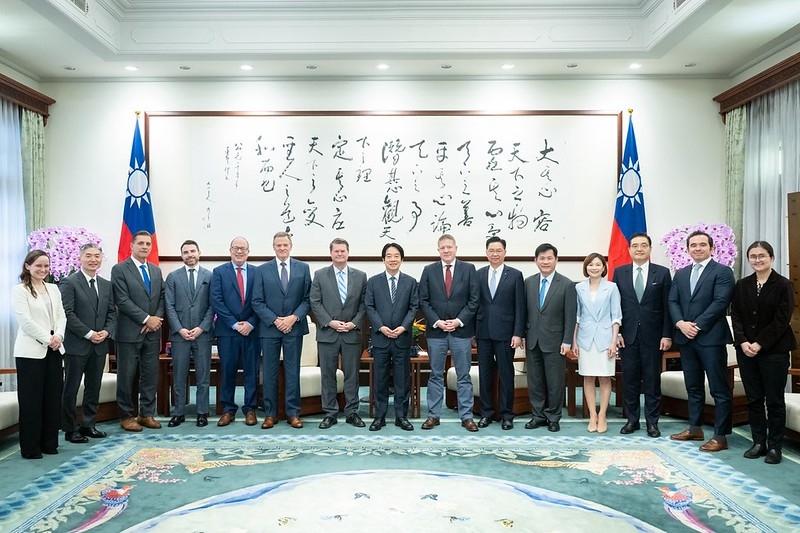
Taiwan President Lai Ching-te met with the visiting delegation from the Indo-Pacific Security Institute today (30th), expressing that in the face of increasingly frequent threats and intrusions from the Chinese Communist Party (CCP), the government not only proposed a special defense budget, but is also promoting the procurement of unmanned vehicles with a special budget to establish Taiwan’s own unmanned drone attack and defense system. Taiwan is strengthening defense cooperation with the United States, contributing even more to international peace and stability.
In his speech this morning to the visiting “Indo-Pacific Security Institute” (IIPS) delegation, President Lai Ching-te first welcomed the Institute’s long-time friend, Chairman Randall G. Schriver, leading the delegation to Taiwan once again after 10 months to demonstrate the most active support for Taiwan through concrete actions. The guests present have long been concerned with Indo-Pacific security and Taiwan-U.S. relations. This visit exemplifies the deep friendship between Taiwan and the United States and once again demonstrates the long-standing, strong, and bipartisan support of the United States for Taiwan.
President Lai Ching-te mentioned that this year marks the 250th anniversary of the founding of the United States and also the 30th anniversary of direct presidential elections in Taiwan. This year, we commemorate the preciousness of freedom and democracy together, as well as advocate for the importance of human rights and the rule of law. However, this month, the CCP has implemented the “Extraterritorial Suppression” Special Law and test-fired intercontinental missiles, severely impacting international human rights and regional peace and stability. Faced with the CCP’s increasingly frequent threats and intrusions, Taiwan deeply understands that “peace must rely on strength,” therefore the government is vigorously promoting defense reform, strengthening asymmetric warfare capabilities, and enhancing the overall societal defense resilience.
President Lai Ching-te pointed out that he believes the guests understand Taiwan’s firm commitment to maintaining national security and the will for Indo-Pacific peace and stability. Taiwan’s defense budget this year already exceeds 3% of GDP according to NATO standards, and it is expected to reach 5% of GDP by 2030. In order to continuously enhance self-defense capabilities, the government has previously actively proposed a special defense budget and is now continuing to push for a special budget for the procurement of unmanned vehicles to establish an unmanned drone attack and defense system. He also thanked Chairman Schriver for coming to Taiwan and accepting media interviews to explain to the public that Taiwan must build its own drone system.
“Taiwan looks forward to continuing to strengthen defense cooperation with the United States, moving from military procurement towards a partnership in joint research and development, and joint production to contribute even more to international peace and stability. Additionally, Taiwan and the United States are not only closely related in security matters but are also inseparable in terms of prosperity and development. The United States is now Taiwan’s largest trading partner, while Taiwan is the United States’ fourth largest trading partner; currently, 25 states and Guam have representative offices in Taiwan, and Taiwan’s 14th representative office in the United States is set to be established in Phoenix, Arizona.” President Lai Ching-te stated.
President Lai Ching-te expressed his delight in seeing Taiwan and the United States sign the “Taiwan-U.S. Investment Memorandum,” “Taiwan-U.S. Reciprocal Trade Agreement,” and “Silicon Prosperity Declaration and Taiwan-U.S. Economic Security Cooperation Joint Statement” earlier this year, further enhancing economic and trade partnership relations. Both sides will reduce trade barriers based on reciprocity and mutual benefit, ensuring the resilience of high-tech supply chains. He once again thanked the visiting delegation for making the trip and wished for a successful and fruitful visit.
In his speech, Chairman Schriver first thanked the President for taking the time to meet and said he was honored and looked forward to exchanging views with Taiwan’s government team. He thanked President Lai for mentioning the 250th anniversary of the founding of the United States and pointed out that after the United States issued the “Declaration of Independence” on July 4, 1776, it faced suppression from Britain attempting to undermine its democratic system; Taiwan also faced threats from CCP missiles during its first direct presidential election in March 1996, with both countries struggling for democracy.
Schriver stated that visiting Taiwan as a delegation each year not only allows them to understand the current situation, but also to observe Taiwan’s progress and development over the past year. This visit witnesses a stronger Taiwanese economy, more stable and resilient U.S.-Taiwan trade relations, and the continuous enhancement of Taiwan’s defense and coast guard capabilities, sufficient to address current challenges, all of which rely on the leadership of the President and the efforts of the government team.
Furthermore, he stated that despite these achievements, everyone still sees the continuous pressure imposed by the CCP on Taiwan, including military intimidation, threats, and escalating legal battles, attempting to further compress Taiwan’s space. Therefore, the delegation hopes to understand how to become a better partner to Taiwan, assist in responding to relevant challenges, and continue to deepen cooperation in Taiwan’s economy, Taiwan-U.S. trade relations, and Taiwan’s defense and security, once again expressing gratitude for President Lai’s audience.