
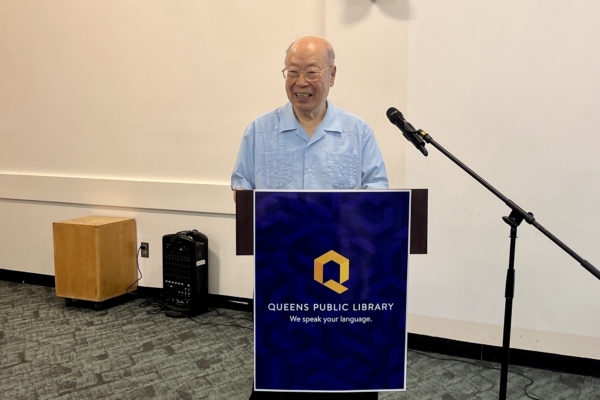
In celebration of the 250th anniversary of the founding of the United States, the Flushing Public Library hosted a seminar on “Chinese Immigration History” on the 25th, featuring Mr. Yu Jinshan, a veteran media professional and immigration history researcher, as the keynote speaker. Through the 170-year history of Chinese immigration to the United States, the seminar looked back on important figures and historical events such as the Chinese Exclusion Act, Sun Yat-sen, Lee Tau Boo, Ding Long, and the “Golden Venture” incident, exploring the contributions of the Chinese to the development of America and the significance of preserving immigrant history and cultural memory in deepening Chinese cultural identity.
The director of the Flushing Library, Zhang Yang, expressed in her speech that the library currently has set up a “time capsule” commemorating the 250th anniversary of the founding of the United States, collecting student essays, historical photos, newspaper clippings, and significant items of the era such as the commemorative flag of the New York Knicks winning the NBA championship. These items will be sealed for 50 years and are scheduled to be opened in 2076 for the 300th anniversary of the founding of the United States. She mentioned that besides providing reading services, the library also carries the important mission of preserving community memories and inheriting historical culture. She said, “History is not just stories but also a mirror. Through understanding history, we can better comprehend the present and envision the future.”
City Councilor Huang Minyi stated that Chinese Americans have a long and rich history in the United States but have lacked systematic historical education for a long time. “We Chinese have a long and rich history in America, but growing up here, I rarely heard about how Chinese people have helped America or contributed to American society.” She pointed out that in recent years, the city government has allocated funds to support community organizations in incorporating Asian and Chinese history into the curriculum of public schools, hoping that more young people will understand that Chinese people have long been an integral part of American history and further establish cultural identity and a sense of belonging.
Yu Jinshan, former president of the Chinese Public Association, spoke on the topic of “Chinese Immigration History,” starting from the 19th-century Chinese laborers’ involvement in building the Transcontinental Railroad. He revisited the Chinese Exclusion Act, the abolition of the act in 1943, the Immigration and Nationality Act of 1965 reform, and the recent waves of Chinese immigration. He emphasized that Chinese immigration history is not only the history of the Chinese but also an essential part of the development history of America.
Regarding Sun Yat-sen, Yu Jinshan mentioned that Sun Yat-sen had visited New York’s Chinatown multiple times, leaving revolutionary footprints and being an important figure worthy of in-depth research in modern Chinese history and Chinese immigration history. He introduced female suffrage pioneer Lee Tau Boo, the origin of the “Ding Long Chinese Studies Lecture” at Columbia University, and the 1993 “Golden Venture” incident, presenting the struggles of the Chinese for equality, citizenship rights, and identity through various historical figures and stories.
He recalled Archbishop Ignatius C. Kung’s efforts to abolish the Chinese Exclusion Act and the history of assisting Chinatown in the 1950s to prevent large-scale immigration “raids.” He pointed out that although the United States has formally apologized for the Chinese Exclusion Act, no compensation has been provided to date; the early Chinese laborers who built the Transcontinental Railroad and participated in the development of the American West were subjected to institutional discrimination for a long time, a history that still warrants continuous reflection by society.
Yu Jinshan stated that there are still many figures and topics in Chinese immigration history worthy of in-depth research, hoping to let more young people understand the struggles of the Chinese in America over the past 170 years through organizing historical materials. He said, “Chinese immigration history is not just the past; it is also a shared memory of the Chinese community today and an inseparable part of American history.”