
The official meeting in Changchun City recently stated that the city’s economic development is facing “unprecedented difficulties and challenges,” a phrase that differs from the usual tone set by high-level meetings in Beijing, sparking attention. Experts believe that this move by local officials is a way to shift blame for self-protection, and also completely exposes the economic “bright theory” touted by Beijing.
According to the news on the Changchun City Government website on July 23, the CCP Changchun Municipal Party Committee Secretary, Zhang Enhui, presided over an expanded meeting of the Standing Committee of the Municipal Party Committee and a so-called “high-quality development” review meeting for the first half of the city. Mayor Gu Gang made work arrangements.
The official statement from the meeting indicated that “the current economic development of the entire city of Changchun is facing unprecedented difficulties and challenges.” Officials claim that they need to “maintain confidence, stay determined,” and “not only see the grim and complex macro situation, but also recognize the more direct and serious impact and challenges faced by their own development.”
In recent years, China’s economy has been declining, yet the CCP high-level officials have consistently emphasized the economic “bright theory” and even suppressed economic scholars who exposed the real economic situation (such as the former chief economist of Guotou Securities, Gao Shanwen). Official meeting statements by the CCP usually start with positive economic outlooks while also mentioning facing “some challenges.”
Regarding this rare expression by Changchun officials, American economist Huang Dawei told Epoch Times that it seems more like a move by local government officials to shift blame and express helplessness. The political bottom line for Beijing’s high-level officials is to “sing the bright theory of China’s economy,” but local officials dare not actively pave the way for the central government’s economic hard landing.
He believes that the reason Changchun made such statements is that the financial treasury has indeed hit rock bottom, and the collapse of the real economy can no longer be concealed. If they continue to pretend that the situation is great, the central government will not increase transfer payments and funds. Once the economic indicators plummet in the second half of the year, the blame will fall on the local authorities for “poor execution.” Therefore, using the phrase “unprecedented” is a way of sending a message to the central government.
In 2023, the official think tank of the Guizhou provincial government released a report stating they couldn’t solve the debt problem and sought help from the central government. This report sparked discussion but was quickly deleted. Subsequently, several counties and cities in Yunnan also echoed cries of poverty.
China issues expert Wang He told Epoch Times that the “tough talk” released by Changchun officials somewhat reveals the true situation of this mess, but then swiftly covers it up. This is a common practice in the CCP officialdom and a survival skill.
He analyzed that Changchun’s economy has faced significant problems in recent years, making it difficult to continue concealing them. Therefore, the current Changchun leadership, especially the new Mayor Gu Gang who previously handled the Hainan Airlines incident in Hainan, was transferred to Changchun to deal with the crisis, indicating that Changchun’s economy has run into trouble. By openly stating they face unprecedented difficulties, half is shifting the blame, and half is making excuses to remove their own responsibilities.
Wang He said that the political infighting within Changchun City is very complex at present because the former Mayor of Changchun had been appointed as the Secretary of the provincial Party committee, so their current discourse is relatively cautious.
“On one hand, they say they are facing unprecedented economic difficulties, but on the other hand, they also mention staying determined, which means they can both attack and defend. They revealed a bit of the truth on one hand while painting a big picture on the other,” Wang He said.
Public records show that Zhang Enhui was transferred from Inner Mongolia to Jilin in March 2021 and appointed as a Standing Committee Member of the Provincial Party Committee and Minister of the Organization Department. In April 2023, he became the Changchun Municipal Party Committee Secretary. His predecessor was Zhang Zhijun, who now serves as the Deputy Chairman of the Jilin Provincial Committee of the Chinese People’s Political Consultative Conference. Gu Gang was transferred from Hainan to become the Changchun Mayor in July 2025. His predecessor Wang Zilian had served as the Deputy Governor of Jilin and was appointed as a Standing Committee Member of the Jilin Provincial Party Committee and Secretary of the Provincial Party Committee in January 2026.
The CCP authorities have proposed the “Revitalization of Northeast China” strategy for over twenty years (since 2003). After the 20th Party Congress, the CCP high command once again emphasized the “comprehensive revitalization of Northeast China.” However, in recent years, the economic collapse and population decline in Northeast China, the pension deficit… the “Northeast situation” has become increasingly severe in recent years.
The so-called “Northeast situation” refers to a series of problems in the Northeast region in terms of the economy, population, social structure, including the difficulty in transitioning the heavy industrial structure, worsening population structure, and economic cliff.
The birth rates in the three Northeastern provinces (Heilongjiang, Jilin, Liaoning) have ranked among the lowest in the country for many years.
In official terms, Changchun is considered the “core engine” and “important economic growth pole to promote comprehensive revitalization of Northeast China” in the so-called revitalization of Northeast China.
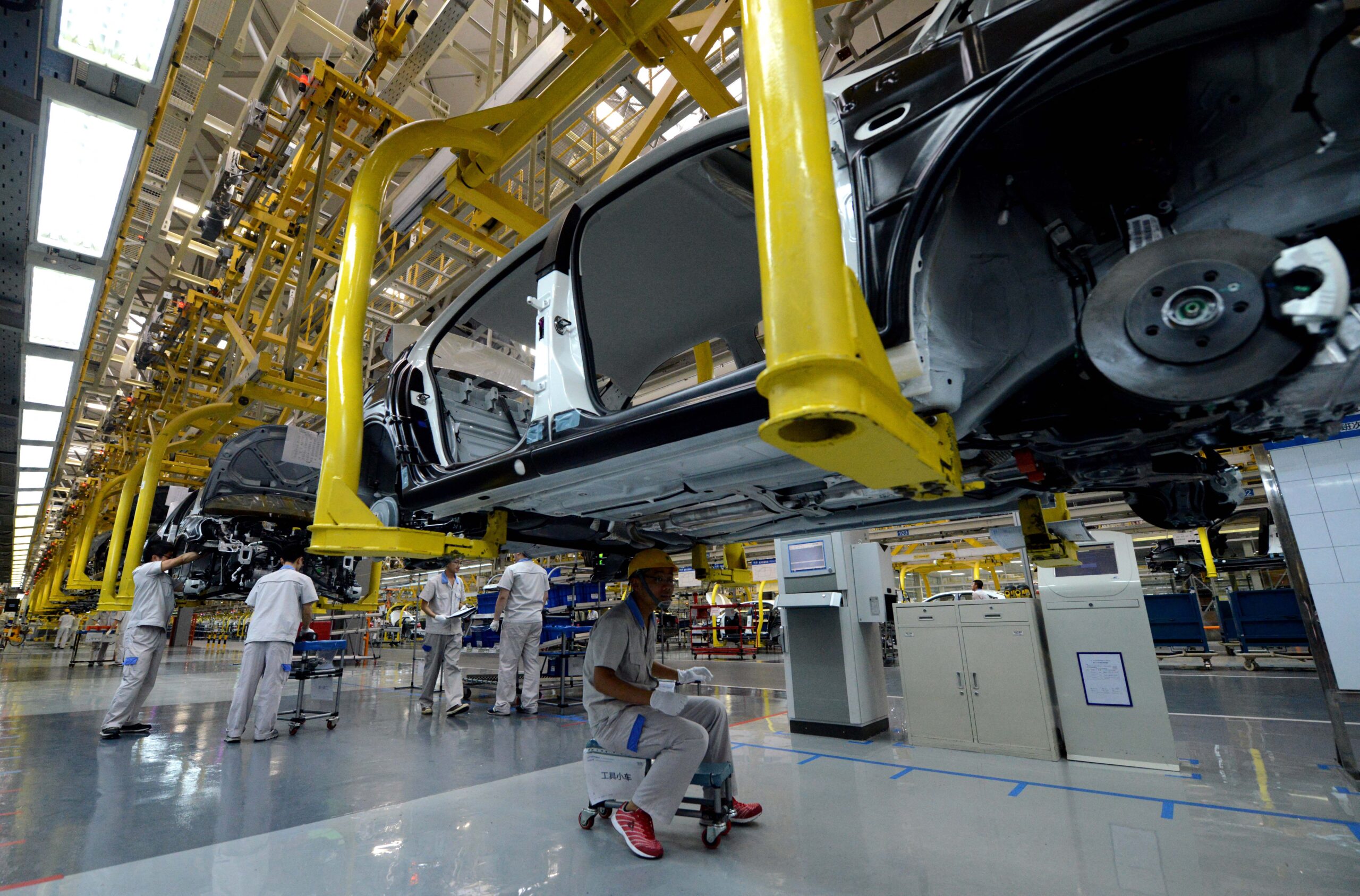
In June of this year, a rare official statement from Changchun named the economic pillar of Changchun, First Automotive Works-Volkswagen, with continued decline in production and sales, facing restructuring pressure. Some Changchun residents revealed that the front-line workshops of FAW-VW have begun “half-month shifts with reduced monthly wages.” Officials rarely admit that extreme internal circulation has left automotive companies with only a 1.5% profit margin. FAW-VW is facing a triple squeeze of internal circulation, administrative issues, and transformation.
Huang Dawei said that in the past, Changchun was a stronghold of heavy industry, with its economy highly reliant on industries like FAW. In the current situation where domestic consumption is frozen, new energy vehicles are extremely saturated, and overall sales of traditional fuel vehicles are declining, Changchun’s pillar industry has suffered a devastating blow.
He said, the “Revitalization of Northeast China” is merely a slogan and is clearly bankrupt in the end because it goes against economic principles. Shouting “Northeast revitalization” for twenty years essentially relies on central government transfer payments, moving money from other provinces to the Northeast. The CCP party members and cadres promoted under this system are basically incompetent and cannot truly revitalize the economy.
Huang Dawei stated that regardless of their motives, Changchun’s use of words this time, which even Beijing dare not use, completely exposes the “bright theory” promoted by the CCP high command. “It’s not that officials suddenly have a conscience, but rather the fiscal interruption within the system and the empty coffers have made it impossible to conceal. With insufficient capabilities, local officials are forced to speak out about this embarrassing truth.”