
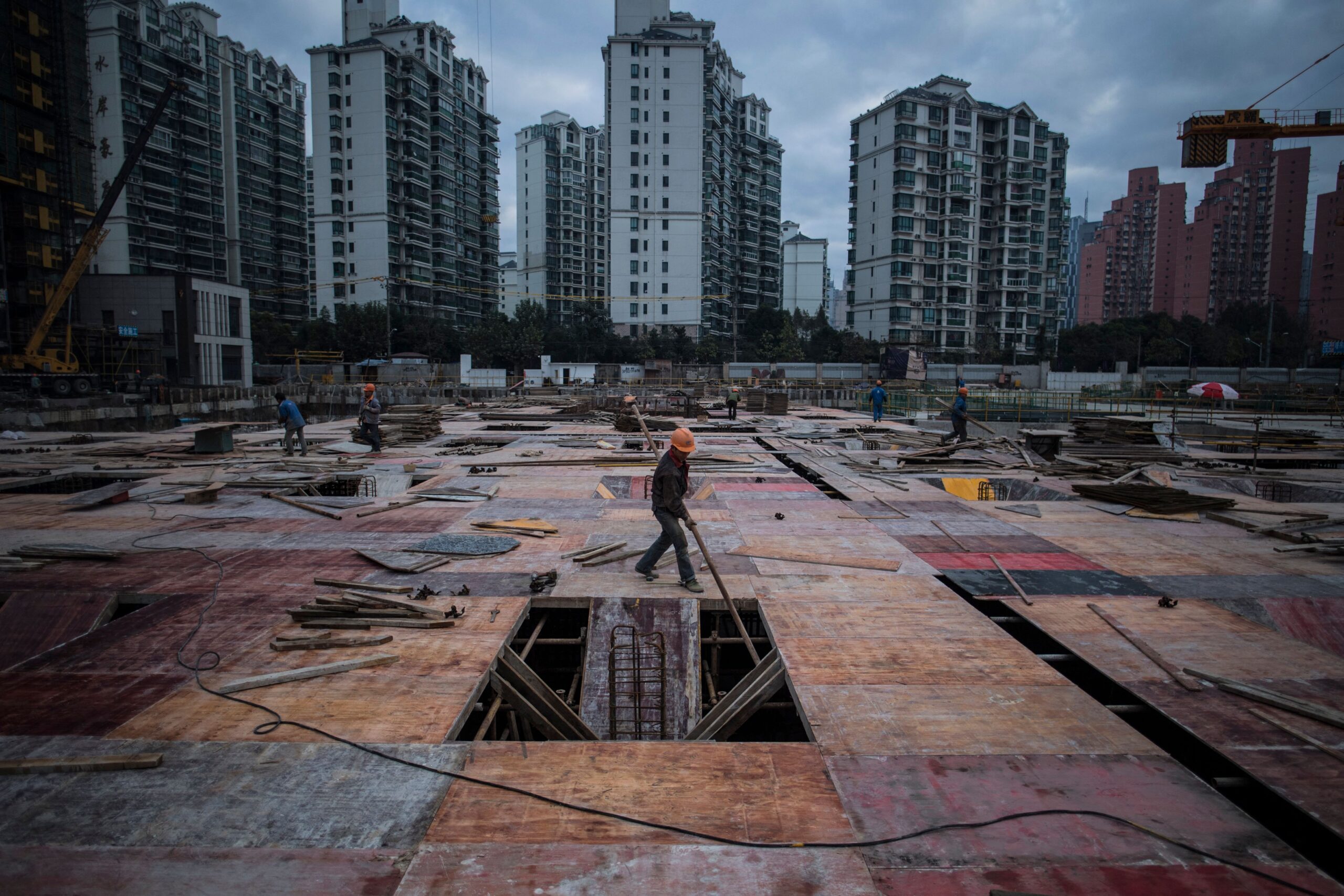
In 2026, the Chinese real estate industry, once seen as the “strongest growth engine,” faced its most thorough administrative suffocation. With Evergrande Group’s founder Xu Jiaying sentenced to life imprisonment, the golden age of private real estate skyrocketing came to an end. The Chinese Communist Party once again introduced a new round of real estate policies, promoting measures such as boosting existing home sales and extending mortgage terms in an attempt to rescue the market.
Scholars interviewed pointed out that this crisis was not simply driven by corporate greed, but rather by a “high-leverage growth machine” built on a mix of land finance, bank loans, pre-sale funds, and household savings. As the population and urbanization approached their peak, it suffered a systemic collapse triggered by the CCP’s forced “deleveraging movement.” “To understand its collapse, one must understand how the system first created this balance sheet and then punished this balance sheet.”
This series of reports is divided into three parts, decrypting the endgame and political-economic costs of China’s real estate market from three dimensions: how did the Chinese real estate industry fall into a debt quagmire? How did the era of private real estate enterprises come to an end? How did the middle class become burdened with debt handcuffs?
In the decades of boom and bust in the Chinese real estate market, there has been a covert control system interwoven with assets and debts quietly operating. Scholars pointed out that the essence of the Chinese real estate market is a “mortgage governance” mechanism. During the upswing, it captures the middle class through paper wealth acquisition, turning into a means of constraint during the downturn, locking residents’ wealth and labor expectations for a lifetime, achieving a state of “wealth without strength, controllable wealth.”
During the prosperity of the real estate market, housing became an important vehicle for restraining the middle class. American economist Davy J. Wong, who studied the Chinese real estate industry, described the Chinese real estate as a “mortgage governance” mechanism, capturing the middle class in an upswing and switching to constraint in a downturn.
He likened this system to a delicate device driving a donkey forward: “The paper wealth of real estate is the carrot in front, long-term mortgages are the reins, and government-controlled land, credit, and real estate policies determine when the carrot gets closer or farther away.”
According to Davy J. Wong’s observations, compared to the “widespread poverty” that easily triggers grassroots unrest and governance crises, Beijing authorities prefer the social governance position of residents in a “controllable wealth” state. People can possess high-value consumer goods and seemingly valuable housing, but these wealth must heavily rely on policies, lack liquidity, and cannot be transformed into independent social organizational capabilities and public discourse rights.
He believed that real estate played the most ideal role in this control mechanism. Firstly, its assets are non-transferable, as urban land is state-owned, property registration, transactions, mortgages, school districts, household registration, and financial credit are all fully controlled by the government administrative system, making it extremely difficult for families to quickly transfer them overseas.
Secondly, nearly 70% of Chinese household wealth is concentrated in housing. “This huge wealth is mostly supported by long-term mortgages, allowing residents to seemingly own a house worth millions, while their future decades of labor income have already been pre-mortgaged to the bank, locking residents’ wealth and labor expectations for a lifetime into the country’s credit machinery.”
This design reshaped the political attitudes of the middle class. An academic paper, “The Economic Origins of ‘Loyal Dissenters’,” published by Cambridge University Press in 2025, indicated through empirical analysis that Chinese homeowners are more concerned and have a stronger sense of rights in public affairs due to property rights interests. However, due to the vast amount of wealth locked in local real estate and urban order, they are highly dependent on the nation’s property registration and administrative allocation system, leading them to lean toward “within the system” channels for rights protection.
However, when the expectation of rights protection within the system faces a significant crisis, resistance from the middle class emerges, as seen in the “forced loan cessation” event that erupted in July 2022.
According to reports by Dajiyuan, at that time, homeowners of over 315 unfinished real estate projects in more than 25 provinces and cities such as Henan, Jiangxi, Hubei, and Shaanxi collectively issued a “loan cessation notice” to the government, regulatory agencies, and banks, announcing that if the projects were not resumed within a specified period, they would collectively stop paying their mortgages.
The report recorded scenarios from various projects, such as a Hengda development project in Jingdezhen, Hubei’s Greenland Optics Valley and Hengda Times New City, Shimao Brilliant City, among others. The report quoted a Henan homeowner named “Yang Yue” (pseudonym) lamenting, “The house we bought is nearly 100 square meters. It stopped construction last year, but we still have to pay the mortgage every month.”
In order to prevent the real estate crisis from spreading to the banking system, thereby threatening financial stability, Beijing proposed the so-called “protect existing property, stabilize people’s livelihood” policy.
In daily life, the heavy burden of housing loans directly translates into labor constraints on individual behaviors. A paper published in the Asia & the Pacific Policy Studies in 2024 demonstrated that housing debt significantly increases household risk aversion and greatly reduces members’ entrepreneurship and risk-taking possibilities.
Wong pointed out that real estate debt is essentially “not just a financial relationship, but a form of labor discipline.” Laborers burdened with long-term mortgages find it harder to resist employers and have little resources and time to engage in public affairs.
According to a March 2022 interview report by “36 Kr” website, case studies of young people burdened with high housing loans reveal this rigid constraint: “Piao Qing” (pseudonym), a real estate salesperson in Chengdu, had a peak monthly income of 40,000 to 60,000 yuan, with a combined monthly mortgage of 23,000 yuan for two properties. After a cooling in the industry, the base salary dropped to only 4,000 yuan, facing the risk of default, expressing regret that “achieving success too early in life, overestimating one’s abilities.”
“Li Yang” (pseudonym), in his 30s and employed in a large company, owned two properties in a suburban area and the urban area of Beijing. The monthly mortgage in the urban area reached 13,000 yuan. He admitted that he believed that “age 40 will become a turning point where personal income will decline,” therefore, under the pressure of mortgage, he dared not easily change jobs or face unemployment.
Beijing data analyst from a large company, “Hu Xiuwen” (pseudonym), and spouse were both laid off on December 24, 2021. His first reaction was to “quickly check how much money was in each of their bank cards,” highlighting the immediate financial impact on families during unemployment.
Macro data also confirms this burden. The household sector leverage ratio soared from 27.8% in early 2011 to 44.8% by the peak of the “monetization of shantytowns” (government compensating resettled households for housing) outbreak by the end of 2016, reaching 62.2% by the end of 2020. Under the influence of slowing GDP growth, it remained at highs of 61.4% to 61.5% from the end of 2024 to the first quarter of 2025 until falling to 59% in the first quarter of 2026 due to hedging.
Wong interpreted that the “monetization of shantytowns” introduced after 2015 reduced down payments and credit extension, which fundamentally were not purely social security measures but stimulants for residents to increase leverage in property buying, boosting demand, and ensuring the state gains land and tax benefits during the prosperous period.
Real estate prices on the mainland of China continued to decline comprehensively, and the market has yet to find its bottom. Larry Hu from Macquarie Bank recently reported that Chinese property prices have fallen to the lowest level since 2016, wiping out 85% of the gains made from 2012 to 2021.
Who bears the cost of the declining property prices? Wong believes that the Chinese real estate system has long been characterized by an asymmetric structure of “public power being cashed out first, and households bearing the consequences later.” It’s a “cyclical extraction mechanism.”
He replied, during the boom, local governments monetize through land transfers and taxes, while residents only acquire paper wealth; in the downturn, asset values evaporate significantly, but local government has already used land revenue, taxes paid can’t be refunded, and household mortgage principal remains.
When the capacity of residents to bear this burden reaches its limit, defaults and foreclosure data both increase rapidly. Quoting the China Banking Institute, the average national housing default rate had reached 3.7% by the fourth quarter of 2025 (only 1.6% in 2022), with some cities exceeding 5%. The investment research platform “GLEON” recently reported that roughly 6 million households are facing the risk of default or foreclosure.
The volume of auctioned residential properties has also reached a historical record high. According to a report by Shenzhen Ruilian Credit Data Company, in 2025, the national auction market listed about 1.2956 million properties, a 16.41% increase year-on-year, nearly half of which are residential properties.
A report from the China Index Research Institute showed that the average discount rate for foreclosed homes in 2025 had dropped to 75.74%, the lowest in seven years, with the transaction price generally lower by 30% to 50% compared to market prices. For residents, it means that half their lifelong wealth is instantly gone, and for banks, actual repayment often falls below 50% of the principal.
Facing this historic real estate downturn, the central decision-makers dared to forcefully burst the bubble, vigorously implement the “Three Red Lines” in 2020, and undergo major restructuring of private developers in 2026, all stemming from their confidence in the CCP’s system control capability.
Wong analyzed to reporters that decision-makers firmly believe that the central government firmly controls state-owned banks, land supply, capital flow, planning approval, and media tools, thus trusting that real estate risks can be safely “isolated” administratively. The costs of the real estate downturn are highly dispersed among home-buying families, local governments, banks, construction enterprises, and local administrative systems and do not immediately reflect on the central government’s balance sheet.
Furthermore, decision-makers believe that emerging manufacturing and strategic industries can replace real estate, severely underestimating the pivotal role real estate plays in household wealth, local finances, and total social demand.
This robust administrative deleveraging has brought short-term economic pressure. Real estate-related activities in 2021 accounted for nearly a quarter of China’s GDP; yet from January to July 2026, under the crisis, nationwide land transfer revenue declined by 30.8%, and real estate development investment fell by 19.2%.
Ding Shuang, Chief Economist for Greater China and North Asia at Standard Chartered Bank, told Reuters that housing demand is likely to continue to be constrained by employment conditions, income prospects, and expectations of further price declines. Therefore, administrative measures such as extending loan terms implemented at the end of August may not significantly boost housing demand.
Wong once again emphasized that although this control has damaged economic growth, it has achieved the desired effects politically: it has reduced the economic autonomy of private capital and middle-class households, thus further concentrating financial resources and project control in state-owned banks, central enterprises, and local state-owned enterprises.
In his view, this “social power reorganization” has transformed the real estate industry into a state monopoly, highly administrative “quasi-public utility.”