
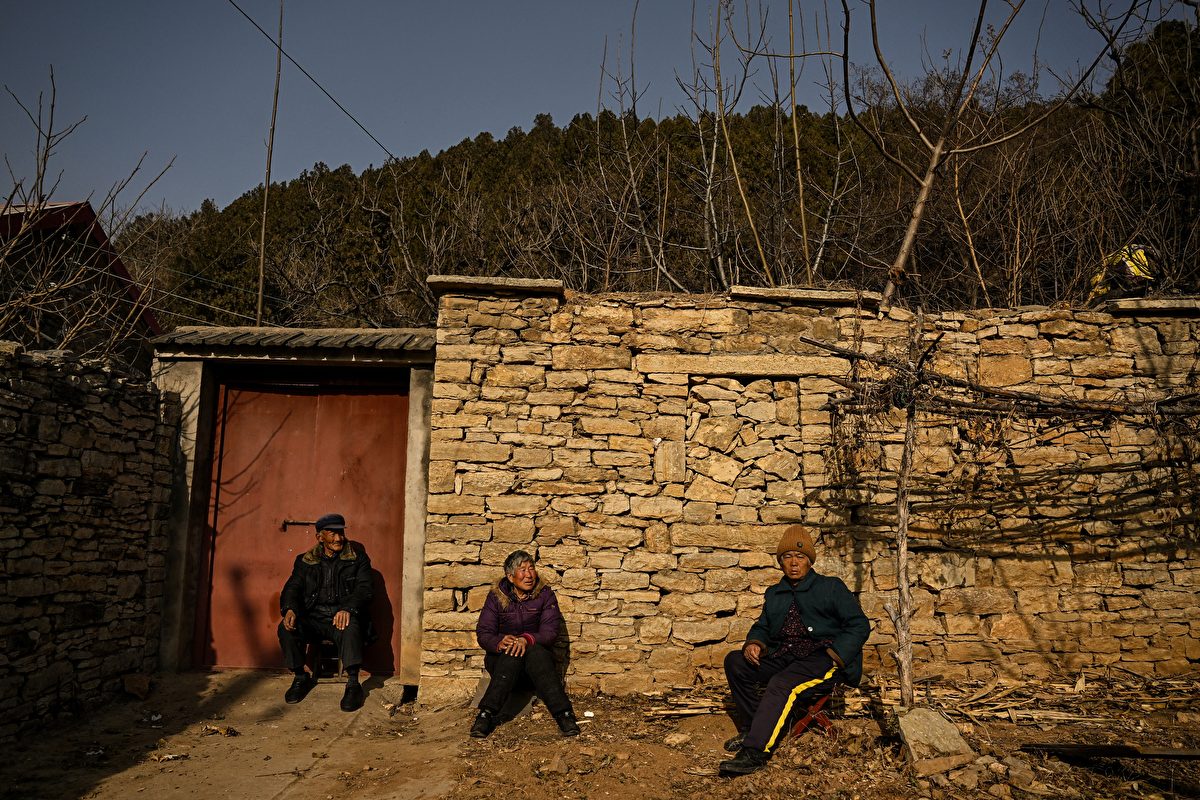
As of the end of 2024, approximately 180 million urban and rural residents in China received basic old-age insurance benefits, with an average of about 246 yuan per month per person, equivalent to about 8 yuan per day. In response to this, interviewed scholars have stated that the treatment of elderly rural residents under the Chinese Communist Party’s old-age system is “extremely harsh, almost to the point of exploitation”.
According to an interview published on the Caixin website on July 24 with Xue Huiyuan, the deputy director of the Social Security Research Center at Wuhan University, by the end of 2024, the average monthly benefit for urban and rural residents receiving basic old-age insurance was about 246 yuan per person. Calculated based on the average disposable income of rural residents in 2023, the replacement rate of old-age pensions is about 13.6%.
The basic old-age insurance for urban and rural residents mainly covers rural residents and urban non-employed residents who do not participate in the employee old-age insurance, including a large number of elderly rural residents. Chinese rural issues scholar Yin Zhixin told reporters that 246 yuan is the national average after summing up various old-age benefits for recipients, but it still falls short of providing comprehensive old-age security.
He said, “In rural areas of China, the authorities’ treatment of old-age benefits is very harsh, almost to the point of exploitation. Many elderly people do not have employee pensions, they support city dwellers, and still need to feed themselves. With an average of about 8 yuan per day, they cannot afford to see a doctor for minor illnesses and cannot afford treatment for serious illnesses.”
Yin Zhixin pointed out that the old-age benefits for urban and rural residents differ greatly from those for urban workers: “Now most farmers are referred to as residents, but after losing their land, they still have not been well treated by the Chinese Communist Party.”
The “Statistical Bulletin on the Development of Human Resources and Social Security Enterprises in 2024” published by the Ministry of Human Resources and Social Security of the Chinese Communist Party shows that by the end of 2024, the number of urban and rural residents participating in basic old-age insurance nationwide was 538 million, with 180.39 million actual recipients. The annual expenditure of the basic old-age insurance fund for urban and rural residents was 532.2 billion yuan.
Anhui social security scholar Wang Luping (pseudonym) told reporters that the basic old-age insurance for urban and rural residents has long adopted a low contribution, low benefit model, which is not fair to insured residents. He said, “The Chinese Communist Party’s consideration is to keep the money in its own hands, and the post-retirement life of the elderly is generally not a primary consideration for them. This has led to the fact that the employee old-age insurance is jointly paid by units and employees, while the urban and rural resident old-age insurance mainly relies on individual contributions and government subsidies. When the economy in China is good, they do not receive the necessary protection; when the economy is bad, their benefits will be even worse. The social security in Anhui in recent years is failing, and retirement benefits are decreasing.”
Public information from Bengbu shows that elderly insured residents aged 65 to 74 receive an additional 2 yuan per month, those aged 75 to 84 receive an additional 5 yuan, and those aged 85 and above receive an additional 10 yuan. In 2024, the basic old-age pension standard for urban and rural residents in the area was adjusted to 170 yuan per month, which only refers to the basic pension and does not include personal account pensions and other items.
Wang Luping stated that according to the local high-age additional standard, insured persons who reach the corresponding age will start receiving additional benefits from January 1 of the following year. Elderly people aged 65 to 74 receive an annual increase of 24 yuan, while those aged 85 and above receive an annual increase of 120 yuan. He believes that such an increase is hardly a substantial help in the daily lives of the elderly.
A document issued by the Henan Department of Human Resources and Social Security in 2019 stipulated that urban and rural residents who have paid continuously for 15 years, or have actually paid for a total of 20 years, excluding supplementary years, will receive an additional 3 yuan of basic old-age pension for each extra year paid after that, with the funding to be borne by the county, city, or district finance.
According to the standards in Henan, insured persons who reach the specified period will receive an additional 30 yuan per month after paying for an additional 10 years; and an additional 60 yuan per month after paying for an additional 20 years. This has been officially categorized as an incentive system to encourage residents to participate early, pay more, and pay for the long term.
Chinese scholar Mr. Yuan stated that although increasing the old-age pension by 2 yuan per month is part of the high-age tilt policy, such an amount hardly has practical significance. Increasing by only 3 yuan for each additional year paid is also unlikely to create a real incentive for contributions.
He said, “In recent years, whether in cities or rural areas, the number of people paying for social security has been decreasing. They feel that adding a few yuan is not as good as saving the money themselves and using it when needed. The reason is that the expenditures do not receive a reasonable return and do not solve the problem of old-age care in the future.”
In recent years, the Chinese Communist Party has repeatedly raised the minimum standard of basic old-age pensions for urban and rural residents. In 2026, it increased from 143 yuan to 163 yuan. This figure represents the minimum standard and is different from the caliber of 246 yuan per month for recipients in 2024 and cannot be directly compared.
Mr. Yuan stated that regardless of how the Chinese Communist Party “sings the bright side”, the reality shows that Chinese farmers are in the most difficult stratum.