
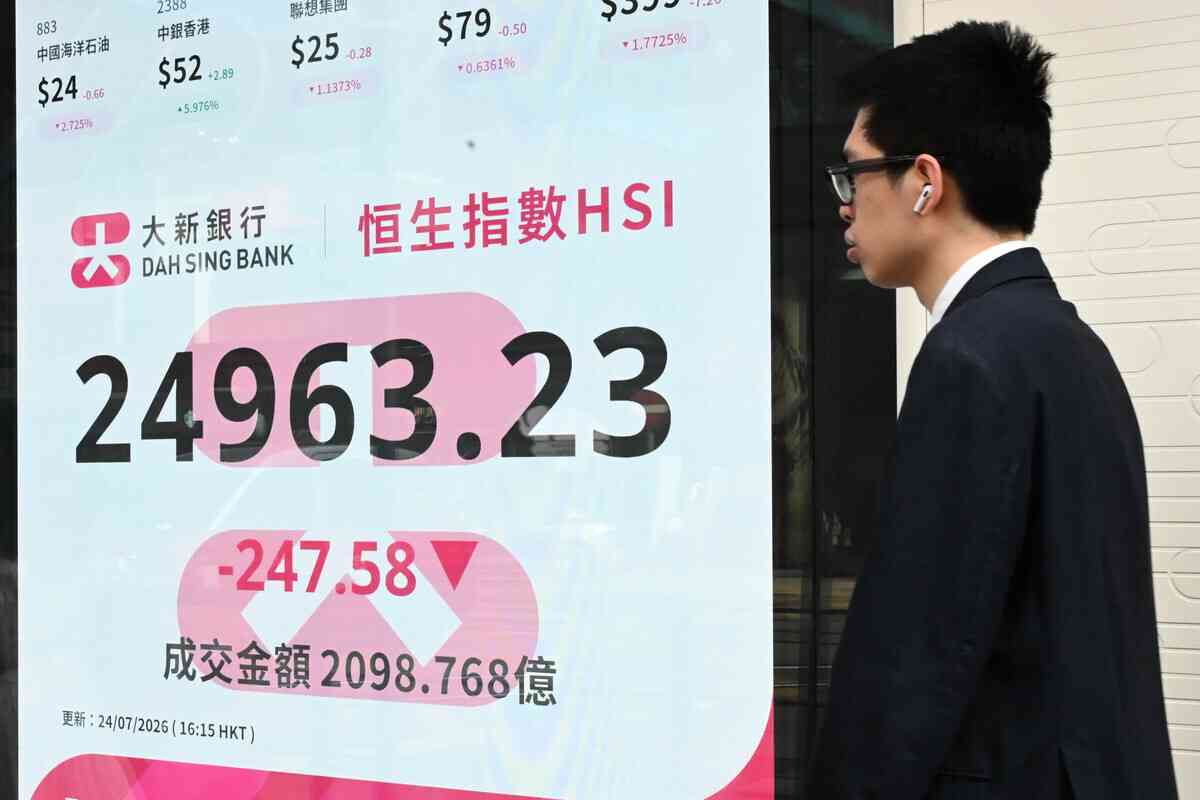
On July 24th, the Hong Kong stock market experienced fluctuations and a downward trend, with the Hang Seng Index falling by 0.98% and falling below the 25,000 point mark. The Hang Seng Tech Index also dropped by 1.47%. Big tech stocks such as Alibaba, Tencent, and Baidu all experienced collective declines, while sectors like printed circuit boards (PCB), real estate, and gold also showed general declines.
According to data from the Hong Kong Economic Times, the Hang Seng Index opened low by 278 points on that day, reaching a low of 24,812.50 points during the trading session, and closing at 24,963.23 points, down by 247.58 points. The Hang Seng Tech Index closed at 4629.51 points, a decrease of 68.97 points, and the Hang Seng China Enterprises Index fell by 0.98%, closing at 8271.06 points.
The total trading volume on the main board of the Hong Kong stock market for the day amounted to 209.77 billion Hong Kong dollars, a decrease of around 10% compared to the previous trading day. The Hang Seng real estate category index fell by 2.06%, and the Hang Seng commercial and industrial category index dropped by 1.51%.
Alibaba saw a drop of nearly 6% at one point in the afternoon, closing with a 4.26% decrease; Tencent Holdings, Baidu Group, Kuaishou, and Bilibili all experienced declines exceeding 2%; NetEase fell by 1.73%, Xiaomi Group and JD.com both fell by over 1%. Suntory fell by 5%, Alibaba Health fell by 2.6%, and MiniMax fell by 1.7%.
Concept stocks related to printed circuit boards (PCB) experienced even larger declines. Chipbond Microelectronics dropped by 9.52%, Jiantao Group and Jiantao PCB both fell by over 7%, Shunho Technology dropped by 6.78%, and Giant Group CNC fell by over 5%.
This marks another significant decline for PCB concept stocks in recent times. On July 22nd, Jiantao PCB dropped by over 16% at one point during the trading session, while Jiantao Group fell by around 10%.
Sectors such as real estate, aviation, coal, photovoltaic, and biomedicine also saw declines. Longfor Group, China Resources Land, and Hang Lung Properties all fell by over 3%, while Greenland China dropped by over 6%.
In the aviation sector, China Eastern Airlines, China Southern Airlines, and Air China all experienced declines of 3.46%, 2.61%, and 2.16% respectively.
Non-ferrous metals and gold stocks also saw a downturn. China Minmetals Resources and Lingbao Gold both fell by over 5%, Luoyang Molybdenum, China Gold International, and Shandong Gold all experienced declines of over 4%, and Zijin Gold International fell by over 3%.
Market reports from Smart Finance and others linked the decline in the Hong Kong stock market that day to the downturn in external markets, rising international oil prices, and the expectation of a Federal Reserve rate hike. The situation in the Middle East pushed up oil prices, with the yield on 10-year US Treasury bonds rising to around 4.71%. During the same period, large tech stocks in Hong Kong, non-ferrous metal stocks, and gold stocks all experienced widespread declines.