
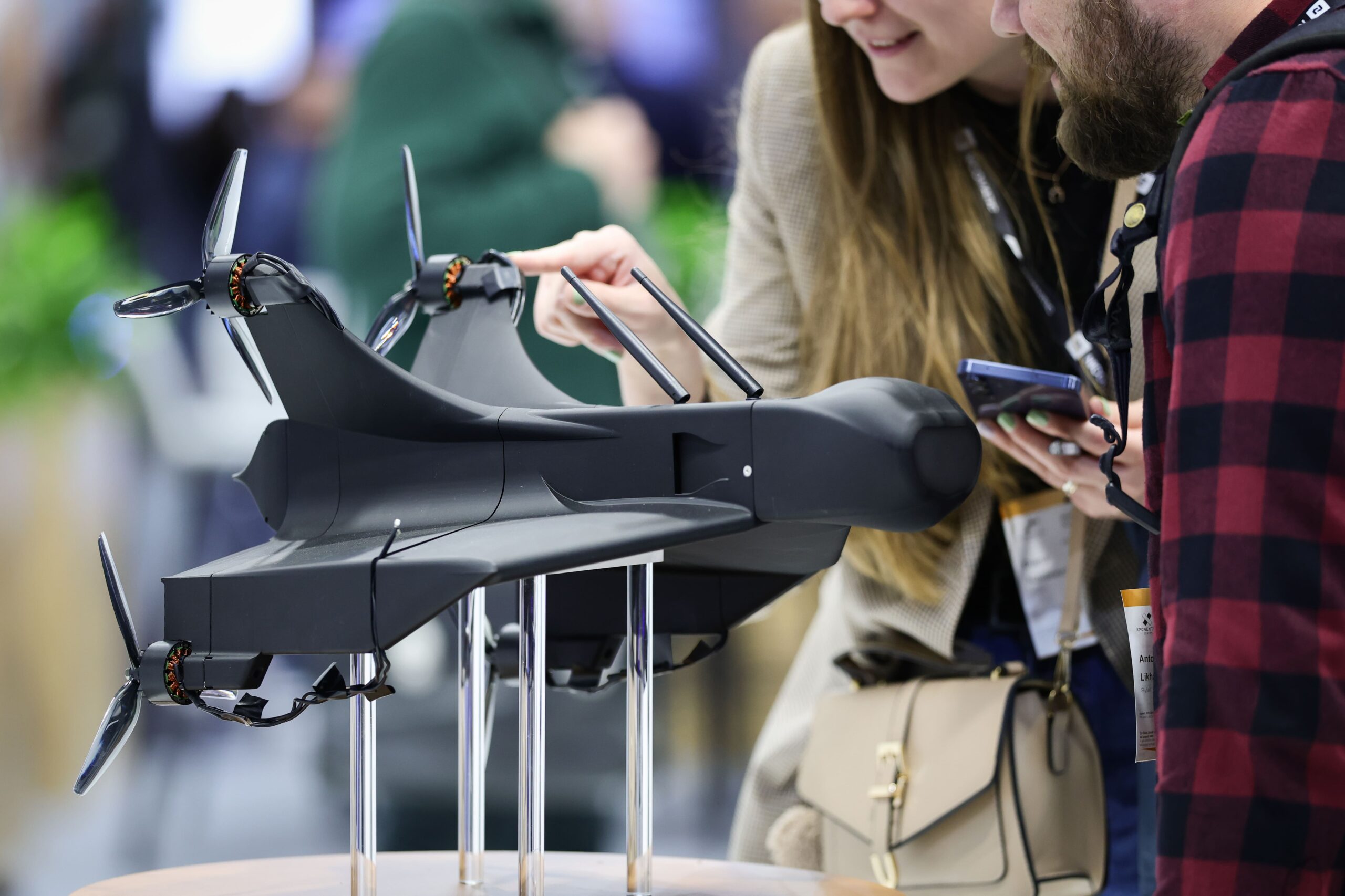
In the future aerial battlefield, victory is no longer just about the performance of fighter jets and missiles, but also about how to break free from the high-cost model of “one missile for one target” and rapidly defeat swarms of drones.
Lockheed Martin unveiled a new anti-drone weapon called “MORFIUS X-Rotor” at the 2026 Farnborough Airshow in London on Monday, July 20. This reusable and cost-effective drone is equipped with a “one-to-many” airborne High Power Microwave (HPM) weapon system, capable of disabling over 50 enemy drones in a single mission.
According to Lockheed Martin, the “MORFIUS X-Rotor” not only has the advantage of being reusable, but can also interface with different command and control systems, eliminating the need for dedicated sensors or fire control radars to carry out anti-drone missions. The MORFIUS system recently completed flight tests in Arizona, California, and Oklahoma, demonstrating its ability to intercept and disable enemy drones.
Randy Crites, Vice President of Missiles and Fire Control Programs, stated, “MORFIUS has redefined the standard for anti-drone combat capability—by using lightweight, reusable High Power Microwave technology, it maintains a high kill rate while reducing the cost per kill, providing a more cost-effective new anti-drone solution.”
The company is accelerating the production of MORFIUS drones and high-power microwave weapon module prototypes, hoping to provide frontline testing and deployment as soon as possible. The system will undergo further testing.
Lockheed Martin also introduced a lower-cost advanced variant of the Patriot intercept missile, primarily designed to intercept air-breathing weapons such as cruise missiles, short-range ballistic missiles, and other threats.
The “PAC-3 Adapted Capability Effector” (ACE) missile is priced at less than half of the “PAC-3 Missile Segment Enhancement” (MSE) missile.
Lockheed Martin stated that the new missile can be directly integrated into existing air defense systems, leveraging the Patriot system and Integrated Battle Command System (IBCS) without extensive modifications, thus accelerating the development process. Lockheed Martin will collaborate with partners in the United States and Europe on the research and development.
Recently, the U.S. military, during Operation Epic Fury, depleted interceptor inventories rapidly to intercept Iranian missiles and the “Shahed” drones, drawing attention to the cost issue of “using high-value weapons against low-value targets.” It is estimated that each PAC-3 missile costs about $4 million, far exceeding the $35,000 cost of an Iranian “Shahed” drone.
Furthermore, the Patriot system has become a crucial defense weapon for Ukraine against Russian forces. However, due to the rapid consumption rate of intercept missiles and tight global inventories, Ukraine is collaborating with nine countries on the “Freyja” project to explore alternative solutions.
This article was referenced from Defense News.