
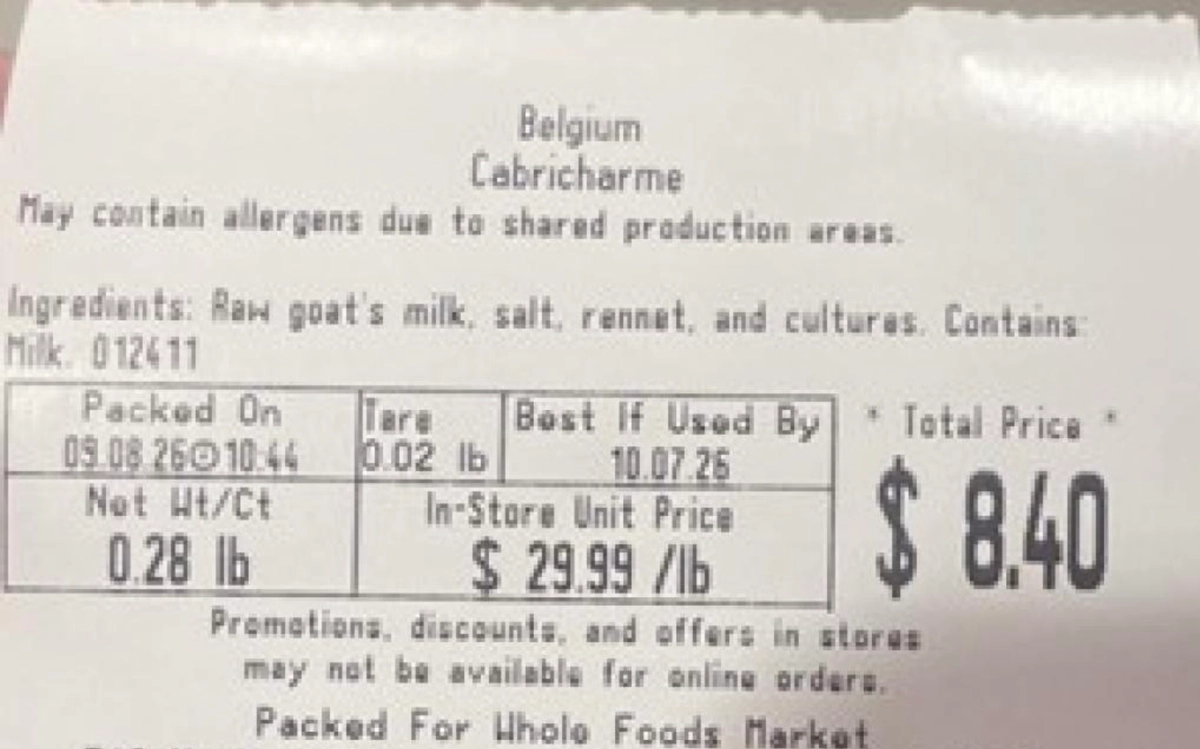
Whole Foods Market is recalling two types of Cabricharme cheese that contain undisclosed egg lysozyme. The U.S. Food and Drug Administration (FDA) forwarded an announcement from Whole Foods Market on September 11, stating that the labels of these two cheeses did not mention the presence of egg lysozyme. Consumption by individuals allergic to or highly sensitive to eggs could lead to severe or potentially life-threatening allergic reactions.
The affected cheeses were sold at the specialty cheese departments of 18 Whole Foods Market stores in Arizona, California, Connecticut, Massachusetts, New Jersey, New York, and Rhode Island.
The first recall is for the “Fromagerie Coop de Mean Cabricharme raw milk cheese (aged 60 days)” with PLU number 57953, sold in California, Connecticut, Massachusetts, New Jersey, New York, and Rhode Island. The second recall is for the Belgian Cabricharme cheese with PLU number 54670, sold in California and Arizona. The best-by dates for both products are before October 7, 2026.
According to the FDA announcement, all affected products have been removed from store shelves. Whole Foods Market stated that customers who have purchased these products do not need to return them, but they should dispose of them properly. Customers can request a full refund with a valid receipt from the purchase location.
As of the announcement, no illness reports related to the recalled products have been received. Consumers with questions can contact Whole Foods Market at 1-844-936-8255 between 7:00 a.m. and 10:00 p.m. Central Time on weekdays and between 8:00 a.m. and 6:00 p.m. on weekends.
The FDA notes that eggs are one of the nine major food allergens required by U.S. law to be clearly labeled on food packaging if they are used as ingredients. The other eight are milk, peanuts, fish, shellfish, tree nuts, wheat, soy, and sesame.
According to testing company Thermo Fisher Scientific Inc., egg lysozyme is a “primary allergenic protein” for children allergic to eggs. Approximately 30% to 40% of egg allergy patients are allergic to lysozyme. Lysozyme accounts for about 3% to 3.4% of the total protein content in egg whites and is used in the food industry in products such as wine and cheese. Its antibacterial properties also make lysozyme a preservative in the pharmaceutical industry.
According to the advocacy organization Food Allergy Research and Education (FARE), about 2% of children have an egg allergy.
“Symptoms of an egg allergy reaction can range from hives to life-threatening anaphylaxis. Allergic reactions are unpredictable, and even trace amounts of egg can trigger a reaction,” FARE stated.
FARE advises individuals with egg allergies to avoid consuming foods that contain eggs, such as pancakes, waffles, cake decorations or fillings, egg-washed bread, marshmallows, hollandaise sauce, cookies, salad dressings, cornbread, pepper jack rolls, and pasta.