
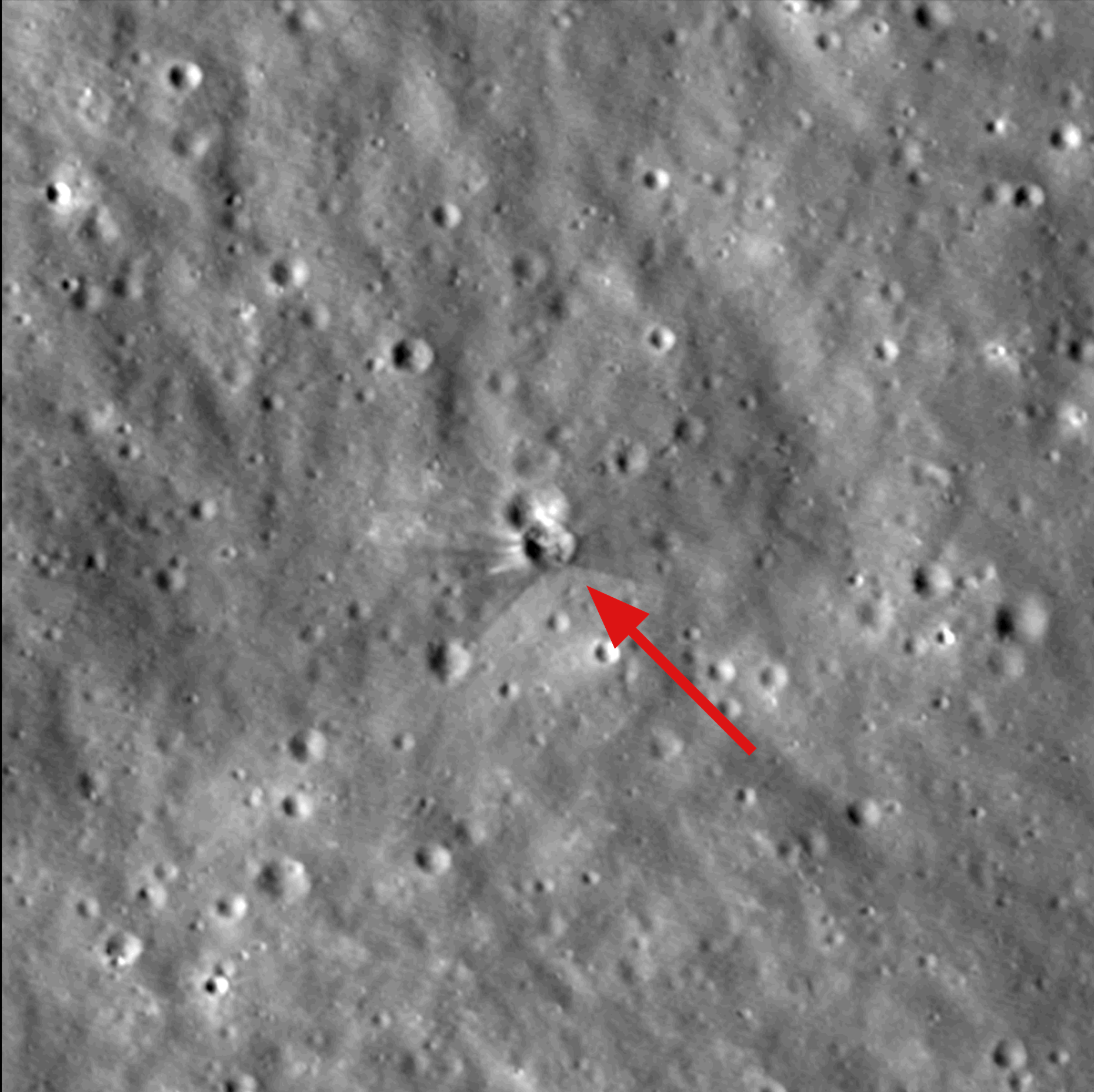
In early August, the debris from the upper stage of SpaceX’s Falcon 9 rocket crashed into the surface of the moon, earning the company the rather awkward distinction of being the first to leave a scar (an artificial impact crater) on the lunar surface. Recently, the United States’ National Aeronautics and Space Administration (NASA) released the first high-resolution images of the impact site captured by the Lunar Reconnaissance Orbiter (LRO), allowing us to witness the scene aftermath for the first time.
This incident traces back to January 2025, during Firefly Aerospace’s Blue Ghost 1 lunar mission. After successfully delivering a lunar lander to the Moon’s orbit, the Falcon 9 rocket’s upper stage did not have enough propellant to perform a controlled deorbit into the ocean. According to orbital analysis reports from Los Alamos National Laboratory in New Mexico, the debris from the 45-foot long, 8,800-pound upper stage was abandoned in a high elliptical Earth-Moon transfer orbit, unable to re-enter the Earth’s atmosphere.
Over the course of more than a year, the debris drifted in space. Due to the complex gravitational disturbances between the Earth and the Moon, as well as the influence of solar winds, the rocket debris gradually shifted its orbit, eventually evolving into an inevitable collision course. On August 5, 2026, at a speed of approximately 8,700 kilometers per hour (equivalent to 2.43 kilometers per second), the debris impacted near the Einstein Crater on the lunar surface, leaving its mark at a velocity 7 times faster than the speed of sound in Earth’s atmosphere.
While this artificial space debris impact event sparked discussions on space orbit environmental management, for astronomers and planetary scientists, this accident provided a rare opportunity to observe and study a lunar impact event and its subsequent effects nearly in real time.
Before the impact, NASA’s Jet Propulsion Laboratory’s Center for Near-Earth Object Studies (CNEOS) seized the opportunity to test methods and tools for monitoring potential Earth threats. Working with global amateur and professional astronomy networks, CNOOS tracked and modeled the errant rocket’s multi-body gravitational orbit data over several months.
Targeting the impact site: The NASA team transmitted predicted coordinates to the Korea Aerospace Research Institute (KARI). The first lunar orbital probe of South Korea, “Danuri” (pronounced as “Shang Yue Hao” in Chinese), successfully captured high-resolution images before and after the impact within hours, pinpointing the impact location with an error margin of about 0.6 miles (approximately 1 kilometer) as predicted by NASA.
Polar orbit imaging challenge: NASA then adjusted the Lunar Reconnaissance Orbiter’s (LRO) observation stance to align with the newly formed SpaceX impact crater for a photo shoot. Operating at a speed of about 1 mile per second at a distance of about 60 miles above the lunar surface in a polar orbit, and with the Moon’s rotation also factored in, each alignment required meticulous calculations. Any deviation exceeding 10 seconds would risk the target moving out of the camera’s frame.
In the end, after multiple orbit cycles, LRO successfully captured detailed crater features at different solar lighting angles and accurately mapped the impact point’s coordinates: 19.4759 degrees N, 93.2862 degrees W (266.7138 degrees E).
Analysis of LRO images confirmed that the rocket debris struck a plain on the Moon at an altitude of approximately 1,676 feet, creating a crater with a diameter of 60 feet and a depth of about 10 feet.
Image analysis revealed:
Dark regolith: The darker material around the crater edge is part of the Moon’s regolith, exposed to long-term effects of solar winds, micro-meteor impacts, and cosmic radiation, mainly originating from the relatively shallow layers within about 1.5 feet below the lunar surface.
Bright ejecta: The radiating bright streaks surrounding the crater are fresh rock fragments ejected from deeper beneath the surface, untouched by radiation and thermal processing.
In the foreseeable future, this impact site will not be cleaned up; it will remain preserved for tens of thousands of years in the windless, waterless environment of the Moon. Deeper understanding of such impacts can assist NASA and other agencies in better preparing for natural disasters like asteroid impacts. If humans ever plan to establish a long-term presence on the Moon, precise assessment and defensive predictions will be crucial. At the very least, a cleanup mission to the Moon is owed.