
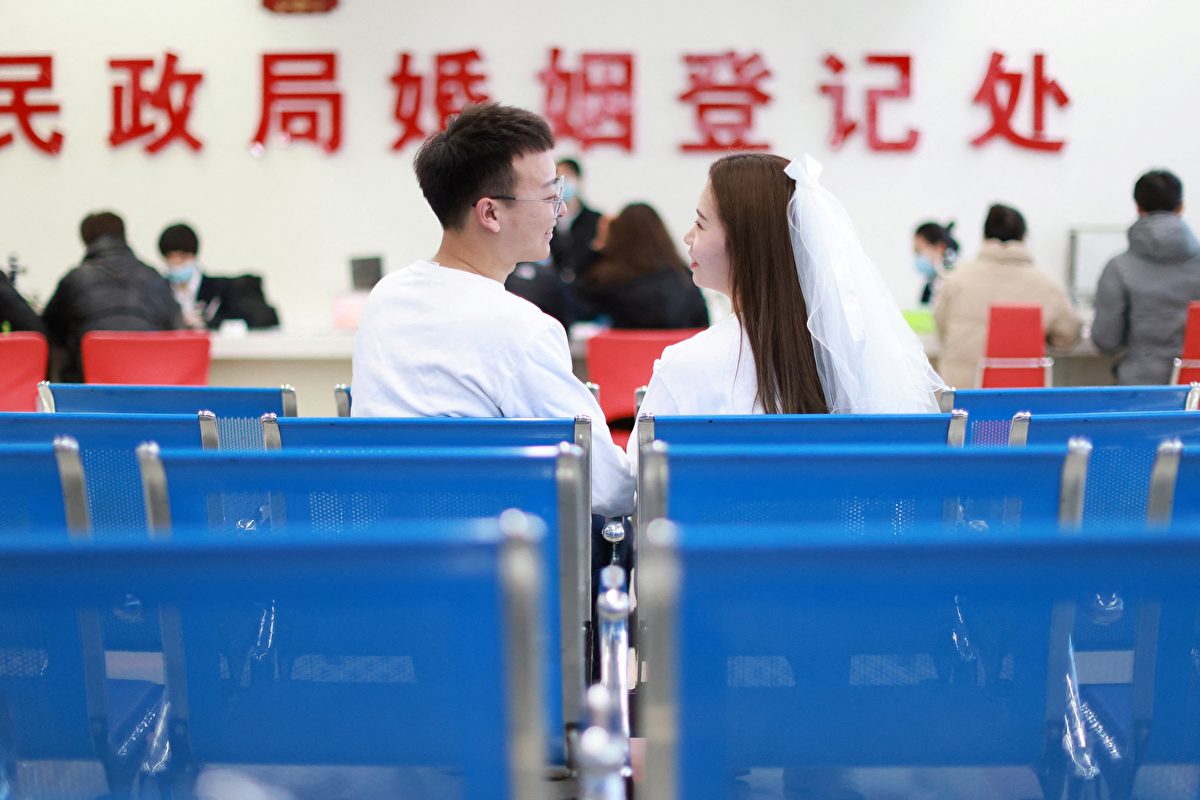
Fujian Province’s Mingxi County recently announced a one-time marriage incentive of 3000 yuan for couples who register their marriage in the county in accordance with the law. The policy aims to address the current trend where young people are reluctant to get married and have children. This news has become a hot topic on July 24th.
According to reports from “First Financial”, Mingxi County recently released the “Implementation Plan for Optimizing Fertility Policies to Promote Long-term Balanced Population Development (Revised)”. The plan stipulates that couples who legally register their marriage at the Mingxi County Marriage Registration Center and undergo pre-marital examinations (both parties are registering their marriage for the first time and establish household registration in the county after marriage) will receive a one-time incentive of 3000 yuan (Chinese currency).
It’s not just Mingxi County; many regions in China have introduced incentive policies to encourage marriage and childbearing among young people.
In April of this year, a village official in Hunan’s Zhumadian City announced in a video that anyone who introduces potential partners to young people in the village and the couple gets engaged will be rewarded 1000 yuan. Since January 1, 2025, Lvliang City in Shanxi Province has been providing a reward of 1500 yuan to couples who register their marriage in the city (both parties are registering for the first time) and the woman is 35 years old or younger.
Furthermore, Longguinanling Village in Baiyun District, Guangzhou, and Xinsihuangtang Village in Hengli Town, Dongguan, have also introduced measures to incentivize marriage.
Not long ago, several places in China, including Hangzhou and Ningbo in Zhejiang Province, distributed marriage consumption vouchers to newlyweds.
Not only local authorities but also some enterprises in mainland China have implemented policies to reward employees for getting married. On June 27, a notice issued by Pangdonglai Cultural Department revealed that since the implementation of the incentive standard on January 2, 2025, a total of 73 employees in the company have received marriage rewards, with a total bonus of 3.65 million yuan.
The frequent issuance of marriage incentive policies by local authorities in the Communist Party of China is due to the continuous decline in the number of marriages in the country. Official data from the Chinese Communist Party shows that the peak of marriages in China was in 2013, with 13.47 million couples registering for marriage that year and has been declining annually since then. In 2019, the number of marriages dropped to 9.273 million couples, falling below 10 million couples. By 2024, the number of marriages had dropped to 6.106 million couples, a decrease of about 20.5% from 2023, reaching a new low.
The declining marriage rates are attributed to several factors, including a shrinking eligible population for marriage, a decrease in the total number of young people reaching marriageable age; postponement of first marriages due to employment pressure and cost of living, with the average age of first marriage significantly delayed to around 28-29 years and even higher in some first-tier and second-tier cities; changing attitudes towards marriage and childbearing in mainland China, where the increasing costs of housing, dowry, and child-rearing expenses have reduced the willingness of young people to get married.
Furthermore, with the decline in marriage rates, the fertility rate has also been decreasing. In 2025, China’s fertility rate had dropped below 1.0, ranking only higher than South Korea among major economies globally. The replacement level for maintaining a country’s population from one generation to the next is around 2.1, meaning on average, a couple needs to have 2.1 children.