
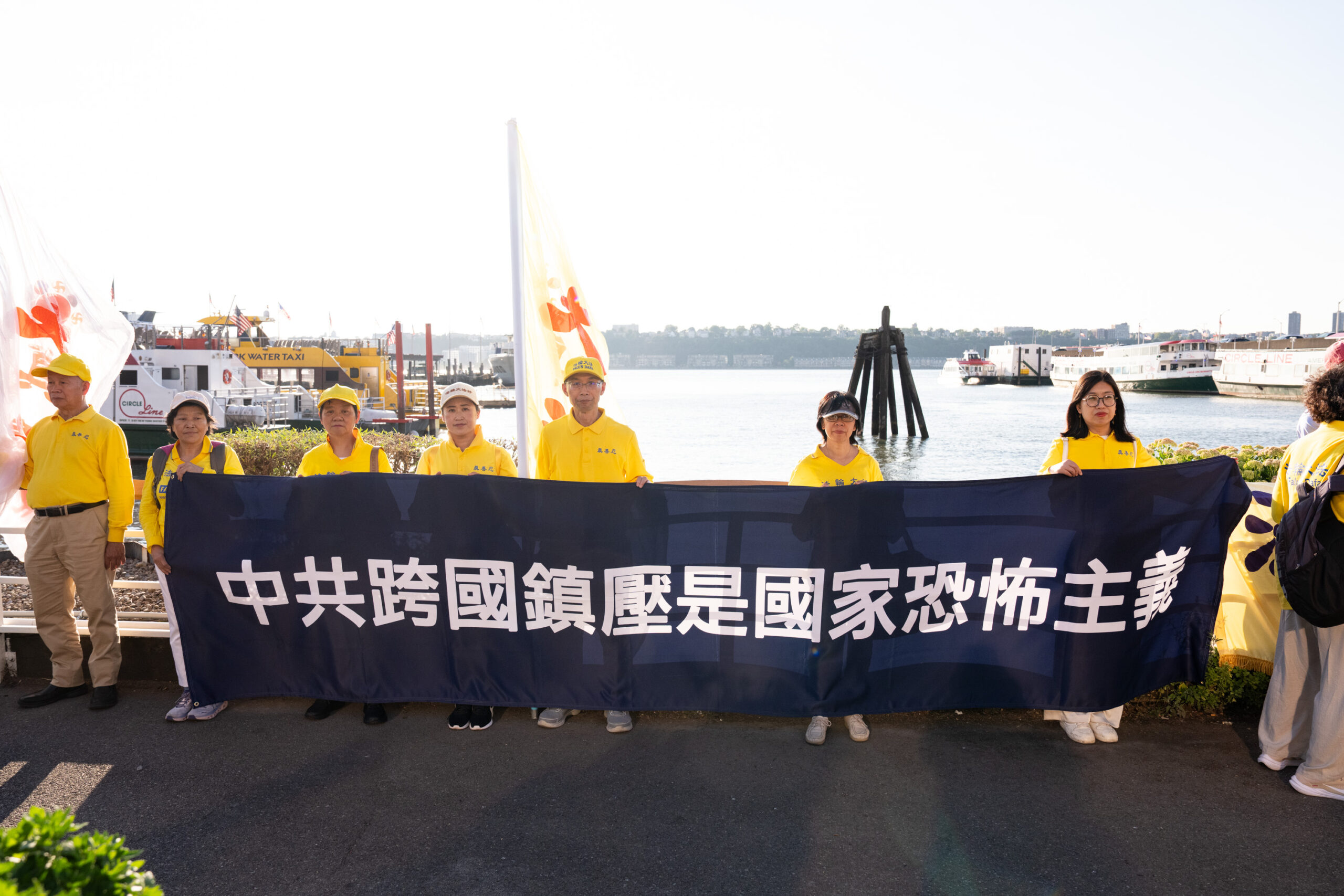
International community recently has at least 54 human rights and civil organizations jointly condemned the Chinese Communist Party’s so-called “National Unity Law,” stating that it threatens global freedom. They have called on countries to take action to counter the CCP’s cross-border repression. The U.S. Senate quickly introduced the “Stop Cross-Border Repression Act” in response. Legal experts believe that China’s National Unity Law is actually an “evil law” that poses a universal social hazard worldwide, leading to global backlash and fostering a situation of “global anti-communism.”
The controversial Article 63 of the CCP’s “National Unity Law” stipulates that if organizations or individuals outside of China engage in acts deemed as “undermining national unity” or “creating ethnic division” in China, the CCP will “hold them accountable according to the law.” This has raised concerns and criticisms from the international community regarding CCP’s “long-arm jurisdiction” and “cross-border repression.”
Former Beijing lawyer Lai Jianping explained, “This evil law of the CCP poses a universal, unacceptable, and fundamental social hazard. People around the world with conscience and justice are facing persecution under this evil law.”
“As an independent scholar,” Lai Jianping stated, “The CCP’s national law has thus sparked a universal resistance globally, inciting a ‘global anti-communism’ movement.”
He remarked, “That’s why so many individuals and organizations have united to resist it, urging governments to take corresponding measures, signifying a universal, collective action of saying ‘no’ to the CCP, which is a necessary backlash resulting from the nature of this evil law itself.”
Overseas human rights lawyer Wu Shaoping also expressed to Dajiyuan that the recent cross-border joint petition by dozens of organizations is, first and foremost, an expression of public opinion. It signifies a shift from criticism towards actionable response.
This movement conveys the international community’s “high level of concern and worry” as these groups involved in the joint petition are “the most directly threatened by the CCP’s ‘National Unity Law,'” reflecting their realistic and direct concerns.
Wu Shaoping explained, “The CCP’s ‘National Unity Law,’ which came into effect in less than two weeks, has elicited such a strong response from the public. It is evident that this wicked law of the CCP has had an impact on the entire world, and civil society has transitioned from individual criticism to a more organized and united response of saying ‘no’ to the CCP.”
Legal scholars argue that Chinese laws do not have extraterritorial effect as they are not international law or bilateral treaties. However, the CCP’s evil law demonstrates a threat it poses to the international community unilaterally.
Wu Shaoping pointed out, “For many years, the CCP has been conducting ‘cross-border repression’ and ‘long-arm jurisdiction,’ posing substantial threats not only to overseas Chinese communities but also to nationals of other countries. Through this ‘National Unity Law,’ the CCP has blatantly exposed its claws even more directly.”
“That is to say, the CCP is directly threatening everyone in the world. This is a unilateral action taken by the CCP,” Wu Shaoping stated.
“The threat it poses lies in the fact that once anyone criticizing or opposing the CCP abroad falls into countries deeply influenced by the CCP or enters CCP’s jurisdiction, they may directly face arrest by the CCP and various forms of persecution. This is where it can pose a threat to the international community.”
Lai Jianping similarly believes that after the implementation of the so-called “National Unity Promotion Law,” anyone criticizing the Chinese government, including pure foreigners, would not have a problem if they do not go to China or countries with extradition treaties with China.
“But once you enter China’s border or go to countries with close relations with the CCP, such as Cuba, Thailand, or Vietnam, the danger is significant,” Lai Jianping continued, “Its ‘long-arm jurisdiction’ cannot reach beyond its territory, but it can seek assistance from countries with extradition treaties with it to apprehend these so-called ‘suspects’ and then extradite them to China. Thus, its primary threat lies here.”
On July 14, the U.S. Senate introduced a bipartisan bill, the “Stop Cross-Border Repression Act,” specifically targeting the CCP’s National Law to counter the CCP’s and other authoritarian states’ “cross-border repression” actions, increasing the potential sentence for “cross-border repression crime” to up to 10 years.
Legal experts view this as a significant legislative action, a powerful move with symbolic significance.
Wu Shaoping highlighted that the international community previously lacked adequate legal foundations to combat the CCP’s “long-arm jurisdiction” and “cross-border repression” actions. This led to situations where CCP agents or operatives did not face severe penalties after many instances of “cross-border repression,” allowing the CCP to become more brazen in its actions, ultimately leading to its direct legislation for such activities.
Lai Jianping stated, “The international community has mainly been engaging in public opinion and political condemnations in the past. Now with the move towards parliamentary legislation, it can be seen as an upgrade, a balanced countermeasure, fundamentally altering the nature of response.”
“If it elevates to the parliamentary level, becoming law, the nature changes completely, providing operability. This presents an actual obstacle on the legislative, enforcement, and judicial levels against the CCP,” including countering those “countries aiding the CCP’s dirty work.”
Wu Shaoping commented, “The U.S. passing legislation through Congress means it is no longer a demonstration of political responses but a turn towards institutional and legal development, equipping enforcement agencies with clearer legal foundations to combat the CCP’s ‘cross-border repression,’ targeting CCP’s overseas agents and operatives with better legal tools and weapons.”
“This will set a great example for the international community. European countries, as well as countries like Canada and the UK, I believe, will also introduce corresponding laws to confront the blatant threats posed by the CCP together.”