
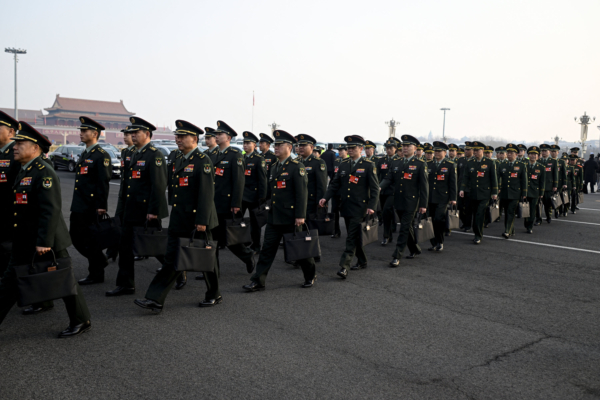
The fifth plenary session of the Chinese Communist Party’s Central Commission for Discipline Inspection (CCDI) opened on January 12, 2026, with the absence of eight major generals and two brigadier generals who are also CCDI members, including Chen Guoqiang, the political commissar of the National University of Defense Technology and former deputy secretary of the military discipline inspection commission.
The fifth plenary session of the 20th Central Discipline Inspection Commission of the Chinese Communist Party was held from January 12 to 14, 2026. CCTV reported the opening scene of the CCDI’s fifth plenary session on January 12.
According to the account under the username “China Personnel Watch,” among the 133 members of the 20th Central Discipline Inspection Commission, there are a total of 22 CCDI members from the military system, accounting for 15.6% of the total number.
All these 22 individuals attended the fourth plenary session of the 20th CCDI in January 2025. One year later, only 12 attended the current CCDI plenary session, with 10 absent, marking an absentee rate of 45.5%.
The ten military CCDI members who were absent from the plenary session are:
• Chen Guoqiang, political commissar of the National University of Defense Technology (Air Force Major General);
• Former deputy political commissar of the Military Science Academy, Yang Xiaoxiang (Army Major General);
• Deputy political commissar of the Navy, Leng Shaojie (Navy Major General);
• Former deputy political commissar of the Navy, Cheng Dongfang (Navy Major General);
• Deputy political commissar and director of the Political Work Department of the Central Theater Command, Lou Chunsu (Army Major General);
• Political commissar of the Central Theater Command, Miao Wenjiang (Army Major General);
• CCDI secretary of the Armed Police Force, Chen Jianfei (Armed Police Major General);
• Director of the Political Work Department of the Armed Police Force, Liu Jun (Armed Police Major General);
• Director of the Political Work Bureau of the Equipment Development Department of the Central Military Commission, Liu Jun (Air Force Brigadier General);
• Audit Director of the Audit Office of the Military Commission, Sun Bin (Army Brigadier General).
Under normal circumstances, all CCDI members should attend the plenary session, regardless of any changes in their positions. The absence of these ten major generals and brigadier generals may indicate issues they are facing.
Among them, Sun Bin, Audit Director of the Audit Office of the Military Commission, was dismissed from the National People’s Congress in October 2025. In November 2025, the official report from the Standing Committee of the National People’s Congress revealed that Sun Bin was dismissed from his position as a national representative for “serious violations of discipline and law.”
Major General Chen Guoqiang, who was absent from the CCDI’s fifth plenary session, is one of the 19 standing members of the 20th CCDI.
In September 2024, Major General Chen Guoqiang, deputy secretary in charge of discipline inspection, emphasized his appointment as the political commissar of the National University of Defense Technology, which drew considerable attention and discussion.
Chen Guoqiang, born in April 1963 in Hengshui Gu City, Hebei Province, holds the rank of Air Force Major General. He has served for a long time in the airborne forces. In January 2009, he served as the political commissar of the 44th Division of the 15th Army of the airborne troops. In August 2014, he was appointed director of the Military Political Department. In March 2017, he continued to serve as the director of the Political Work Department of the Airborne Troops.
During Miao Hua’s tenure as director of the Political Work Department of the Military Commission, Chen Guoqiang was promoted to director of the Political Work Department of the Aerospace Systems Department of the Strategic Support Force in 2018; in March 2021, he was appointed deputy political commissar of the Central Theater Command and director of the Political Work Department; in August 2021, he was transferred to serve as the deputy secretary in charge of discipline inspection of the Military Commission, and also as the deputy director of the Military Commission’s Supervision Commission.
After being transferred, independent commentator Yang expressed on the social media platform X that Chen Guoqiang is the core deputy of Xi Jinping’s anti-corruption work in the military, calling him the “right-hand man of the Xi family.” He wrote, “Chen Guoqiang is the executor of major cases and special cases in the military, including Li Shangfu, Wei Fenghan, Li Yuchao, and others, and is the executor of the large-scale prison rises in the military, a figure like Zhou Xing and Lai Junchen today.”
At the time, external analysis indicated that Chen Guoqiang’s transfer from a core position was not arranged by Xi Jinping but rather an action by anti-Xi forces, revealing that Xi Jinping’s military power is weakening, with his power base being eroded.
In addition to Chen Guoqiang, other military leaders who were absent from the CCDI plenary session mostly have connections with Miao Hua and were promoted by him. Major generals such as Chen Guoqiang, Yang Xiaoxiang, Leng Shaojie, Chen Jianfei, and others all saw promotions during Miao Hua’s tenure at the helm of the Political Work Department of the Military Commission.
Miao Wenjiang had associations with Miao Hua in the Lanzhou Military Region. While Miao Hua served as the director, deputy political commissar, and political commissar from December 2010 to December 2014 in the Lanzhou Military Region, Miao Wenjiang held various positions such as deputy director of the Political Department of the Xinjiang Military Region, director of the Political Department of the Southern Xinjiang Military Region, political commissar, and so on.
Both Yang Xiaoxiang and Miao Hua rose through the ranks in the former Nanjing Military Region and held political work positions in the 12th Group Army of the Nanjing Military Region.
During Miao Hua’s tenure as a member of the Military Commission and director of the Political Work Department, Miao Wenjiang successively served as deputy political commissar and director of the Political Work Department of the North Theater Command and political commissar of the Army in the Central Theater Command; Yang Xiaoxiang successively held the position of secretary of the discipline inspection commission in the Strategic Support Force and deputy political commissar of the Military Science Academy; Leng Shaojie was successively promoted to political commissar of the Army Logistics Department and deputy political commissar and director of the Political Work Department of the Central Theater Command; Chen Jianfei was successively promoted to deputy political commissar of the Armed Police Force and secretary of the discipline inspection commission of the Armed Police Force; Cheng Dongfang was successively promoted to chief procurator of the Military Procuratorate and president of the Military Court.
On the eve of the Fourth Plenary Session of the Central Committee of the Chinese Communist Party, on October 17, 2025, the Ministry of National Defense of the Chinese Communist Party announced that nine generals, including Vice Chairman of the Military Commission He Weidong and former director of the Political Work Department of the Military Commission Miao Hua, were suspected of serious crimes and were expelled from the party and the military.
During the Fourth Plenary Session, 22 main committee members and 14 alternate committee members were unusually absent. Of the 22 absent main committee members, 18 were from the military. Eight central alternate committee members were not replaced as customary, including five major generals such as Fang Yongxiang, the director of the General Office of the Military Commission.
Following the Fourth Plenary Session, the military continued to release signals of purification. The official military newspapers of the Chinese Communist Party repeatedly named He Weidong, Miao Hua, and others in the context of their cases, stressing that “corrupt elements have no place to hide in the military” and emphasizing the need to “eliminate harmful elements.” Signs indicated that the military’s purification actions are still ongoing.