
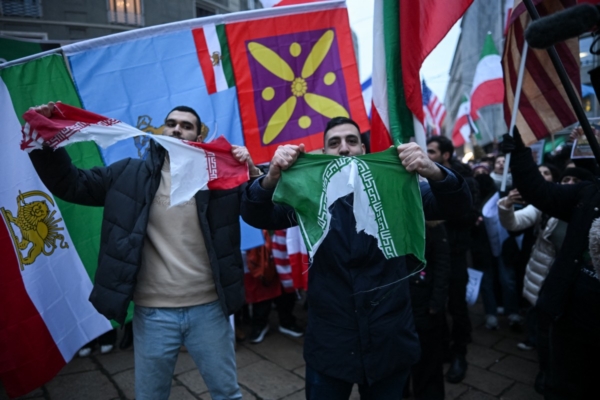
Iran’s Bazaar merchants, who were once the financial backbone of the Islamic revolution in 1979, have now turned against the clergy class that they helped install in power. This discontent, sparked by economic collapse, has evolved into the most severe challenge to the legitimacy of Iran’s religious rule since the establishment of the Islamic Republic.
According to Reuters, from small shop owners to large wholesalers, the frustration among Bazaar merchants in Iran has been growing. Over the past few decades, their political and economic influence in Iran has been shrinking, while the elite “Revolutionary Guards” have increased their control over the economy, establishing a vast closed network of power.
A merchant from the historic Grand Bazaar in Tehran, which has a history of several hundred years, told Reuters, “We are in trouble. Due to U.S. sanctions, and with the economy completely controlled by the Guards and their associates, we cannot import goods. They are only concerned with pursuing their own interests.”
The wave of protests sweeping across the country, posing the most severe challenge to the clerical leadership in history, erupted at the end of December last year at the Grand Bazaar in Tehran. At that time, hundreds of shop owners condemned the sharp decline in the Rial exchange rate, but quickly turned their grievances into political protests. Protesters set fire to portraits of Supreme Leader Ayatollah Ali Khamenei and chanted “down with the dictator.”
Tehran analyst Saeed Laylaz pointed out that the core issue lies in extreme price fluctuations, which have left merchants unable to make business decisions, rendering the government completely unable to control the situation.
The Revolutionary Guards, founded by the late founder of the Islamic Republic, Ayatollah Ruhollah Khomeini, have exponentially expanded their influence with the support of Khamenei. Today, the Guards control a wide range of areas from oil, transportation, communications to construction.
The Iranian oil business affected by sanctions has fallen into the hands of the Guards at every level – from the “shadow oil tanker fleet” that secretly transports crude oil to the logistics and front companies that sell oil primarily to China. A senior Iranian official who requested anonymity revealed to Reuters, “No one knows how much of the money the Guards make from oil sales actually returns to the country… They are too powerful, and no one dares to question them.”
Despite the clerical establishment losing economic power, they still rely on the Revolutionary Guards and their affiliated Basij militia to maintain political order. Insiders have told Reuters that Khamenei cannot afford to anger the Guards by curbing their economic influence, as the regime needs them to quell protests.
However, the brutal repression has sparked strong international outrage. According to the American human rights organization HRANA, since the beginning of the protests on December 28, 544 deaths have been verified (including 496 protesters and 48 security personnel), with 10,681 people being arrested. Yet, a joint statement released on Tuesday (January 13) by “UN Watch,” led by 30 NGOs from 17 countries, reveals that the death toll from the Iranian protests has surpassed 12,000.
The alliance has submitted an urgent petition to the United Nations, urging immediate action to stop the “terroristic massacre” of protesters.