
On August 10th, the fate of an asylum seeker holding a C8 card took a sudden turn in a federal court due to a question from the federal judge, “Can I just release him?” He had been detained in immigration prisons in New Jersey and Pennsylvania for a total of 188 days, experiencing three failed bail attempts and courtroom losses.
Mr. Chi, a Chinese immigrant, had come to the United States in 2018 after facing persecution in mainland China due to his beliefs. He applied for political asylum and held a C8 card, but after submitting his asylum application, the immigration authorities did not schedule an interview. When he was captured by ICE while working at a bonded warehouse in New Jersey on February 4th, he was aware that ICE had started enforcement actions in these types of facilities weeks before.
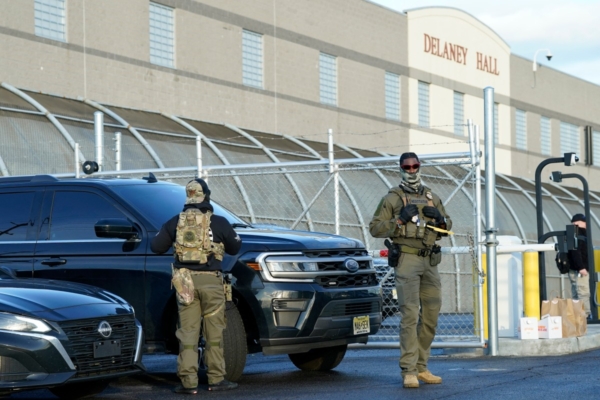
Mr. Chi described the day he was apprehended as unforgettable, with hundreds of federal law enforcement officers, sniffer dogs, and helicopters circling above. Eventually, he and four other South American immigrants were taken away by ICE.
Mr. Chi was detained in immigration facilities in both New Jersey and Pennsylvania, where conditions were tough, resembling scenes from the movie “The Shawshank Redemption.” He lost nearly 20 pounds in a little over six months due to the unfamiliar food inside. The most difficult part for him was the uncertainty after three failed bail attempts and courtroom losses – not knowing if he would be released or what the outcome would be.
In late June, immigration lawyer Jinrui Zhang took on his case and filed a petition for a writ of habeas corpus with the federal court, seeking relief on human rights grounds.
Zhang explained that in the current stringent immigration enforcement environment, having an asylum application pending does not guarantee that an individual will not be detained by ICE, especially if their visa has expired. Even while an asylum case is still being processed, there may be enforcement risks.
Due to Mr. Chi’s genuine persecution in his home country and the urgency of his situation, his son reached out to Congressman James P. McGovern, who wrote to the Department of Homeland Security and the State Department requesting the prompt release of Mr. Chi. Congressman Pat Ryan from Mr. Chi’s district also expressed concerns about his case to the Department of Homeland Security.
On August 3rd, a federal judge ruled that Mr. Chi should have a federal bail hearing, citing due process issues in the bail procedures conducted in immigration court.
Surprisingly, during the federal bail hearing on August 10th, government lawyers opposed the federal court holding the hearing for Mr. Chi and suggested he return to immigration court for the bail hearing. However, the federal judge persisted and questioned the government lawyers, asking why they were sending the case back after it had been deemed unconstitutional.
The judge also inquired if the government lawyers had seen his ruling from August 6th, to which they responded affirmatively. At that moment, the judge proposed releasing Mr. Chi directly, leading to the pivotal question, “Can I just release him?” Eventually, the government lawyers conceded that legally, the federal judge had the authority to release Mr. Chi.
The situation completely turned around. Zhang remarked, “This is a very rare victory.”
However, upon Mr. Chi’s release, the government imposed a series of strict conditions, including mandatory weekly check-ins with ICE, wearing an electronic ankle monitor, staying home between 9 p.m. and 7 a.m., and undergoing drug tests when requested by ICE.
Zhang challenged these conditions in court one by one. After intense negotiations, most of the stringent conditions imposed by the government were eventually lifted. Zhang stated that the final requirements mainly focused on legal compliance, timely appearances, and other basic conditions, without the severe restrictions initially proposed by the government.
The sudden order for immediate release caught everyone off guard, including the on-site law enforcement officers unsure of how to execute it promptly. Mr. Chi’s personal items were still in the immigration detention facilities at that moment, and staff needed guidance on how to handle them.
Apart from the federal judge’s findings of issues in the immigration court’s bail procedures, Mr. Chi’s family and Zhang discovered discrepancies in the documents filled out by ICE, including false information about his travel from Taiwan to the U.S., marital status, and employment timeline.
After his release, Mr. Chi expressed deep gratitude to the two federal congressmen for their attention and assistance in his case. He also thanked Zhang for her professional help in navigating a challenging situation, bringing the case to the federal court through a writ of habeas corpus and passionately advocating for his freedom during the hearing, ultimately securing his release.