
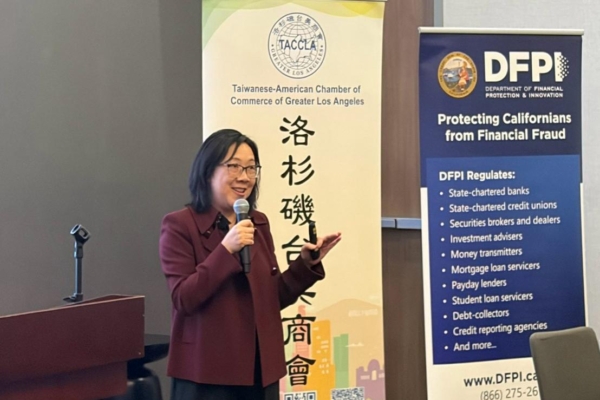
The Taiwan-US economic and trade interactions are frequent, with trade finance serving as a bridge between Taiwanese and American enterprises. Sukyee Lok, a representative from the California Department of Financial Protection and Innovation (DFPI), revealed during a “Financial Security and Fraud Prevention Seminar” hosted by the Los Angeles Taiwan Chamber of Commerce (TACCLA) on August 14th that there are currently 12 Taiwanese banks operating in California. As of the end of last year, the total assets of Taiwanese banks in California had reached around $20 billion, with total loan amounts nearing $17 billion, and the related data has shown consistent growth over the past 6 years.
Lok provided a detailed overview of the business layout and regulatory status of Taiwanese banks in California during the seminar. She explained that the operational models of Taiwanese banks in California mainly consist of two categories: “Overseas Branches” and “Local Commercial Bank Subsidiaries.”
Overseas Branches include 10 banks such as Taiwan Bank, Mega Bank, Chang Hwa Bank, Yuanta Bank, First Commercial Bank, Hua Nan Bank, Land Bank of Taiwan, Mega International Commercial Bank, Taiwan Business Bank, and Cooperative Bank of Taiwan, with most having branches in both Northern and Southern California. Their operations primarily focus on wholesale finance, including trade financing, cross-border trade, large syndicated loans, and providing credit to enterprises with Taiwanese backgrounds.
Local Commercial Banks include CTBC Bank USA, the local subsidiary of First Commercial Bank, as well as local businesses related to Hua Nan Bank/Woori Bank. As they are legally allowed to accept retail deposits, their service range is more comprehensive, covering consumer loans, general deposits, and wealth management services.
Lok emphasized the significant role that Taiwanese banks play in the California financial market, stating that “almost all Taiwanese banks are profitable” and have become crucial profit centers for their Taiwanese parent companies or headquarters, providing essential financial links for trade financing and corporate finance between Taiwan and the U.S.
Regarding the role of regulatory authorities, Lok stated that the DFPI is responsible for supervising all foreign bank branches and local commercial bank subsidiaries operating under Californian charters. Regular special inspections are conducted to rigorously assess the financial soundness of banks, the effectiveness of risk management mechanisms, and compliance with local banking regulations.
She stressed that the purpose of financial regulation is not to hinder the normal operation and business expansion of banks but to ensure the safety and soundness of bank operations through a robust regulatory framework, thereby effectively safeguarding the interests of all stakeholders, including consumers, shareholders, and employees. “No one wants to see auditors, but we are actually partners with the banks,” Lok joked, emphasizing that the core purpose of inspections is to promptly identify risks.
In an environment where online crime and financial fraud are increasingly rampant, information technology security has become a crucial aspect of modern bank regulation. Lok explained that in addition to establishing firewalls and regularly testing systems to fend off hacking attacks, banks must develop comprehensive “Business Continuity and Disaster Recovery Plans.” In the event of a cyber-attack or other significant incidents, banks must quickly restore business operations to prevent consumer data and funds from being compromised.
In conclusion, Lok noted that the number of Taiwanese banks under the supervision of DFPI is quite substantial, all within her scope of responsibility. She reminded banking industry participants that financial security is no longer just about traditional financial management; information security, risk management, and the ability to withstand risks in business recovery will be essential issues for modern financial institutions to maintain stable operations. ◇