
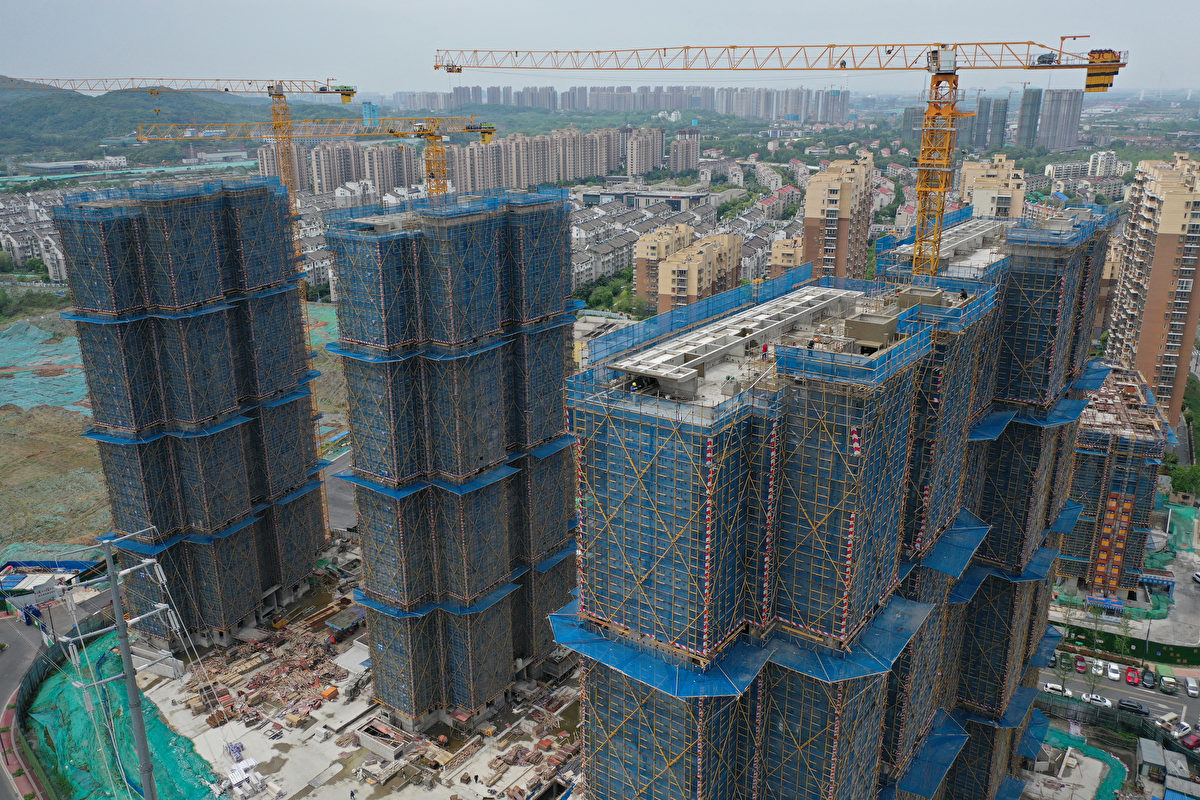
Continued Losses of Mainland Listed Real Estate Companies
The wave of losses in mainland listed real estate companies continues to spread. Among the 76 A-share real estate companies that have disclosed their performance forecasts for the first half of 2026, 55 are expected to incur losses, with a total anticipated loss ranging from 38.4 billion yuan to 50.2 billion yuan. The total market value of A-share and H-share listed real estate companies has shrunk by 66% compared to the peak in 2019. Analysts believe that the real estate crisis is still ongoing, as the market continues to bottom out.
According to a report by “First Financial” on July 21st, financial data service provider Wind data shows that as of that day, the 55 companies expected to incur losses accounted for over 70% of the total disclosed companies. Among them, about 70% of the companies facing losses have seen their losses expand compared to the same period last year, with only 14 companies narrowing their losses.
Vanke, with an expected net loss attributable to shareholders of the listed company ranging from 12 billion yuan to 15 billion yuan, faces the largest loss scale, surpassing the 11.947 billion yuan loss in the same period last year. Vanke attributed the performance decline to a decrease in project settlement scale, low gross profit margin, asset impairment provision, as well as losses from some operational and non-core financial investments.
Huaxia Happiness (stock abbreviation *ST Huaxin) expects to incur a loss of 5 to 7 billion yuan; China Overseas Land & Investment A forecasts a loss of 3.4 to 4.2 billion yuan; while China Fortune Land Development Group, previously profitable in the same period last year with 172 million yuan, is expected to transition to a loss of 3 to 4 billion yuan.
Jindi Group, Sunshine City Properties, and Xin Da Di Real Estate are all expected to incur losses exceeding 1 billion yuan; Rongsheng Development anticipates a loss of 950 million to 1.4 billion yuan.
Jinke Group expects a profit of 17 to 25 million yuan, but after deducting non-recurring gains and losses, it is still expected to incur a loss of 54 to 62 million yuan.
In comparison with the significant losses, the number and scale of profitable real estate companies are relatively small. Among the 76 real estate companies, only 21 are expected to be profitable, with a total profit of 3.6 to 4.2 billion yuan. Calculated based on the upper and lower limits of performance forecasts, the total losses of companies facing deficits are about 9 to 14 times the profits of profitable companies.
While some companies have managed to turn losses or significantly increase profits, their improved performance mainly relies on project settlements, asset reorganization, asset disposals, or contributions from new business. Zhongzhou Holdings expects a profit of 990 million yuan, a YoY increase of 422.44%, mainly due to project concentration, increased settlement income, and rising gross profit margin.
The situation of listed real estate companies being heavily burdened by losses has persisted for several years. From 2022 to 2025, the average net profit of listed real estate companies has remained negative, indicating continuous industry losses. In 2026, the real estate “loss wave” remains uncurbed.
Liu Shui, Director of Corporate Research at China Index Research Institute, stated to “First Financial” that the industry is still operating at the bottom, and the duration, extent, and reach of this profit contraction far exceed previous real estate cycles.
The prolonged downturn in the real estate sector continues to weigh on real estate stocks. Wind data shows that as of July 20th, the total market value of A-share listed real estate companies has decreased from 1.125 trillion yuan at the beginning of the year to 883.6 billion yuan, a decrease of over 20% within the year.
When including A-shares and H-shares, the total market value of listed real estate companies has plummeted from the peak of 4.7 trillion yuan in 2019 to around 1.6 trillion yuan, marking a cumulative decline of 66%.
Further, data from the National Bureau of Statistics of China shows that in the first half of this year, mainland real estate development investment decreased by 18%, new commercial housing sales area dropped by 11.6%, sales volume declined by 13.6%; funds for real estate companies decreased by 20.2%, and the new construction area of houses decreased by 23.4%.
Yan Yuejin, Deputy Director of the Shanghai E-House Real Estate Research Institute, analyzed to “First Financial” that the industry as a whole still lacks the conditions to turn losses into profits for the entire year 2026. The pessimistic comment from “Financial Bulletin” suggests collapses in investment, construction, profits, and market capitalization, hinting at a bleak outlook for the real estate industry.
Chinese economic expert Li Tingqian stated to Da Ji Yuan that the real estate crisis is still ongoing, and the entire market continues to decline.
Authorities have implemented a series of market rescue measures, creating public opinion in major cities such as Beijing, Shanghai, Shenzhen, and Hangzhou to revive the real estate market, especially the luxury housing market. However, Li believes that this has minimal impact on the overall market.
He noted that the top leadership of the Chinese Communist Party has issued calls to rescue the market through official channels like “Seeking Truth” magazine and even emphasized the financial attributes of real estate, essentially contradicting their policies of suppressing the market in recent years. Despite these efforts, buyers are still hesitant to enter the market.
Li Tingqian said that after limited effectiveness from other measures, authorities have introduced “urban renewal” to revitalize existing stocks and build so-called “good houses” to attract buyers, listing it as a direction for the “15th Five-Year Plan.” However, this “top-down design” still focuses on the supply side without addressing the issue of insufficient demand, leading to a misplacement of priorities.