
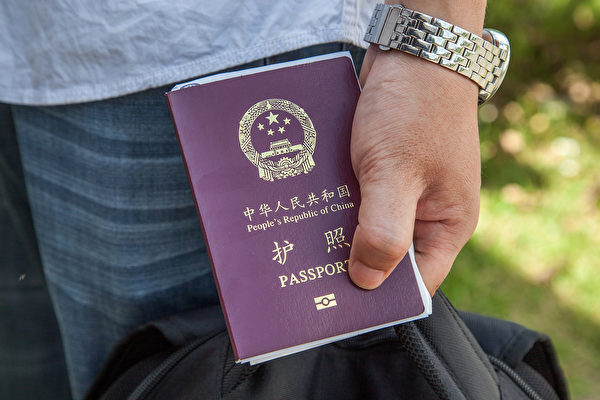
The new regulations on entry and exit management by the Chinese Communist Party are set to officially take effect on September 15. According to sources within the system, government agencies, financial institutions, state-owned enterprises, hospitals, and schools have recently expanded the scope of passport checks. Some units are requiring employees to report on themselves and their family members’ possession of Chinese passports, foreign passports, and overseas residency documents. Passport supervision used to mainly target positions involving secrets and certain levels of cadres, but now the scope has been further expanded. Authorities are concerned not only about the outflow of funds and technology but also about the leakage of information within the system.
The “Regulations on Entry and Exit Management” issued by the State Council of the Chinese Communist Party will come into effect from September 15. A source within the CCP system, Mr. Huang (alias), revealed to The Epoch Times that in the past two months, departments under the State Council and related enterprises have been internally compiling information on staff members holding passports. They are also requesting reports on whether spouses, parents, and children, among other family members, possess passports or overseas residency documents.
Huang mentioned that another recent investigation targets government agencies, financial institutions, state-owned enterprises, hospitals, and schools. Personnel are being asked to fill out information regarding themselves and their family members’ possession of foreign passports, the country to which the passport belongs, and the number of passports held. This investigation has not been publicly announced, and the forms and notifications are being circulated internally within the units.
He stated that in the past, the centralized storage of travel documents for private trips was mainly for specific personnel in sensitive positions or cadres of deputy department level and above. This time, the coverage of the investigation has expanded to regular employees and their family members.
According to Huang, this reporting not only involves Chinese passports but also foreign passports and overseas residency documents. Related units are keeping track of staff members and their family members’ travel document statuses via internal forms.
Another individual, Mr. Sun Haitao (alias), working in a large state-owned financial institution, confirmed that various systems including government agencies, state-owned banks, securities companies, large public hospitals, and universities have received internal notices requiring all employees to fill out a special survey form inquiring about “holding foreign passports, dual nationality, or foreign permanent residency (green card).”
Sun mentioned that in addition to indicating ownership of foreign passports, those holding foreign passports must also provide information such as the issuing country, issue date, passport number, and the exact number held. Even if someone has not acquired foreign citizenship but only holds foreign permanent residency, they must proactively declare it. He also disclosed that immigration consulting companies have been instructed to report client information to relevant departments, stating, “If it is discovered that civil servants or employees of institutions are applying for immigration without reporting it to the unit, they will face consequences.”
A government administrative staff member working in an oil field in Tianjin, Mr. Li, told The Epoch Times that authorities have expanded passport supervision to include public officials’ family members, primarily targeting the phenomenon of “naked officials” and the issue of internal information leakage. Li stated, “In the past year, there have been serious leaks of internal information involving corruption and the state of China’s economic operations. The authorities suspect that some of this information has been taken out by individuals who have immigrated overseas or are preparing to leave the country. Even after leaving China, these individuals still have access to information about the domestic situation through their previous connections, leading to concerns within the authorities about intelligence leaks.”
As per Li’s understanding, relevant departments are compiling files on these individuals, with the investigation including their previous work units, alma maters, as well as social relationships with classmates, colleagues, and others. “For example, where you used to work, where you graduated from, which classmates are working in which departments domestically, all of this needs to be registered.”