
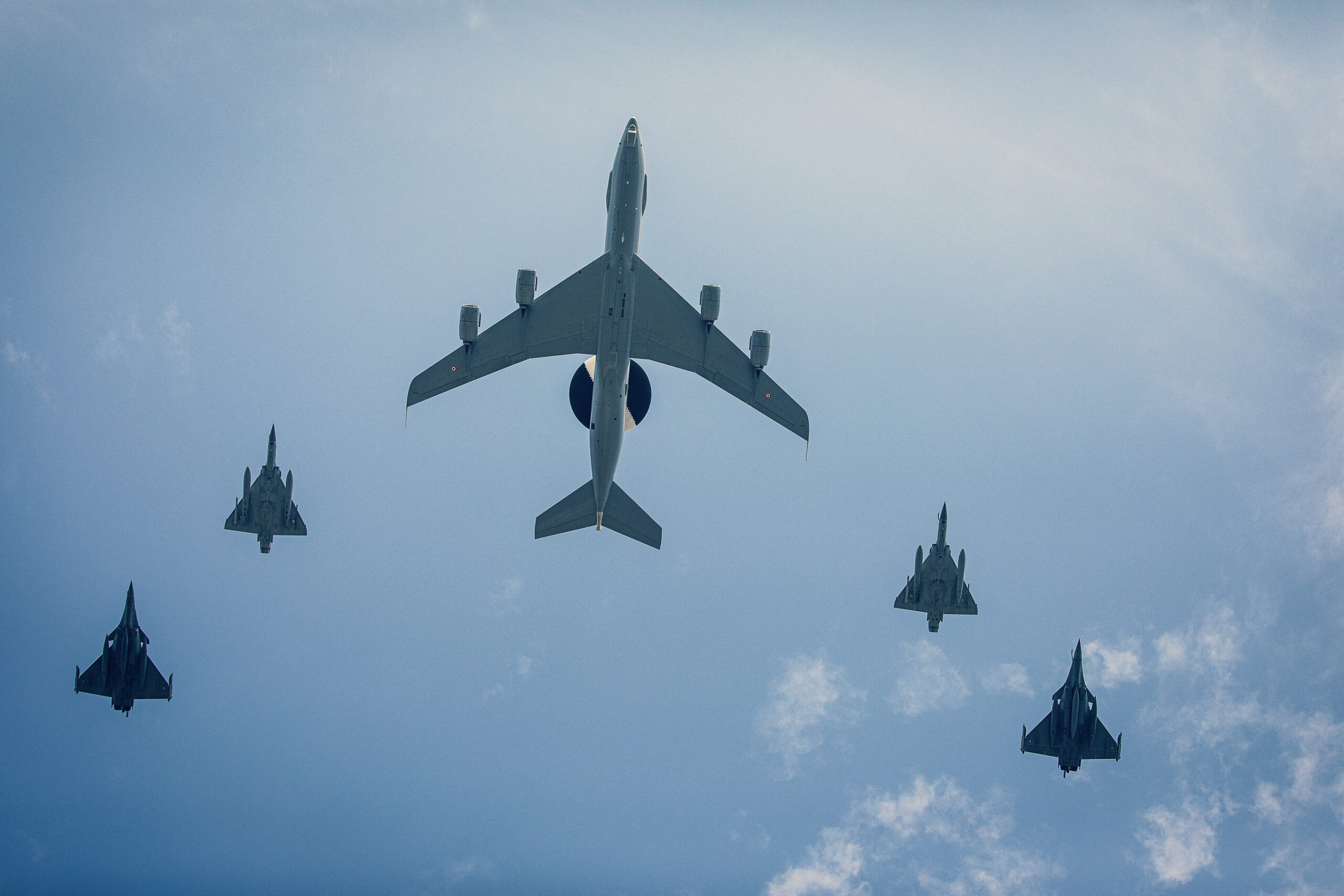
This week, four French Rafale fighter jets took off from a French Air Force base, embarking on a global cruise that spans 40 days and covers a distance of 25,000 miles (approximately 40,000 kilometers). Codenamed “Pegase 26”, this long-range military exercise, known as “Operation Pegasus 2026”, will traverse North America, Asia, and Europe/Middle East continents, aiming to counteract China’s strategic expansion worldwide.
The four Rafale fighter jets and their support formation officially took off on Tuesday (September 8) from the Istres Air Force base in southern France to commence the 40-day global cruising mission. Coordinated from headquarters near Lyon in eastern France, the exercise involves nearly 300 personnel and is fully supported by three A330 MRTT “Phoenix” refueling tanker aircraft and two A400M transport planes.
Accompanied by an Associated Press reporter, the French military aircraft documented their flight over the Arctic, Greenland, and Alaska while engaging in joint aerial exercises with the US F-22 Raptors.
During the initial phase of the exercise, the two single-seat and two two-seat Rafale fighter jets spent nearly 11 hours and underwent 5 aerial refuelings to fly directly from the Arctic and Greenland to Alaska. General Julien Sabènè, the commander of Operation Pegasus 2026, noted that this exercise marks the first time since its inception in 2018 that it has taken the Arctic route en route to the Indo-Pacific region.
Sabènè pointed out that with the melting glaciers, the Arctic route is gradually opening up, making it easier for potential adversaries like China to access the polar region. In recent years, China has labeled itself as a “near-Arctic state” and has actively promoted the “Polar Silk Road” in an attempt to control polar routes and resources.
By conducting training in Arctic conditions, the French military not only demonstrates the determination of Western allies to keep the Arctic open but also opens up a rapid strategic route to the Indo-Pacific for reinforcements.
The Indo-Pacific region is the strategic core of Operation Pegasus 2026. The French fighter jets will stay in the Indo-Pacific for nearly a month and participate in joint exercises with key strategic partners such as Japan, South Korea, Indonesia, and India.
Facing China’s hegemonic expansion in the South China Sea, Taiwan Strait, and South Pacific, the French military is building a defense network through air coordination with island nations and Indian Ocean partners.
Deputy Minister of Defense Alice Rufo emphasized, “We must be able to cooperate immediately when facing threats together.”
Defense analysts point out that through this long-haul voyage, the French military showcases its capability as a nuclear-power nation to protect overseas territories like New Caledonia and French Polynesia, ensuring that the free and open Indo-Pacific order remains intact.
In the final phase of the exercise, the aircraft will fly over the Persian Gulf region, pass through Qatar, and conclude the journey in Egypt. The Persian Gulf and the Suez Canal are critical chokepoints that connect Eurasian trade routes. In light of China’s increasing influence in the Middle East and Africa (such as the Djibouti base), the French military’s cruise in this region aims to uphold the freedom of key waterways and international law.
Rufo stressed, “Sovereignty can only be effectively exercised within a network of partnerships.”
According to the Associated Press reports, the Operation Pegasus 2026, spanning three continents, demonstrates France’s ability to swiftly transfer aerial combat capabilities between strategic regions like the Arctic, Indo-Pacific, and Middle East, along with allies, to defend the international order.