
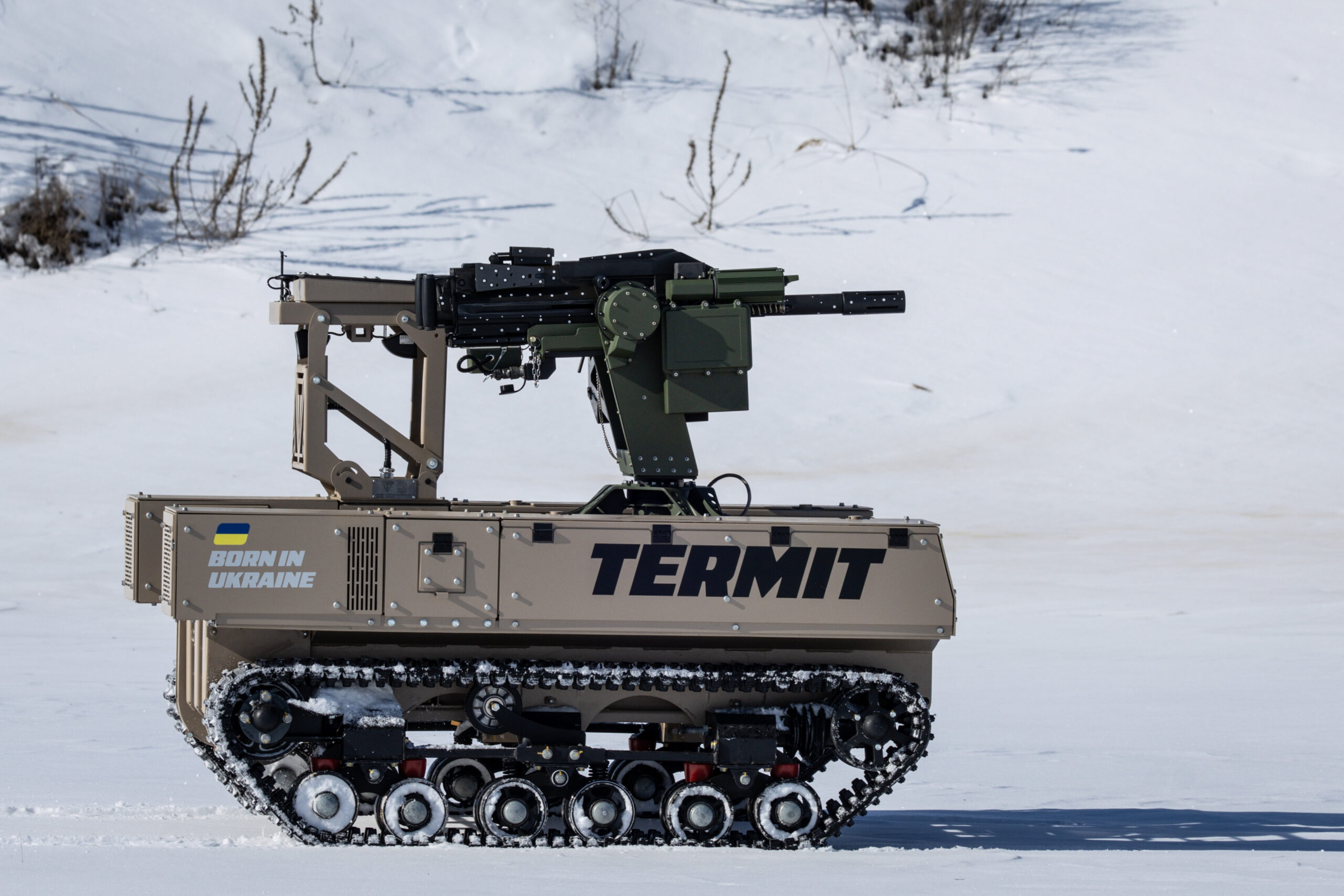
The ongoing conflict between Russia and Ukraine has entered its fifth year, with Ukraine facing a shortage of troops and the infantry assault by Russian forces. In response, Ukraine is accelerating the deployment of Ground Unmanned Vehicles (UGV) to the front lines, utilizing robots to replace soldiers in carrying out high-risk missions.
According to a report by Reuters on Friday, September 11th, this trend may be driving a new battlefield “revolution.” From unmanned aerial drones to ground robots, the Ukrainian battlefield is rapidly moving towards “unmanned” warfare.
Reuters interviewed the Third Army Corps, which is considered one of Ukraine’s elite forces, using ground unmanned vehicles on the Russian-Ukrainian battlefield. In a maintenance workshop near the front lines in northeastern Ukraine, mechanics of the Third Army Corps are preparing UGVs known as “Hyenas.” These vehicles can carry explosives to advance towards Russian positions, attack bunkers, or halt enemy advances. The mechanic mentioned that similar unmanned ground vehicles have even forced two Russian soldiers to surrender.
Major General Andrii Biletskyi, commander of the Third Army Corps, stated that gradually replacing infantry with UGVs represents the next “revolution” in warfare. The Corps plans to replace around one-third of frontline personnel with unmanned systems by the end of this year.
Biletskyi believes that with the increasing aerial threats on the battlefield, the tasks that infantry can carry out have significantly decreased to only 10% of what they were in the past. He pointed out that UGVs are part of the automation process of warfare, combining artificial intelligence for battlefield data analysis, allowing humans to focus more on tactical planning and decision-making.
The applications of ground robots are not limited to just attacks. The Ukrainian military has utilized them for transporting ammunition, food, and water, as well as evacuating wounded personnel.
Data released by the Ukrainian Ministry of Defense recently showed that as of early September this year, UGVs have carried out approximately 112,000 logistics and casualty evacuation missions, with over 25,000 missions completed in August alone.
Under pressure from a shortage of troops and reduced Western assistance, Ukraine is significantly increasing the use of robots, drones, and remote-controlled vehicles.
As early as April of this year, Ukrainian President Zelensky announced that for the first time, the Ukrainian military captured Russian positions without the involvement of infantry, relying on ground robots and drones.
However, UGVs are currently unable to fully replace soldiers. They face limitations when dealing with mud, obstacles, and complex terrains, and cannot clear buildings and trenches like infantry. Their production capacity is also far behind that of aerial drones.
For Ukraine, facing a shortage of troops, the greatest value of robots may not be to completely replace human combatants but rather to reduce casualties. A former infantry deputy commander of NC13 stated that if ground robots had been widely used at the beginning of the war, “many of my friends should still be alive.”