
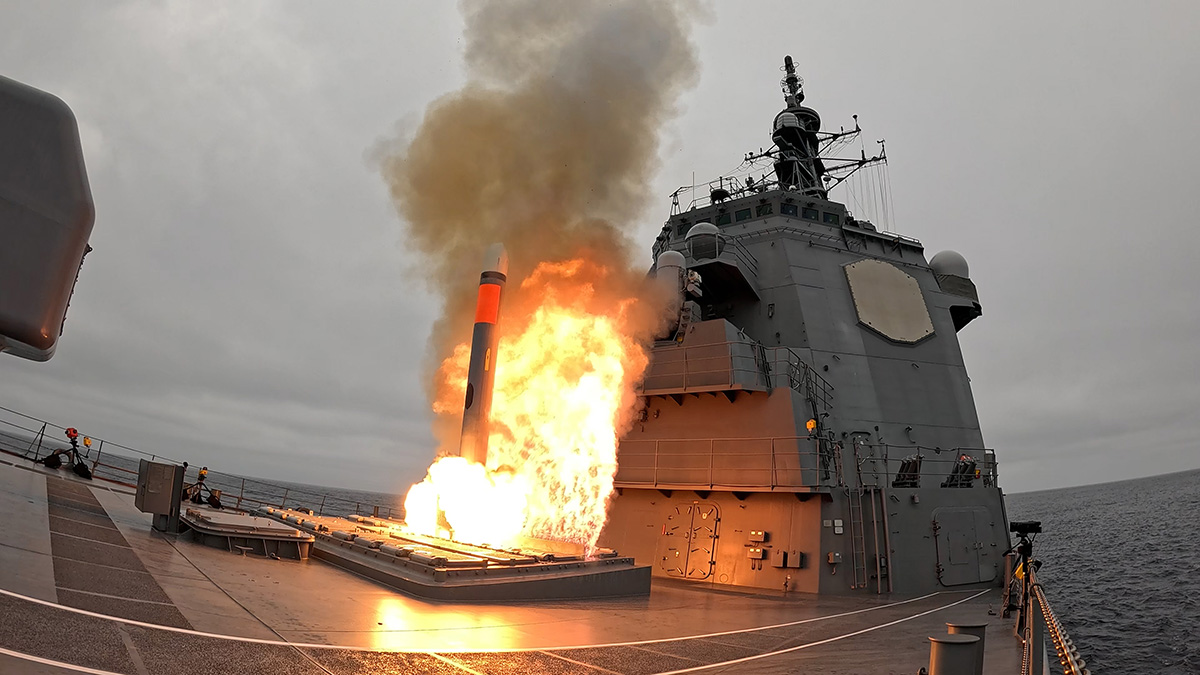
On Wednesday, July 29, the Japanese destroyer “JS Chokai” (DDG-176) conducted the first test launch of “Tomahawk” cruise missiles. This is a significant milestone in the process of enhancing operational capabilities through U.S.-Japan naval cooperation.
Japan’s Ministry of Defense announced on Thursday that the “JS Chokai” conducted live-fire testing of Tomahawk missiles in the Pacific Ocean with support from the U.S. Navy. This test verified the new capabilities of the destroyer and the proficiency of its crew.
The “JS Chokai” is Japan’s first “Arleigh Burke”-class destroyer with the capability to launch Tomahawk land-attack cruise missiles. These missiles, manufactured by Raytheon, a U.S. defense contractor, are long-range weapons specifically designed for land attack missions. According to the Naval Air Systems Command (NAVAIR), the missile is designed to fly at high subsonic speeds at extremely low altitudes, using multiple mission-tailored guidance systems to navigate along evasive routes.
This launch makes Japan the third country in the world to launch Tomahawk missiles from surface combatants, following Australia and the Netherlands. Including the United Kingdom, which launches Tomahawk missiles solely from submarines, Japan becomes the fourth country with this capability.
Officials from Japan’s Acquisition, Technology & Logistics Agency (ATLA) stated that the test confirmed the successful execution of the launch procedure by the vessel and its crew, including related operational protocols. They added that the test also verified the missile’s trajectory towards the intended target.
Due to coordination with the U.S. Navy and considerations for safeguarding Japan’s defense capabilities, ATLA declined to disclose specific operational details. Unreleased details include the exact test locations in the Pacific Ocean, types of targets, flight distances, guidance procedures, number of missiles launched, and whether Block IV or Block V Tomahawk missiles were used.
The “JS Chokai” departed Japan for San Diego in September last year for modifications to enable Tomahawk missile operations. The vessel completed the retrofit work in March. During its time in San Diego, the “JS Chokai” and its crew engaged in training related to Tomahawk missile operations with the U.S. Navy. The “JS Chokai” is scheduled to return to Japan in September this year.
On Tuesday, the Japanese Maritime Self-Defense Force (JMSDF) posted on social media, stating, “The ‘JS Chokai’ currently docked in San Diego is steadily progressing in Tomahawk missile operation training. The JMSDF is committed to enhancing readiness for real missions to further strengthen deterrence and response capabilities.”
The launch of Tomahawk missiles by the “JS Chokai” marks the conclusion of a month-long live-fire training exercise led by the U.S. during which the Japanese Maritime Self-Defense Force participated. Since June 27, the JMSDF has conducted multiple live-fire exercises overseas, including a SINKEX targeting retired vessels, as part of the Valiant Shield 2026 exercise in Guam and the RIMPAC 2026 exercise in Hawaii.
The introduction of Tomahawk cruise missiles is part of Japan’s “counterstrike” capability-building plan outlined in the 2022 National Defense Strategy. This strategy emphasizes the acquisition of long-range, off-shore strike weapons to enable Japan to engage invading forces from afar.
Japan intends to retrofit an additional seven Arleigh Burke-class destroyers and two destroyers equipped with the Aegis system to have the capability to launch Tomahawk missiles.
According to a contract signed in January 2024, Japan will purchase a total of 400 Tomahawk missiles. Defense Minister Shinjiro Koizumi announced in March this year that Japan has already received some Tomahawk missiles from the United States.
Records from the Japanese Ministry of Defense show that Koizumi stated, “Our plan to introduce Tomahawk missiles from fiscal year 2025 to 2027 remains unchanged. We will continue to work closely with the United States to ensure smooth procurement.”