
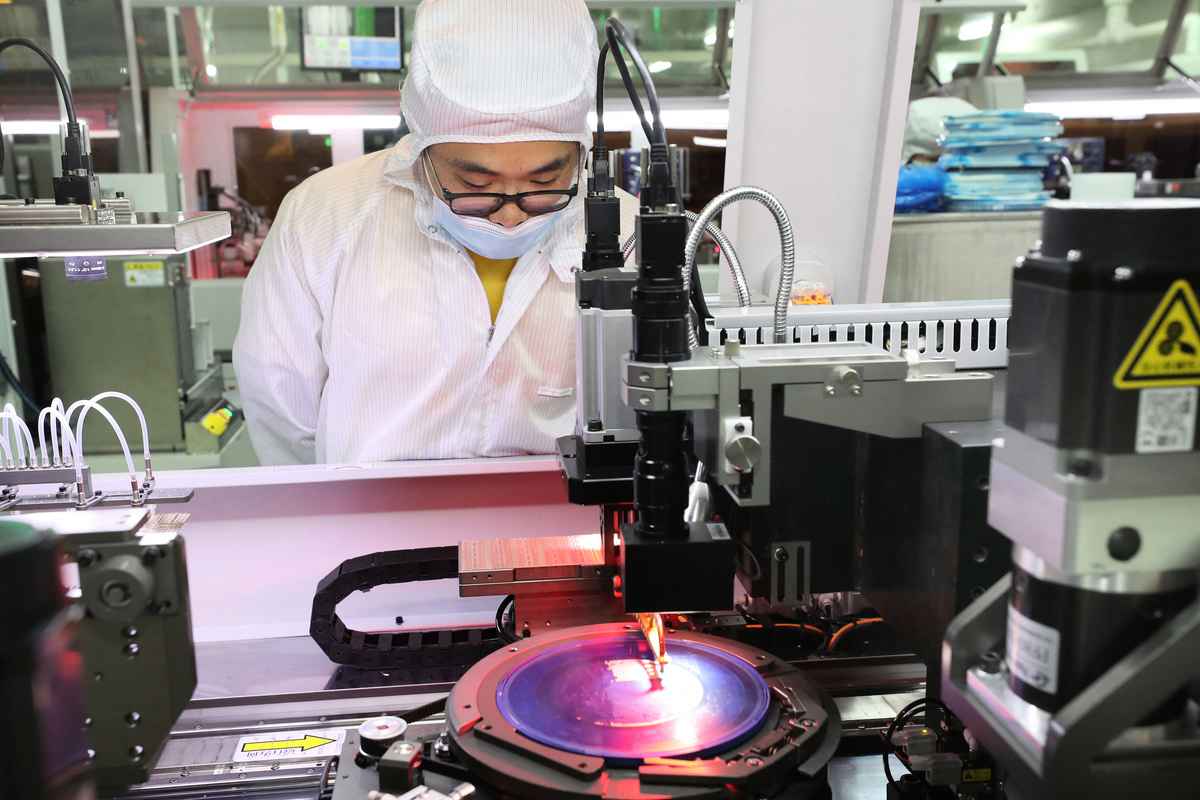
According to reports, a state-owned semiconductor equipment company in Shanghai has started mass production of immersion deep ultraviolet lithography machines (DUV), which are essential for producing various types of chips. However, analysts point out that China’s technology faces bottlenecks, and extreme ultraviolet lithography machines (EUV) still remain the most challenging threshold to overcome.
Reuters reported on July 28th that sources revealed Shanghai Aishengna Electronic Technology Group, a state-owned enterprise, has begun mass production of domestically developed DUV. The company has integrated teams from multiple Chinese equipment companies, becoming a key driver of this domestication project.
Business data shows that Aishengna was established in August 2023 with a registered capital of 7 billion yuan, with shareholders including Shanghai Electric Holding Group and a subsidiary of Shanghai International Trust, both state-owned enterprises.
Sources indicate that Aishengna has integrated teams from startup Yulangsheng and Shanghai Micro-Electronic Equipment (SMEE). Yulangsheng is a semiconductor equipment company supported by Huawei, which began testing DUV prototypes last year and is recognized by the Chinese government as one of the key enterprises in the semiconductor independent research and development strategy. Recruitment information also shows that Aishengna and Yulangsheng share the same address in Shanghai.
In addition to the aforementioned companies, research teams from Huawei and Tsinghua University are also involved in the development of this technology.
Specializing in the technology industry, The Information revealed more information that Aishengna aims to produce about 5 machines this year, with plans to increase to around 20 machines in 2027. The related equipment is expected to be delivered this year to SMIC, Huahong Semiconductor, and memory manufacturer Changxin Technology.
Due to export control measures by the US government restricting Chinese companies’ access to EUV (extreme ultraviolet lithography machines), DUV (deep ultraviolet lithography machines) have become the most advanced lithography equipment that Chinese chip manufacturers can currently obtain.
It is currently unclear whether Chinese companies using domestically developed DUV can achieve or surpass the chip yield of the equipment from Dutch lithography giant ASML.
Nick Patience, AI research director at Futurum Group, told CNBC that ASML has continuously improved its equipment through decades of practical experience. Chinese companies still need to undergo extensive on-site testing and technological iteration over a long period, not just meeting the standard of “being operational,” but must at least catch up in terms of yield with existing equipment.
He believes that reliability is another test. Wafer fabs typically operate continuously throughout the year, so lithography machines must maintain precise overlay errors, capacity, and stability through thousands of wafer exposure processes.
He also pointed out that even with imported DUV equipment, the production performance of SMIC still lags behind TSMC. Furthermore, Aishengna, a state-owned enterprise lacking a market track record, already faces a significant gap from the starting point.
There are rumors that China is also actively developing domestically produced EUV, but it is still in the prototype stage. For processes below 7 nanometers (nm), EUV technology is indispensable.
Dutch semiconductor expert Marc Hijink recently wrote in the “New Rotterdam News” that the most challenging threshold for the Chinese semiconductor industry to overcome at present is advanced lithography machine EUV, a technology that still has no alternative solutions.
Hijink believes that Dutch lithography giant ASML took about 15 years, during which Japanese competitor Nikon and others withdrew due to the high technical difficulty. Nikon invested over 100 billion yen in EUV technology in the past but ultimately failed.
EUV expert Ahn Jin-ho from Hanyang University told The Korea Herald that for China, it may be possible to demonstrate a domestically developed EUV system once, but it is unlikely to develop a system that can be mass-produced within the next ten years.
“For industry giants like Nikon and Canon that have long dominated exposure technology, they have not succeeded in conquering extreme ultraviolet exposure technology. This technology cannot be mastered by brute force,” he said.