
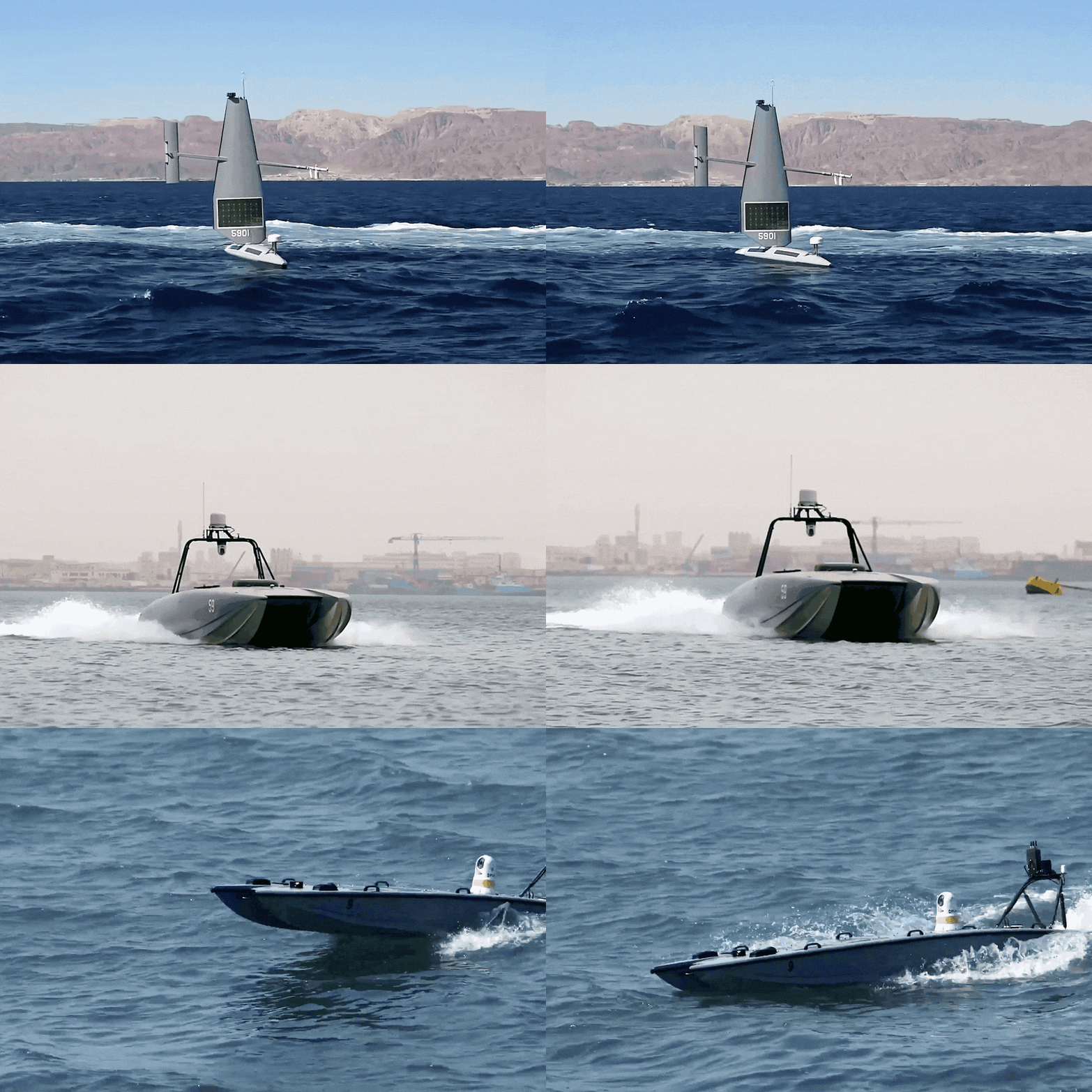
Recently, a private unmanned surface vessel manufacturer in the United States announced that its produced unmanned vessel successfully approached a People’s Liberation Army Navy ship operating within the exclusive economic zone (EEZ) of the Philippines and recorded close-up footage.
According to a report by Reuters on Wednesday (July 29), California-based unmanned surface vessel manufacturer Seasats released a video showing its unmanned surface vessel named “Lightfish” approaching a Chinese PLA Navy Type 052D missile destroyer at a close range, approximately 105 kilometers northwest of Luzon Island in the Philippines on June 16, and successfully capturing footage.
Seasats CEO Mike Flanigan stated that the unmanned vessel successfully approached the Chinese naval ship, not only capturing footage but also collecting data on the ship.
The report highlighted that the video drew attention for revealing a shift in the nature of warfare: the small unmanned vessel “Lightfish,” which costs around $240,000, being able to approach and potentially pose a threat to a billion-dollar warship, highlighting the potential of low-cost unmanned vehicles in modern maritime surveillance operations.
Seasats mentioned that the unmanned vessel is the smallest in their product line, capable of being operated by 1 to 2 persons, and can be launched and retrieved within minutes. It is compact in size, has shallow draft, can perform missions at sea continuously for up to six months, and can be equipped with optical and infrared cameras, active and passive sonar, as well as electronic intelligence (SIGINT) and electronic warfare (EW) equipment.
Tensions in the South China Sea have been escalating in recent times. Last week, the Philippines and the Chinese coast guard had multiple standoffs in the vicinity of Ren’ai Reef and the Scarborough Shoal. Subsequently, the U.S. Navy deployed the “USS Washington” aircraft carrier strike group in the Indo-Pacific region to carry out navigation missions in the South China Sea, showcasing the rapid deployment and maritime projection capabilities of the U.S. military in the Indo-Pacific region.
Seasats Company announced in May of this year that the “Lightfish” unmanned vessel completed its first autonomous crossing of the Taiwan Strait. The vessel deployed from a remote location, relied entirely on autonomous navigation systems for the entire journey, with operators monitoring and managing remotely.
Meanwhile, the company is actively collaborating with allies in Taiwan and the Indo-Pacific region to promote the deployment of persistent maritime surveillance systems in critical maritime areas. The company is also producing a larger unmanned vessel called “Quickfish,” which is currently in the mass production phase.
Furthermore, Seasats has been cooperating with the U.S. government and recently secured government contracts worth over $100 million.
Unmanned surface vessels are ships that do not carry crew and are capable of navigating on the sea’s surface through remote control or autonomous navigation systems. They are typically equipped with sensors, cameras, and communication systems, allowing them to perform patrols, surveillance, intelligence gathering, and even carry out attack missions.