
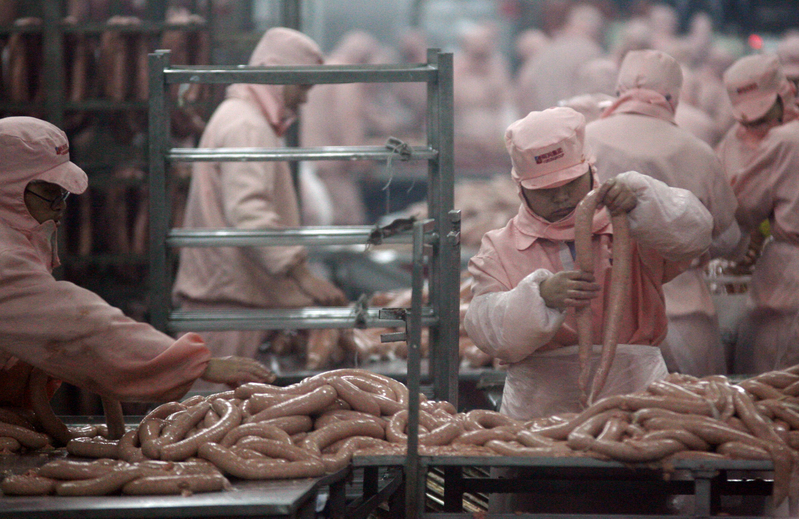
The Xinjiang Agricultural University has been exposed for organizing students to work in the farms and tomato processing plants under the Xinjiang Production and Construction Corps in the name of “supporting agricultural labor practice courses”. According to posts circulating online, the agreements require workers to take responsibility for any safety accidents, prohibit them from claiming compensation from the companies, and the companies do not pay social insurance for the workers. The school enforces student compliance through courses and discipline requirements, while the companies use agreements to absolve themselves of responsibility. Netizens say that this forced labor is similar to Xinjiang re-education camps.
On July 25th, a user on Zhihu claiming to be a graduate of Xinjiang Agricultural University revealed that the university has long implemented the so-called “supporting agricultural labor practice courses”. Students usually have about 20 days off after starting their sophomore year and are sent by the university to the farms, fields, or food processing plants to pick cotton, peppers, grapes, tomatoes, and work on tomato sauce production lines.
The content of the “Safety Management Agreement” provided by a member of the public shows that Party A is the Xinjiang Zhongji Red Tomato Industry Co., Ltd. Tianhu Branch, with a working period from July 28, 2024, to October 30, including tasks such as packaging, unloading materials, and boiler assistance. Packaging, unloading, and boiler assistance are all part of the factory production process, involving mechanical handling, high-temperature environments, and labor safety risks, not just ordinary visits or short-term educational activities.
Article 5 stipulates that Party B must disclose their physical condition when employed, and if any information is withheld, the company can terminate the agreement without economic compensation. Article 7 defines the relationship between the two parties as a “temporary labor service relationship, not a labor contract relationship” and states that the company “does not bear any obligation to pay social insurance”.
Sociologist Chen Muqi of Xinjiang University, in an interview with reporters, stated that such safety agreements clearly violate relevant regulations: “The school controls students’ courses, credits, discipline, and graduation qualifications. Students find it challenging to resist the arrangements made by the school. I believe parents are also unhappy to see this discriminatory agreement, which is why it was shared online. I think sending students to work in factories under the guise of ‘practice courses’ diminishes the employment relationship. The wages are determined by the factory, with students bearing the responsibility for work-related accidents, turning educational management rights into a tool for cheap labor supply to companies.”
Article 4 of the agreement states that if a safety accident occurs during work, “Party B bears all responsibility” and is prohibited from claiming compensation from Party A in any form. Article 3 stipulates that if Party B violates the company’s rules and regulations, labor safety regulations, or does not follow management orders, Party A has the right to terminate the agreement without economic compensation.
Chen Muqi said, “This agreement requires workers to accept the company’s management but shifts all accident, medical, and compensation responsibilities onto the individual. While the company controls job assignments and termination rights, workers are required to waive their right to claim compensation in advance. These contract terms are clearly established on unequal footing, essentially exploiting students. I don’t know how much benefit the school gains from this.”
The agreement does not mention the name of Xinjiang Agricultural University or reveal the identity of Party B. However, the tomato company, production positions, and seasonal employment periods mentioned align with the graduate’s disclosure of the tomato processing factory labor scene. The related materials bring into question the safety responsibilities, pay distribution, and the relationship between the school and the company behind the so-called “labor practice”.
Public information on Xinjiang Agricultural University’s official website shows that in the past 25 years, the university has organized over 80,000 instructors and students to participate in farming and study activities, claiming to have created nearly 4.2 billion yuan in direct economic benefits, sparking concerns about the relationship between student labor education and commercial interests.
In recent years, the Chinese Communist Party has increasingly incorporated labor education into school curricula, requiring students to obey unified arrangements under the guise of collectivism, hard work education, and social practice. Once these systems are combined with seasonal labor demands from companies, students could become easily deployable, low-cost labor that is difficult to hold accountable. Schools control students under the pretext of education, while companies escape responsibility through agreements, making young people’s labor, health, and safety the cost of lowering expenses for both parties.
A Urumqi resident, Xiao Liang, stated that forcing students to participate in production labor through coercion based on curricula, discipline, and graduation qualifications appears similar to “Xinjiang re-education camps” to him. In Xinjiang, schools, companies, and local administrative agencies under the CCP system all have authority over students. Schools especially emphasize obedience to school management, with disobedient students warned and potentially expelled for repeated mistakes. “Many companies want to tie themselves to schools to exploit cheap labor for profit. In Xinjiang, if you expose unfair treatment online or say you’ve been mistreated, it’s not just a matter of being blocked; the police may summon you.”
As of now, there is no public explanation on whether Xinjiang Agricultural University arranges for students to work in the aforementioned company-owned factories, whether there are financial transactions between the school and companies, or how student labor compensation is settled.