
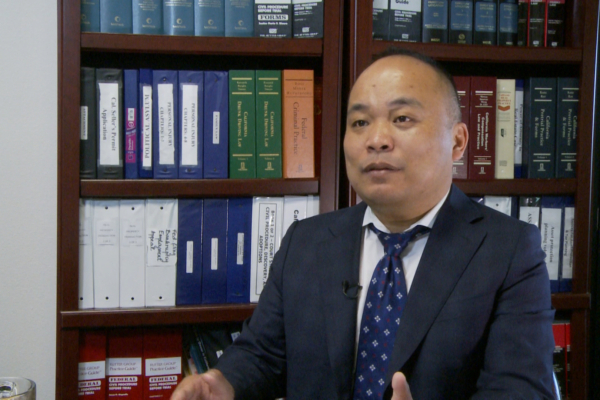
Domestic violence accusations in the United States are considered serious criminal charges, with inestimable losses once the accused individual is prosecuted. Southern California Chinese lawyer Liu Longzhu has warned that “false domestic violence” cases have recently become increasingly common, serving as a “legal weapon” for some individuals with ulterior motives to gain personal advantages.
Many clients have been visiting Liu Longzhu’s office recently, tearful and desperate, recounting their experiences of falling into the trap of false domestic violence. Some have lost their properties, some have lost custody of their children, some are left with permanent arrest and fingerprint records, and some have lost their jobs and green cards as a result.
Liu Longzhu stated that many people in domestic violence cases mistakenly believe that as long as they were “set up” or “provoked,” they are innocent. However, this often marks the beginning of a “no turning back” situation for many individuals.
To avoid becoming victims of domestic violence accusations, Liu Longzhu believes that it is essential for the Chinese community to distinguish between “real domestic violence” and “false domestic violence.”
“What is ‘real domestic violence’? Many Chinese people believe that physical violence towards the other party constitutes domestic violence. In reality, domestic violence extends beyond physical actions. For example, if the other party continuously insults you, uses the most hurtful words to provoke you, and even taunts you saying, ‘Hit me! If you dare, touch me!'” The ultimate goal is to incite you to react. Any form of physical interaction, even if it’s just a push, tug on the other party’s clothes, or dropping a cup from your hand, can be considered “real domestic violence” under California law.
“What is ‘false domestic violence’? If you haven’t laid a finger on the other party from the beginning to the end, and the other party, seeing that you won’t respond, proceeds to break things in the house, or even harshly scratches their own arms or face, and then calls 911 crying out for help.”
When the police arrive at the scene and see the mess and the other party’s injuries, they will immediately take you away in handcuffs. The other party can use this incident to apply for a temporary restraining order, forcing you out of the house, gaining an advantage in divorce property division, child custody battles, and even obtaining an advantage through VAWA or U visas.
Liu Longzhu expressed that what makes false domestic violence victims feel hopeless is that the vast majority of people do not have the awareness to keep video or audio recordings as evidence. In court, facing the police reports and the injuries of the other party, their words are often futile.
In the face of potential setups, Liu Longzhu advises Chinese friends to control their emotions at all times in their work and daily lives, avoiding any form of physical contact during conflicts.
He suggests that in California, during arguments between spouses or cohabiting partners, it is best to leave the scene immediately and never confront the other party when emotions are running high. Because once physical conflict occurs, regardless of who struck first, the outcome often leads to a “double loss” and may result in irreversible legal consequences.
During Conflict: Remain as Cold as Ice, Leave Ironclad Evidence
• Maintain absolute calmness. Remember, never lay a hand on anyone, never push or break anything. In California, even pulling the other party’s clothes can be considered assault.
• Start legal audio/video recording. Although California is a “two-party consent recording state,” there are exceptions when it comes to violent threats or preserving criminal evidence; a safer option is to openly record video on your phone, or install visible surveillance cameras in common areas at home such as the living room or hallway.
When Police Arrive: Exercise Your Rights, Speak Sparingly
• Invoke your right to remain silent. Many Chinese people believe that explaining the “development of the relationship” to the police will lead to understanding. This is a deadly misconception. Police in California are not there for marriage counseling; they are seeking the “primary wrongdoer.” The more you say, the easier it is for the police to misinterpret your words in their reports.
• Request evidence documentation. If the other party leaves scratches or bites on you while self-harming or attacking you, clearly ask the police to photograph and record the evidence.
• Stick to facts and demands. Clearly tell the police, “The other party is lying, I did not lay a hand on them, I request to contact my lawyer.”
After Being Taken Away or Receiving Court Subpoenas: Prioritize Legal Compliance, Pivot on Both Fronts
• Do not violate the restraining order. Even if every word in the temporary restraining order is false, you absolutely cannot contact the other party through phone, WeChat, email, or any third party until the order is officially lifted. In California, violation of a temporary restraining order is a serious criminal offense.
• Immediately hire a team of lawyers specializing in “criminal law + family law.” False domestic violence cases are typical complex cases intertwining “criminal charges” and “family law disputes.” You need experienced criminal defense lawyers to handle the criminal charges from the prosecution, while requiring lawyers proficient in family law to address hearings for the restraining order, divorce and property disputes; only by tightly coordinating both can you break the deadlock.
Collecting Counter-Evidence: Exhaust All Means to Turn the Tables
• Retrieve electronic data. Save all WeChat messages, texts, emails, especially threatening language used by the other party such as “If you don’t give me money, I will call the police to arrest you” or “I will make sure you go to jail and never get a green card.” These can be fatal weapons to refute false accusations.
• Retrieve third-party monitoring and witnesses. Doorbell surveillance from neighbors, public cameras in the community, sworn testimonies from roommates or visiting friends can all become crucial points in breaking false domestic violence cases.