
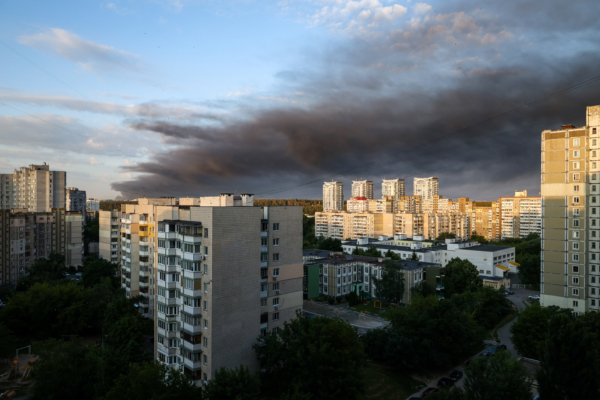
On a day in early June 2026, a Russian missile hit a church in the capital city of Kyiv, Ukraine. In the news footage, the roof collapsed, walls charred, and thick smoke still rose among the ruins.
When the news reached New York, a Taiwanese-American surgeon in his seventies immediately picked up the phone and dialed a number across the ocean. On the other end was a pastor he knew. Hearing that their friends were safe, the doctor visibly breathed a sigh of relief.
Just a few months ago, this doctor stood in that church singing hymns and praying with the local Christians. At that time, he had traveled deep into the Ukrainian war zone, standing with the Ukrainian people.
This doctor is Dr. Tsai Rongcong, the president of the North American Taiwanese Medical Association (NATMA) who has lived in New York for over fifty years. Since the outbreak of the Russia-Ukraine war four years ago, he and the association’s doctors have upheld the spirit of “Taiwan Can Help,” undertaking medical missions in Ukraine twice, providing professional medical services such as heart surgery, laparoscopic surgery, and dental treatment in the challenging war environment, showcasing Taiwan’s medical prowess and international care.
“Today it’s Ukraine, tomorrow it could be Taiwan,” Dr. Tsai said. Since the Russia-Ukraine war broke out on February 24, 2022, this thought has always lingered in his mind.
“Should we really go to Ukraine?” In 2023, when Dr. Tsai first had the idea of supporting Ukraine, he kept asking himself this question. He was neither a diplomat, nor a soldier, nor a member of an international rescue organization; he was just a retired surgeon.
But fundamentally, Dr. Tsai is a patriot, someone who loves Taiwan deeply. He agreed with the view of the late Senator Lindsey Graham of South Carolina that Ukraine and Taiwan are part of a global democratic front against authoritarian expansion – defending Ukraine is key to deterring a Chinese invasion of Taiwan. If Russian President Putin wins in Ukraine or the U.S. withdraws, Taiwan will be the next victim.
“Supporting Ukraine means supporting Taiwan!” A clear answer began to form in Dr. Tsai’s mind. “The people of Taiwan need to stand alongside the people of Ukraine to win this war. Such unity will help reduce the risk of war in the Taiwan Strait.”
However, Ukraine is a battlefield, and foreigners there are trying to leave by all means. Yet, they were heading inside. Even the Taiwanese government does not encourage people to go to Ukraine. Dr. Tsai sought help from Taiwan’s representative to the U.S. at the time, Xiao Meiqin, who advised him not to go.
But Dr. Tsai has always held a belief: “Ask not what your country can do for you, ask what you can do for your country.” In the end, he found 15 like-minded friends, including 13 doctors and volunteers, as well as two television reporters, all of whom participated at their own expense without exception.
On August 23, 2023, the first humanitarian medical aid team led by Dr. Tsai Rongcong from the U.S. and Taiwan, was about to depart for Ukraine. The North American team was led by thoracic surgeon Xu Wenrui, while the Taiwan team was led by ENT doctor Wu Huifang. The night before departure, a U.S. doctor finally had to give up due to family concerns about the dangers of war.
The aid team first arrived in Warsaw, Poland by plane and then were driven by trucks to the western Ukrainian city of Rivne.
Over the next month, except on Sundays, Dr. Tsai and his colleagues worked at the local municipal hospital every day. Hospital operating rooms and intensive care units were relocated to the basement to avoid war damage, and residents were not allowed to go out during curfew or at night. The hospital had about 850 beds, with many soldiers injured by landmines and bomb explosions.
“The patients’ conditions were heart-wrenching,” Dr. Tsai recalled. “I recommended a below-knee amputation for a complex ankle joint case caused by severe contamination to speed up recovery.”
Dr. Tsai saw blue and yellow flags hanging on the walls with the signatures of wounded comrades, the source of strength for the soldiers who longed to recover and return to the battlefield.
The second visit was in August 2025, this time with 12 people. Before departure, they purchased war risk insurance and registered their trip with the U.S. State Department. The night before embarkation, Dr. Tsai sent all team members an email reminding them to “hold your loved ones tightly and tell them you love them.”
This time, they also arrived in Warsaw first, but then they took a train for over a dozen hours to Kyiv. When the train passed through icy plains and dark forests, Dr. Tsai thought this journey would also be smooth and safe.
However, they encountered trouble at customs. A member of the medical rescue team was detained by Ukrainian border officials due to missing visa documentation. They spent the whole night making phone calls to reach out for assistance, even their phones were overheating. At dawn, the situation was finally resolved. Not only did they clear the customs successfully but they also made the local media aware of the presence of Taiwanese people coming to support, turning the rescue team into newsworthy figures.
During the 10-day period of field assistance, they treated many frontline soldiers. Their surgical, medical, and dental teams served over five hundred civilians in urgent need of medical assistance, while also donating a large number of medical equipment, surgical supplies, and medical materials.
Due to long-term lack of dental care, many Ukrainian soldiers could not eat properly, affecting their nutrition intake and combat capabilities. After meticulous and careful treatment by the dental team, they regained their chewing function and reacquired the strength and confidence to return to the front lines.
“What truly amazed me was not the war itself, but the attitude of the Ukrainian people facing the war,” Dr. Tsai said in an interview with this newspaper in June of this year.
When Russia launched a full-scale invasion of Ukraine in 2022, almost all global media were discussing one question: how long could Kyiv hold out? Some said seventy-two hours; some said less than a week. People were saying, President Zelensky fled.
Yet, on the second day of the war, a video less than forty seconds long circulated online. In the streets of Kyiv at night, Ukrainian President Zelensky held a phone, with the Prime Minister, Parliament Speaker, and Office of the President standing by his side. Facing the camera, he said, “Good evening, we’re all here, we’re defending independence together.” He also told the U.S., which offered him a plane for evacuation, “I need ammunition, not a ride.”
Four years have passed in a blink, and Zelensky has kept his promise, while the war continues. The brave Ukrainian people have nurtured such a strong president; this ordinary yet extraordinary president, who rose from a background in comedy, truly represents the resilient Ukrainian nation.
Dr. Tsai recalled a moment from his second visit to Kyiv. At five in the morning one day, Russian missiles struck, and the whole street across from their hotel was blown away. When daylight broke, he saw the road filled with cars.
He ran out and asked the Ukrainians, “Are you evacuating?” People replied, “No, we’re going to work.”
“The sky over Kyiv never seemed to truly sleep; when the air raid alarm sounded, people couldn’t be bothered to go to the underground shelters,” Dr. Tsai said. He saw the city being bombed, residential areas and cultural heritage sites damaged, and the Kyiv Pechersk Lavra Monastery, recognized by UNESCO as a World Heritage Site, also hit by shelling.
Despite this, people went to work as usual, children went to school, churches held gatherings, markets operated normally. They were striving to maintain social order, showing the strong vitality and resilience of the Ukrainian people.
Dr. Tsai also mentioned Taiwanese volunteer Chen Shengguang, who sacrificed himself for Ukraine. His photo and the national flag were displayed prominently in Kiev’s Maidan Square, marking a historical moment of solidarity between the people of Taiwan and Ukraine in defense of freedom and democracy.
Dr. Tsai also witnessed a statement by Zelensky: “Every Ukrainian has become a defender.” He summarized nearly one hundred public speeches by Zelensky to the nation, international leaders, and the world during the first year of his presidency since 2019 until the start of the war.
Zelensky said, “We firmly believe: life without freedom is like walking dead”; “In 1991, the Soviet Union disintegrated, the Cold War ended, and Ukraine became an independent country. Now what they are defending is no longer language, race, faith, ancestors, but values of life and lifestyle, willing to sacrifice their own precious lives for the freedom and democracy of future generations”; “The world has become smaller, please do not think war is far away from you”; “Ukraine is fighting for the free world”…
“The resilience of Ukraine has astonished the world,” Dr. Tsai said. “The president did not flee, the government did not fall, the army stood strong against the Russian attacks. In this clash of values, President Zelensky’s morale-boosting speeches played a vital role.”
Dr. Tsai stated that Taiwan and Ukraine have many similarities. Just as Xi Jinping and the Communist Party claim Taiwan for “reunification” based on a so-called “shared heritage and kinship,” Putin also propagates that Russia, Ukraine, and Belarus are “brothers,” thereby denying Ukraine’s sovereignty.
“Xi Jinping asserts that Taiwan is an inherent part of China since ancient times, does not acknowledge Taiwan’s sovereignty as belonging to the Taiwanese people, let alone renounce the use of force to unify Taiwan; these claims are absurd lies,” Dr. Tsai said. The claim that “Asians cannot accept democracy and socialism is more effective” is also erroneous because Taiwan, a small nation, excels in economy, politics, society, culture, and healthcare that is admired worldwide, making Taiwan’s democratic model a beacon for the free world.
The two trips to Ukraine made Dr. Tsai realize that Ukraine has held on until now, even seeing the dawn of victory, not just because they received international aid or weapons from the U.S. and Europe, but because this nation decided from the beginning of the war: “Not to give up their country.”
“Taiwan should keep a clear head and learn from Ukraine’s experience,” Dr. Tsai said, citing numerous long-term conflicts in history to propose the view that “war does not end, only abandoned.” He believes that many wars have not truly achieved peaceful resolutions but rather gradually faded from international focus as all parties grew tired. “Facing the changing international situation, Taiwan must strengthen its defense capabilities and democratic resilience, while continuing to emphasize the importance of humanitarian values and international cooperation.”
Dr. Tsai used the metaphor of a “boar” to describe his expectations for Taiwan.
“A boar in the deep forest, untouched by anyone. We must become such a boar in technology, weapons, as well as psychologically and politically,” he said. “Sun Tzu’s Art of War says: ‘Do not rely on the enemy not coming, depend on us being prepared for the enemy.’ Preparedness prevents war, coupled with the formidable strait, it will make Xi Jinping realize the difficulties and retreat.”