
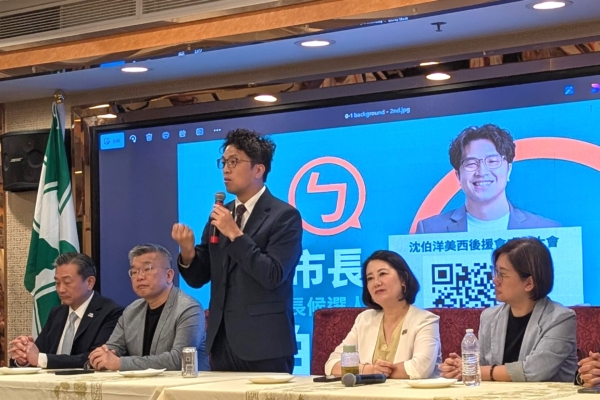
In order to deepen Taiwan-US relations and respond to regional security challenges, Democratic Progressive Party (DPP) legislator Shen Boyang recently visited the United States and established campaign supporters in the west and east coast for his mayoral campaign in Taipei.
On July 21 (Wednesday), during his visit to Los Angeles, he emphasized in an interview and at a community event how crucial overseas Taiwanese and Taiwanese Americans are as “key enablers” in the face of continued pressure from the Chinese Communist Party (CCP) on Taiwan, whether it is countering cross-border perception warfare, building non-red supply chains in technology, or advancing civil city diplomacy.
Reflecting on his journey into studying China and national security issues, Shen Boyang mentioned that when he first started in this field, not many people were paying attention to it. It was through his education, research, and interactions with overseas Taiwanese in the United States that he gradually developed the perspective needed to analyze international situations and national security.
He expressed gratitude to the Formosan Association for Public Affairs (FAPA), Taiwanese community associations across North America, professor associations, and student organizations. Shen Boyang pointed out that many overseas Taiwanese have been rooted in the United States since the 1970s and 1980s, tirelessly advocating for Taiwan’s democratic development and international participation. He acknowledged their role in receiving the latest knowledge, leading the way for Taiwan in terms of both resources and intellect, and inspiring him to continue engaging in public affairs.
Discussing how overseas Taiwanese can assist in defending against the CCP’s “perception warfare” and disinformation, Shen Boyang analyzed how the CCP not only conducts information warfare against Taiwan but also spreads rumors detrimental to Taiwan internationally.
He urged Taiwanese Americans, who are exposed to a wide range of English (and even Spanish) information daily, to promptly identify and refute these English-language rumors that target Taiwan’s international standing. Shen Boyang stressed the importance of Taiwanese generations utilizing their language skills and local advantages to narrate the true situation in Taiwan to their local communities, counteracting the CCP’s overseas propaganda, and safeguarding Taiwan’s international image and diplomatic space.
Regarding national security, technology, and democratic diplomacy, Shen Boyang emphasized that now is the best time for Taiwan to leverage its technological advantages to foster international partnerships.
With global authoritarianism on the rise, democratic countries are actively establishing a “non-red supply chain.” Taiwan possesses world-class semiconductor and high-tech capabilities, ensuring that its industries are not infiltrated or overtaken by China. For instance, in the development of unmanned vehicles such as drones, crucial chips and components can come from Taiwan for both the United States and European countries. Through the fusion of technology and democratic values, Taiwan is demonstrating itself as an indispensable security partner in the global supply chain.
Regarding his visit to Los Angeles, Shen Boyang mentioned that Los Angeles County, with its population of over ten million people, holds valuable urban operational experiences that Taiwan can learn from. He specifically focused on three main areas for on-site inspections and exchanges:
1. Urban climate and heat island effect: Exploring strategies for cooling cities under extreme weather conditions;
2. Disaster control: Sharing experiences and collaboration mechanisms for dealing with complex disasters like earthquakes, fires, and hurricanes;
3. Urban planning and community development: Examining green space preservation, integration of historical traces, and experiences in transforming local markets into places for industrial resurgence and emergency evacuation.
To strengthen connections with second and third-generation Taiwanese Americans and local American communities, Shen Boyang advocated for diplomacy not being limited to “officials talking to officials” but adopting a “problem-oriented” approach to civil exchanges. By allowing more local residents to understand Taiwan’s strengths, challenges, and contributions, support for Taiwan can be translated into influencing local political sentiments, which forms the most solid foundation for cementing Taiwan-US relations.
Reflecting on his past initiatives in private organizations like the “Black Bear Academy” and founding the “Taiwan Democracy Lab” (Doublethink Lab), which have now led him into participation in policy-making at the Legislative Yuan, Shen Boyang highlighted the importance of bringing international experience, national security knowledge, and urban design research into public policy.
He emphasized that his goals remain consistent whether within or outside the system; he plans to continue enhancing Taiwan’s international visibility through parliamentary diplomacy and urban exchanges, cooperating with overseas compatriots to strengthen Taiwan’s robust defense of democracy and freedom.
Despite being wanted by the CCP, Shen Boyang remains undeterred, believing that CCP’s long-arm jurisdiction should not be feared, and he expressed gratitude for his family’s support and accompanying him in facing the risks of being a political figure. Shen Boyang suggested that countries around the world establish an overseas law enforcement mechanism to deal with the CCP, only then can the CCP be deterred from its reckless expansion. ◇