
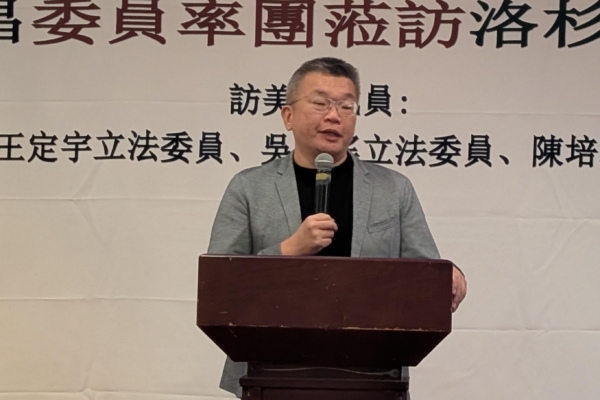
The DPP Caucus Leader in the Legislative Yuan and the Chairman of the Chinese Professional Baseball League (CPBL), Tsai Chi-chang, led a delegation to Los Angeles on July 21st (Wednesday) to kick off a visit to the United States. He stated that sports serve as the best medium to transcend language and political barriers. The main focus of this visit to the U.S. is to engage in “sports diplomacy” and showcase Taiwan’s strength. Apart from visiting Washington D.C. to promote important missions deepening Taiwan-U.S. relations in defense, economy, and Taiwan Strait security, Tsai also hopes to let the world see Taiwan’s robust soft power through the enthusiasm and prowess of Taiwanese baseball.
Tsai Chi-chang believes that baseball is not just a sport but also a golden window for Taiwan to showcase its strength and values to the international community. In recent years, in addition to solidifying the domestic market, the CPBL has actively engaged in international exchanges, maintaining long-term cooperation with the Nippon Professional Baseball (NPB) in Japan while also expanding close ties with Korean and Australian professional baseball leagues.
To further enhance the international influence of the baseball industry, Tsai Chi-chang’s visit to the U.S. includes various arrangements for baseball exchanges. This Sunday (26th), he will be the honored guest to throw the first pitch at a game of the New York Mets, showcasing Taiwanese baseball culture to American fans.
On Monday (27th), Tsai will hold closed-door discussions with the Commissioner of Major League Baseball (MLB) to delve into the diverse cooperation between Taiwan and the U.S. in baseball. Additionally, he will also strive to bring overseas games to Taiwan.
Tsai Chi-chang revealed that he will officially propose to MLB, hoping that in the future, MLB’s overseas opening games will not be limited to Japan and Korea but could also be staged at the Taipei Dome, which can accommodate approximately 40,000 spectators. He emphasized that Taiwanese fans’ passion for baseball has gained international recognition, possessing excellent market potential and hosting capabilities.
Tsai Chi-chang stated that while the baseball market size needs continuous expansion, through deep collaboration with various professional baseball leagues worldwide, Taiwan can collectively boost the global influence of baseball. He also hopes to facilitate more exchange games between American professional baseball teams and the Taiwanese national team or professional baseball teams in the future.
Regarding the concern from the public about the issue of “recruiting Taiwanese players in MLB to join the national team,” Tsai Chi-chang shared his nurturing and connecting philosophy. He believes that calling upon outstanding players to serve the country should not rely only on laws and systems but more crucially on the “deep trust and emotional connections established in peacetime.”
Acting by example, Tsai always takes the opportunity during his visits to the United States for official duties to visit Taiwanese players striving in the Major and Minor Leagues. Even if he cannot personally attend due to conflicting schedules, he delegates representatives to convey his care.
Furthermore, at the end of each baseball season when Taiwanese players returning home, the CPBL regularly organizes gatherings. Tsai Chi-chang said, “This has long been a heartwarming tradition.” He actively understands the needs of players in training and daily life in the U.S., providing timely assistance, touching players with warmth, which naturally increases their willingness to represent the national team on tours.
In addition to baseball exchanges, Tsai Chi-chang’s visit also represents the DPP Legislative Caucus and the party central committee to Washington D.C., engaging in in-depth dialogues with American political figures and think tanks, focusing on three crucial areas:
1. Maintaining peace and stability in the Taiwan Strait: Upholding the status quo in the Taiwan Strait, avoiding conflict, and collectively creating regional peace in the Indo-Pacific.
2. Deepening Taiwan-U.S. defense cooperation: Expressing gratitude for U.S. arms sales and security support, advancing defense budgets, and establishing self-defense capabilities.
3. Deepening Taiwan-U.S. economic and trade linkages: Leveraging Taiwan’s semiconductor and high-tech manufacturing advantages, combining with U.S. AI and research skills to build a mutually beneficial supply chain.
Tsai Chi-chang emphasized that Taiwanese companies actively investing in the U.S. align well with global industrial layout trends. Both sides display strong complementarity in technology and supply chains, continuously solidifying the close partnership between Taiwan and the U.S.
Facing media inquiries about being included in the list of sanctions by the Chinese Communist Party, Tsai Chi-chang remained calm and confident. Looking back, when he received the then Speaker of the U.S. House of Representatives, Nancy Pelosi, during her visit to Taiwan as the Deputy Speaker of the Legislative Yuan, fulfilling his legislative responsibilities but faced political pressure reveals the other party’s “arbitrary sanctions and lack of rationality.”
Tsai Chi-chang emphasized that Taiwan is a democratic country with numerous democratic partners’ support. He said, “We oppose long-arm jurisdiction. For us, being sanctioned is a badge of democracy. I never had plans to travel to China, so being denied entry has no impact on me.”
Tsai Chi-chang also mentioned that the government has been continuously injecting resources to develop the baseball sport in recent years, with significant upgrades from grassroots cultivation to the professional environment. This visit to the U.S. aims to showcase Taiwan on the international stage through sports soft power and the resilient democratic economic strength, letting Taiwan shine bright on the global arena. ◇