
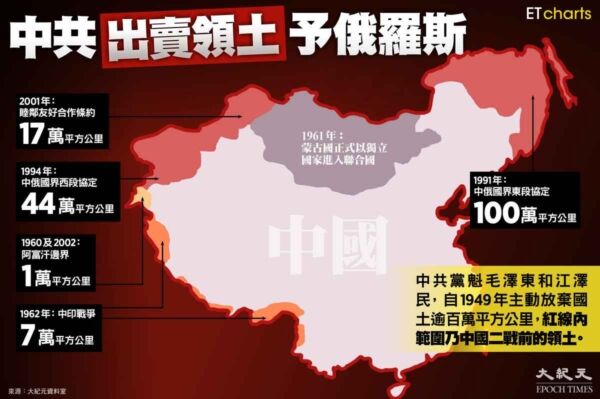
Recently, President Tsai Ing-wen of the Republic of China made a statement during an interview with TV host Zhang Yaqin, saying, “China’s attempt to annex Taiwan is not for the sake of territorial integrity. If it were really for territorial integrity, why not reclaim the lands signed away in the “Aigun Treaty” occupied by Russia?”
This remark by Tsai Ing-wen immediately sparked strong reactions internationally and ignited discussions among the Chinese mainland population and overseas Chinese.
Based on recent media reports, it is found that Tsai Ing-wen’s statement has exposed four major scandals of the Chinese Communist Party (CCP).
It is widely known that former CCP dictator Jiang Zemin was the biggest traitor of contemporary China. In December 1999, during the 50th anniversary of the CCP’s founding, 21 years of “reform and opening up,” 8 years after the dissolution of the Soviet Union, and when Russia was weak, Jiang Zemin signed the “Treaty on the Historic Waters Boundary of the Two Sides” with Russian President Yeltsin, fully acknowledging a series of unequal treaties signed by the corrupt and incompetent late Qing government with Tsarist Russia, including the “Aigun Treaty” and the “Beijing Treaty,” and unconditionally handed over more than one million square kilometers of land in China’s Northeast to Russia. Jiang Zemin also gave away the Tang Nu Uliang Sea area, which was occupied by Tsarist Russia and later the Soviet Union, to Russia.
In 2002, Jiang Zemin made the decision to “approximately split” the China-occupied Black Blind Island with Russia. As a result, the CCP handed over 164 square kilometers of Chinese territory to Russia.
Jiang Zemin’s aforementioned betrayal constitutes a severe crime against “endangering national sovereignty, territorial integrity, and security,” constituting offenses of “splitting the country” and “endangering national security.”
It is notable that so far, no CCP party group, branch, party headquarters, party group, party committee, discipline inspection commission, political and legal affairs committee, organization department, publicity department, United Front Work Department, External Liaison Department, or any CCP-affiliated organization, nor any CCP party media, has ever criticized Jiang Zemin’s act of treason.
Furthermore, after the death of Jiang Zemin, the biggest traitor in contemporary China, the CCP even enshrined Jiang in the CCP’s “Great Hall of Famous Figures,” calling him a “great Marxist, a great proletarian revolutionary, politician, military strategist, and diplomat”!
The interview of Tsai Ing-wen by Zhang Yaqin was broadcast on September 1st, and the CCP Central Committee, National People’s Congress, Chinese People’s Political Consultative Conference, State Council, Supreme Court, Supreme Procuratorate, Taiwan Affairs Office, Ministry of Foreign Affairs, etc., all remained silent and did not provide any response.
In October 1982, Jin Yong published an editorial titled “Equivalent to a Thousand Hong Kongs in Territory” in Hong Kong’s Ming Pao, in which he mentioned the unequal treaties China signed with various neighboring countries, especially the territorial disputes with the Soviet Union. He highlighted the unequal treaties of 1858 and 1860, where China was forced to cede vast territories north of the Black Dragon River and east of the Ussuri River, totaling 409,913 square miles, equivalent to the combined size of France and East and West Germany, or exactly a thousand times the size of Hong Kong.
Jin Yong’s articles were left unchallenged by the CCP.
According to the recollection of Hong Kong media figure Cheng Xi, an official from the external affairs department of the CCP once expressed helplessness, saying that due to Jin Yong’s social influence, it was challenging to counter him. They even sought historians, experts on border issues, and legal specialists to debunk Jin Yong’s claims, revealing the difficulty in doing so and suggesting that only Deng Xiaoping could handle the situation to prevent further escalation.
What did Deng Xiaoping do?
On July 18, 1981, Deng Xiaoping, in his capacity as Vice Chairman of the CCP Central Committee, met with Jin Yong, the founder and chairman of Ming Pao. Jin Yong became the first Hong Kong individual to have a separate meeting with Deng.
Following this meeting, Jin Yong’s novels were “unbanned” in mainland China; the CCP authorities in Zhejiang province exonerated Jin Yong’s father, Che Shuxun, who was wrongfully killed during the crackdown on counter-revolutionaries; and Jin Yong was appointed as a member of the Hong Kong Basic Law Drafting Committee and the Consultation Committee by the CCP.
Subsequently, Jin Yong did not raise the issue of Russian occupation of Chinese territory with the CCP.
On September 30, 2004, Cheng Xiang, writing under the pseudonym “Zhong Guoren,” published an article entitled “The One Thing Jiang Zemin Owes the Chinese People” in Ming Pao, revealing for the first time through Chinese-language media that in 1999, the CCP signed a new border treaty with Russia that effectively abandoned the land seized by the Russians from China during the Qing era.
Six months after the publication of this article, on April 22, 2005, Cheng Xiang was arrested by the CCP on charges of “espionage” and sentenced to three years in prison.
On December 1, 2009, Chinese historian Lu Jiaping wrote an appeal titled “Regarding Jiang Zemin’s ‘Two Traitors, Two Deceptions’ and the Political Fraud Issue Requiring Investigation.” He specifically mentioned Jiang Zemin’s selling of the territory north of Black Dragon River, east of Ussuri River, an area equivalent to over forty Taiwans, to Russia.
On May 13, 2011, Lu Jiaping was convicted of “inciting subversion of state power” by the CCP and sentenced to 10 years in prison.
Prior to July 1, 2008, I wrote numerous letters about Jiang Zemin’s betrayal, sent by registered mail to many CCP leaders from the top to the grassroots.
On November 26, 2009, all the letters I wrote before July 1, 2008, exposing Jiang Zemin’s treachery, were used by the Beijing First Intermediate People’s Court as “evidence” of my “crime,” leading to an unlawful five-year prison sentence.
In recent years, Russia has repeatedly invited the CCP to participate in various activities in Vladivostok, which was once Chinese territory.
On September 4, responding to Russia’s invitation to attend the Eastern Economic Forum in Vladivostok, CCP Vice President Han Zheng, during a meeting with Russian President Putin, expressed his gratitude and delight at being invited to Vladivostok.
Using the CCP’s rhetoric on Taiwan, Vladivostok has “always been Chinese territory.” However, since Jiang Zemin handed over Vladivostok to Russia, the CCP has openly recognized Vladivostok as Russian territory.
After Tsarist Russia occupied Vladivostok, they discarded the Chinese place name “Vladivostok” and replaced it with “Vladivostok,” meaning “Conquer the East.”
Today, from the CCP’s party media to its top leaders, they all refer to Vladivostok as “Vladivostok.”
On September 24, 1982, when Deng Xiaoping met with British Prime Minister Margaret Thatcher, he made a statement regarding the issue of Hong Kong sovereignty. This speech was repeatedly propagated by the CCP as Deng Xiaoping’s theory of “defending national sovereignty.” Deng Xiaoping said, “The sovereignty issue (of Hong Kong) is not up for discussion.” He further emphasized that if China did not reclaim Hong Kong by 1997, 48 years after the founding of the People’s Republic of China, any Chinese leader or government would fail to explain to the Chinese people and the world. He stated that failure to reclaim Hong Kong would mean the Chinese government is akin to the late Qing government, and the Chinese leaders are like Li Hongzhang, concluding that any Chinese government should step down and automatically exit the political stage in such a scenario.
According to Deng Xiaoping’s statement, if the CCP does not reclaim the Chinese territories occupied by the Soviet Union following the Russian invasion, it signifies that the CCP is similar to the late Qing government, and CCP leaders are akin to Li Hongzhang, leading to the conclusion that the CCP government should “automatically exit the political stage, without any other choice.”
However, today, as the world’s largest traitorous party, the CCP not only refuses to acknowledge its acts of betrayal, but also unwillingly withdraws from the political stage. On the contrary, they continue to wave the banner of “patriotism,” using the excuse of “defending national sovereignty, territorial integrity, and security” to intimidate Taiwan, staging ugly, farcical, and malicious dramas.
At the moment Tsai Ing-wen has exposed the CCP’s lies, people of Chinese descent worldwide should understand the CCP’s four major scandals mentioned above and completely sever ties with the world’s largest traitorous party – the CCP.
Dajiyuan – first published