
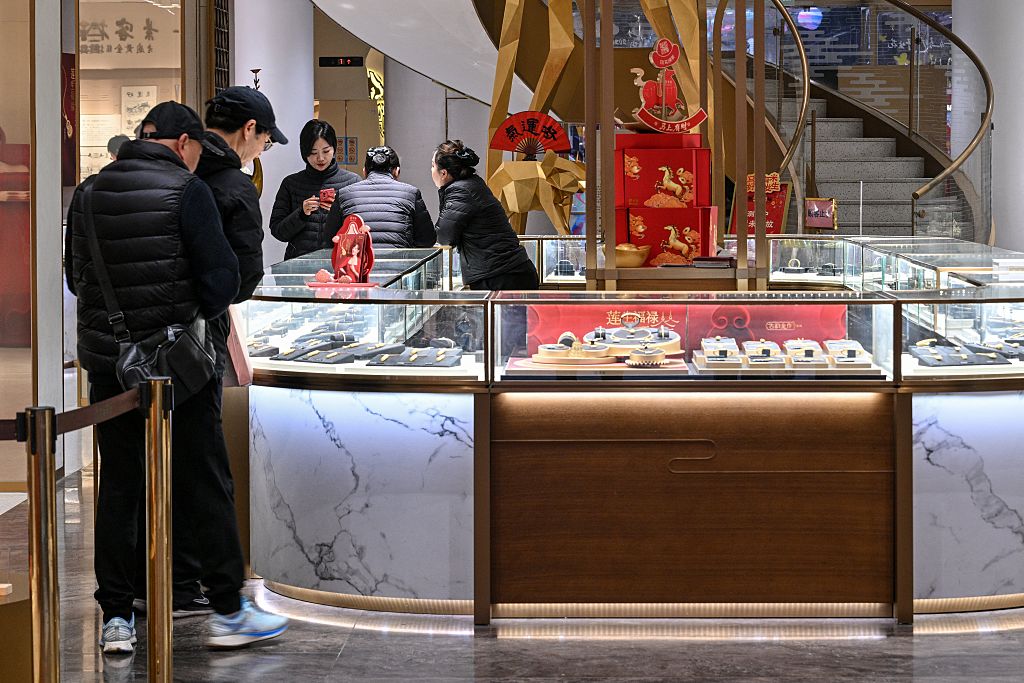
In February this year, mainland China’s gold brand Lao Pu gold raised prices by an average of about 25%, and in less than half a year, stores in Beijing, Shanghai, Guangzhou, and other cities started participating in Qixi promotional activities. Some products were offered at discounts as low as 85% after multiple discounts were applied, sparking dissatisfaction among high-end customers.
Before Qixi, major malls such as SKP in Beijing, Guoji Jin in Shanghai, and Taikoo Hui in Guangzhou all offered promotions at their Lao Pu gold stores, as reported by Sina Finance’s “Guilu” column on August 14.
According to store staff, after stacking full discounts, mall points, member discounts, and installment payment advantages, the actual price could be as low as 85% off.
For instance, a traditional gold jewelry piece originally priced at 32,490 yuan at the SKP store in Beijing was discounted to 27,878 yuan, a savings of over 4,600 yuan. Sales personnel claimed it was the “lowest price ever.” Scalpers on-site offered even lower prices, about 82% to 85% off.
In 2025, Lao Pu gold adjusted prices three times, with an overall increase of over 50%. On February 28th this year, the brand once again raised product prices by an average of about 25%.
The sudden promotion after frequent price hikes has upset loyal customers. One consumer mentioned that a product he bought for 33,400 yuan previously now costs just over 30,000 yuan, resulting in a loss of about 3,000 yuan. Another said, “Not even a week after purchasing, it dropped by 5,000 yuan, a terrible loss.”
As promotions are ongoing, the second-hand market quotes are also decreasing. According to reports, a popular product priced at 55,660 yuan at retail is being quoted by second-hand vendors at only 35,600 yuan, equivalent to around 64% of the original price, with even deeper discounts for certain less popular styles.
Another consumer who spent over 20,000 yuan on an 8.46-gram pendant in March this year received a quote of only around 12,000 yuan from a second-hand dealer. Some dealers are no longer offering discounts based on purchase price but instead on the weight of gold, with prices increasing by tens of yuan per gram based on the daily gold price.
A gold recycling merchant stated that with gold prices falling this year and discounts on new retail goods widening, second-hand market quotes have also declined.
During the discount period for Lao Pu gold, the consumption of gold jewelry in mainland China continues to decrease. Data from the World Gold Council shows that in the first half of 2026, gold jewelry demand in mainland China dropped by 30% year-on-year to 136 tons, which is 52% lower than the average level of the previous ten years for the same period.
The association stated that consumer confidence is low, economic growth is slowing, and the real estate market remains weak, leading people to be cautious about non-essential spending. The high and fluctuating gold prices have also caused some consumers to delay their purchases.
Financial data shows that by the end of 2025, Lao Pu gold’s inventory had increased from 4.088 billion yuan at the end of 2024 to 16.044 billion yuan, and interest-bearing bank loans and other borrowings increased from 1.373 billion yuan to 6.264 billion yuan.
Although the company expects a 60% to 66% increase in revenue and an 83% to 85% increase in adjusted net profit in the first half of this year, its stock price plummeted by 23.76% on July 28th. The stock price hit a low of about 282 Hong Kong dollars during July trading, a decrease of over 70% from the historical peak in July 2025.
Mainland luxury goods expert Zhou Ting told “Guilu” that this discount is a short-term impulse choice under performance pressure. She believes that consumer hesitation due to gold price fluctuations, coupled with high-end mall rents and store expansion costs, requires brands to drive sales through discounts. However, long-term discounting may weaken its pricing stability and high-end positioning.