
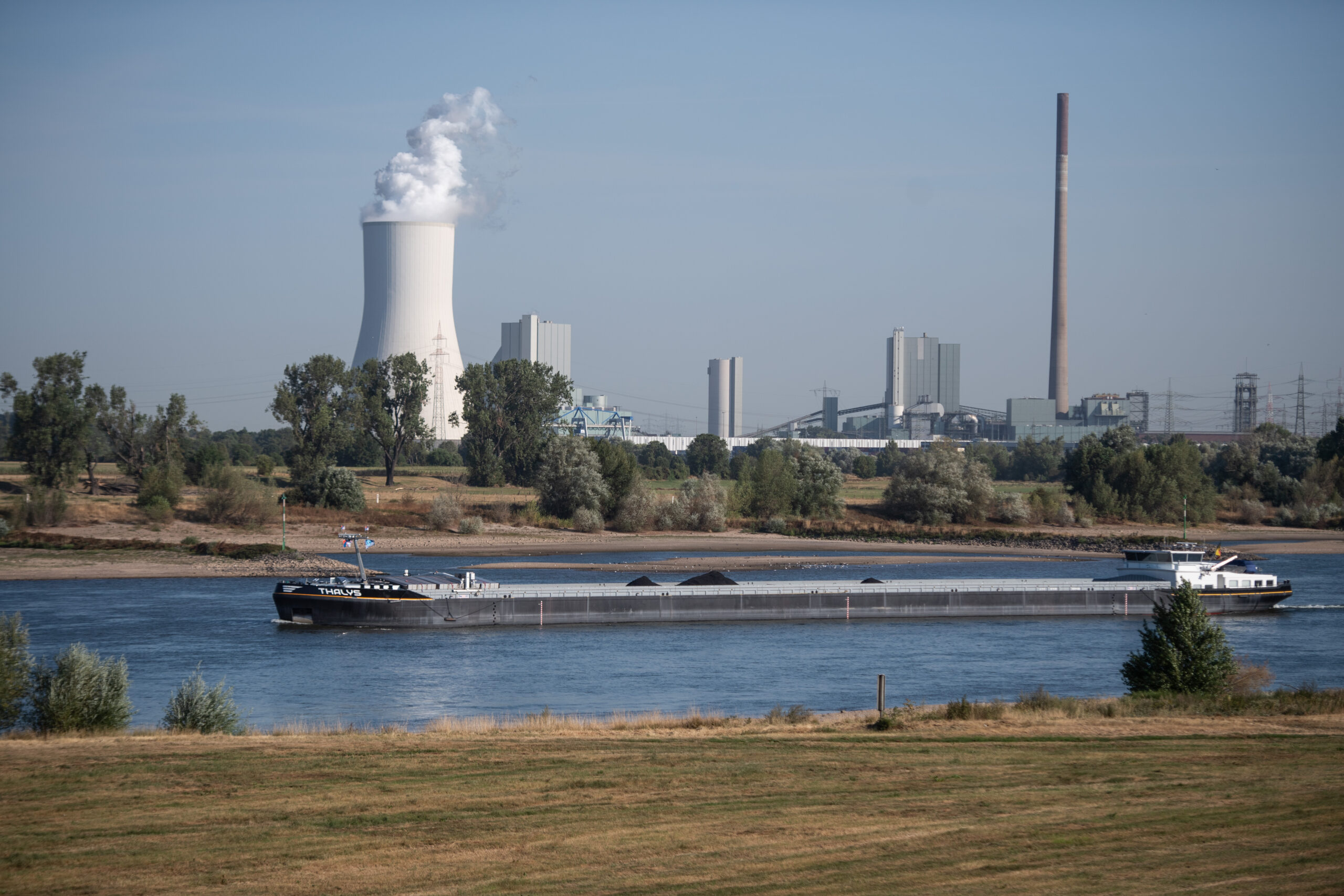
As the extreme heatwaves and drought persist across Europe, the continent’s most important inland waterway, the Rhine River, saw a significant drop in water levels, hitting a new historic low.
Near Koblenz, a crucial bottleneck on the river at Kaub, the water level gauge plummeted to 6 centimeters (2.4 inches) on Friday night, August 14, before slightly rising to 8 centimeters on Saturday morning, both far below the previous record low of 25 centimeters set in 2018.
The sudden decrease in water levels has paralyzed waterway transport, leading to a massive surge in freight costs, up to 10 times the normal rates, forcing a large amount of cargo to urgently shift to road transport, plunging Germany’s industrial supply chain into a severe crisis.
According to data from the German Federal Waterways and Shipping Administration (WSV), the water level gauge at the Kaub section had dropped to single digits in mid-August. Although the actual water depth in this section is about 1 meter deeper than the gauge reading (approximately 1.06 meters), the gauge has traditionally served as a key indicator for safe navigation in the area.
As the Kaub section is the shallowest and most critical point on the Rhine River, shipping broker Riverlake informed Reuters that the extreme water levels have brought about a virtual standstill in two-way shipping between upstream and downstream. Although authorities have not officially declared a closure, most vessels are carrying only about 15% to 20% of their capacity to avoid grounding, engaging in “light loading operations”, while some large vessels are completely unable to pass through.
The disruption in water transport has directly led to a sharp increase in logistics costs. Data from organizations like the Swiss Touring Club (TCS) shows that under normal water levels, shipping goods from Rotterdam in the Netherlands through the Rhine River to Basel in Switzerland costs around 22 to 28 Swiss francs per metric ton. However, under the extreme low water levels, immediate shipping costs have surged to about 240 Swiss francs per metric ton, a nearly tenfold increase.
With water transport severely hampered, the majority of logistics have urgently shifted to truck and rail transportation. The German government has reached agreements with various states to temporarily lift restrictions on truck traffic on Sundays and public holidays to support maintaining the supply chain through road transport.
The Rhine River serves as Europe’s core transportation artery, handling the transport of chemicals, bulk commodities, fuels, and agricultural products. As the low water level crisis escalates, several German corporate giants have reported operational disruptions.
Chemical industry giants such as BASF, Covestro, and Lanxess have activated warning mechanisms. Covestro, in particular, has declared force majeure stoppages in some production lines due to raw material shortages, with some shipments forced to switch to rail and road transport or employing shallow-draft vessels for support. Thyssenkrupp and other steel mills face disruptions in the transport of iron ore and scrap steel; power companies and refineries also struggle due to insufficient coal and refined oil transport.
The Kiel Institute for the World Economy points out that experience has shown if the water level gauge at the Kaub section remains below 78 centimeters for a consecutive 30 days (the last time the Kaub water level was above 78 centimeters was in mid-July), Germany’s industrial output could decrease by 1%. Economists warn that if the drought and low water level crisis continue into the autumn, it may drag down Germany’s GDP by around 0.4 percentage points for that quarter.