
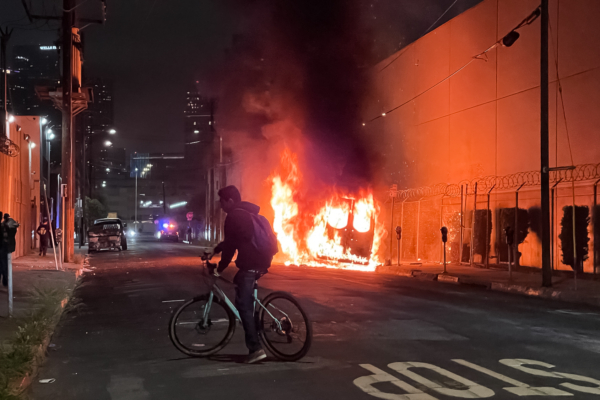
Last year, during the immigration enforcement period in June, a riot erupted in downtown Los Angeles, drawing nationwide attention. Now, several individuals involved in the incident have been steadily prosecuted or sentenced. On Tuesday, July 28, a man who set fire to a police car was sentenced to 37 months in federal prison and ordered to pay a $250,000 compensation.
According to a press release from the U.S. Department of Justice, 42-year-old Ismael Vega was sentenced by a district judge on Monday. The plea agreement stated that on the evening of June 8 last year, Vega and a large group of protesters gathered on the 101 freeway overpass in downtown Los Angeles, where there were several California Highway Patrol (CHP) vehicles below the bridge, with officers trapped underneath. Despite knowing the consequences, Vega deliberately threw an incendiary device accurately at a police car.
At that time, several protesters on the overpass picked up bricks, vegetation debris, and fireworks, ignited them, and threw them at the CHP vehicles below, with officers just a few feet away. Vega admitted in the plea agreement that he understood the burning debris falling on the police car could pose a significant risk of death or serious bodily harm to the officers, yet he still lit a large piece of cardboard over his head and threw it towards the engine hood of the CHP vehicle.
Subsequently, another defendant, 23-year-old Yachua Mauricio Flores, poured liquid onto the burning police car below, causing the fire to spread, while Vega was seen gesturing and cheering alongside Flores. When law enforcement tried to clear the crowd, Vega repeatedly picked up stones and threw them at the officers in an attempt to obstruct and interfere with their duties.
Photos shared on the Facebook page of the Central California District Attorney’s Office revealed the intense blaze of the CHP police cars under the bridge, with the surrounding road strewn with rocks and concrete blocks thrown by the rioters. CHP officers were forced to evacuate the vehicles and take refuge closely under the overpass, in a precarious situation.
Flores will face sentencing on August 3, with a maximum federal sentence of 5 years, while another suspect, 40-year-old Adam Charles Palermo, is scheduled for a hearing on December 14 this year, potentially facing up to 20 years in federal prison.
This riot not only sparked nationwide attention but also brought heavy costs to Los Angeles. Two days after the incident to prevent further deterioration of public safety, Los Angeles Mayor Karen Bass declared a one-week curfew in parts of downtown.
According to data from the Los Angeles Controller’s Office, in response to the riot, the city of Los Angeles spent $32 million within two weeks, primarily for security operations of the Los Angeles Police Department (LAPD).
Additionally, Los Angeles County highlighted in the “Economic Impact of Federal Immigration Enforcement” report that the overall economic impact of the protest activities exceeded $1 billion, including total output loss and labor income loss.
The unrest stemmed from enforcement actions by the U.S. Immigration and Customs Enforcement (ICE). On June 6 last year, ICE conducted raids in multiple locations in Los Angeles, arresting at least 45 undocumented immigrants. The operation sparked protesters to take to the streets, escalating into violent incidents. Following the events, both California Governor Newsom and Mayor Bass publicly criticized the ICE raids, questioning federal enforcement’s severity.
In response, the Department of Homeland Security released data in January this year, emphasizing that their enforcement primarily targets illegal immigrants involved in criminal activities. In the past year, ICE has arrested nearly 7,000 gang members (suspected of murder, drug trafficking, human trafficking, and carjacking), over 43,000 individuals posing threats to national security, and more than 1,400 known or suspected terrorists.