
German law enforcement announced on Saturday (September 12) that the identities of two suspects involved in the drone bomb attack on a Ukrainian plane at Leipzig Airport have been confirmed. It is believed that at least one of them has ties to the Russian military intelligence agency, GRU.
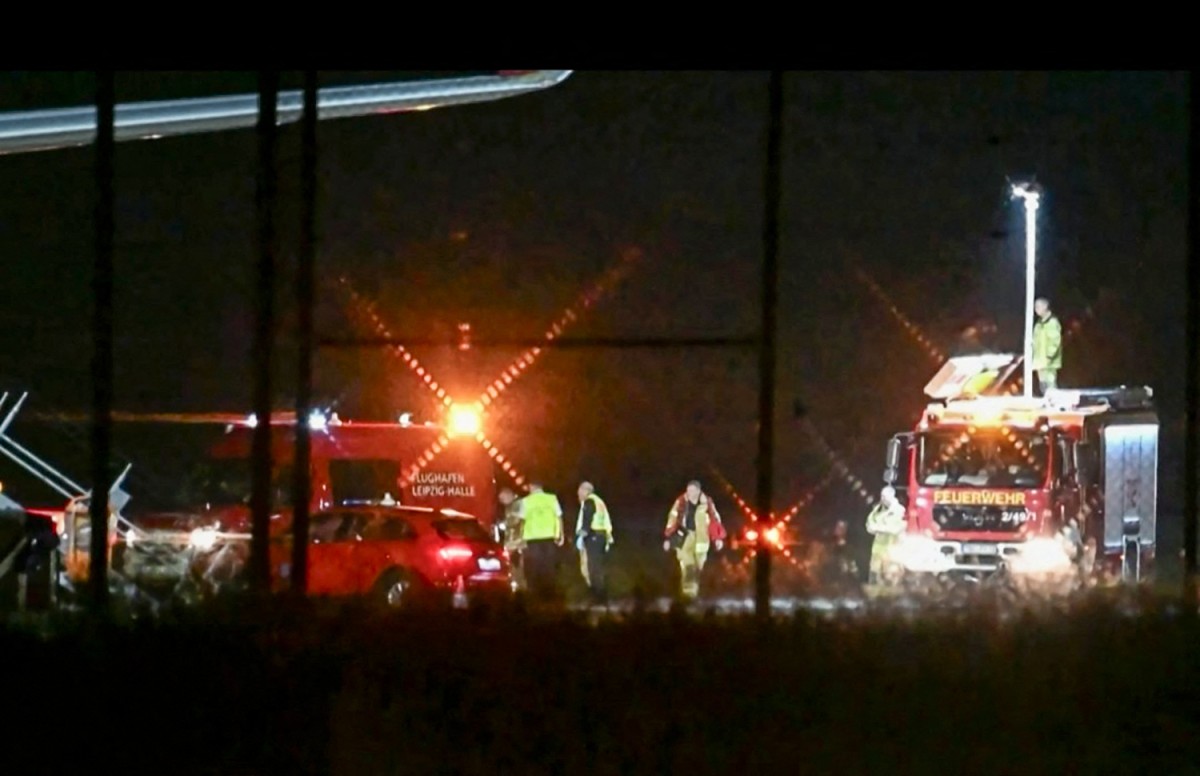
According to a report from German newspaper DIE Welt on Saturday, on the evening of August 5, a drone carrying an explosive device approached a Ukrainian Antonov An-124 transport plane at Leipzig Airport, attempting to carry out an attack.
The drone struck the wing of the Ukrainian transport plane and crashed to the ground without detonating the explosive device. The reason for the failure to detonate is still unclear.
The Ukrainian Foreign Ministry stated at the time that the incident did not cause any casualties or damage to the aircraft.
Operations at Leipzig Airport were temporarily suspended as a result of the incident. The airport serves as a key logistics hub for delivering Western aid to Ukraine.
Previous reports suggested that the attacked Ukrainian An-124 transport plane may have been carrying ammunition that had recently arrived from France in Leipzig for further transportation to Ukraine. However, German authorities have officially denied that there was ammunition on the plane at that time.
It was reported that the drone approached the aircraft around 7:30 pm. Since fuel tanks are usually located inside the wings, the drone was likely aiming to hit this part of the aircraft to cause maximum damage.
German security authorities have identified the two suspects involved in the case as Andrei K., a Belarusian citizen, and Oleg L., a Russian citizen. Oleg L., the Russian, is believed to have connections to the Russian military intelligence agency GRU and was responsible for planning and logistics of the drone attack.
Investigations revealed that Oleg L. entered Germany from Turkey, conducted the drone attack, and immediately flew to Serbia. He is currently in Russia.
Authorities were aware of Oleg L.’s connection to GRU when he arrived in Germany. After he left Germany, no surveillance was conducted on him.
DNA evidence has played a crucial role in the investigation. Forensic experts found DNA traces on a piece of equipment deemed to have been used to control the drone by law enforcement.
Andrei K.’s DNA had previously been recorded in Finland and Lithuania, where he has a criminal record in both countries.
Poland has accused him of being involved in a 2024 fire at a household goods store in Łódź, and local prosecutors are investigating him for intentional destruction.
German law enforcement stated that the explosives used in the drone attack were transported into Germany through Bulgaria and Serbia, possibly concealed in truck compartments and later stored in underground warehouses near the airport.
Police have identified several possible hiding places linked to the case. Investigators believe the suspects originally planned to use multiple drones in the attack.
The Federal Public Prosecutor’s Office in Germany is continuing the investigation on charges of attempted explosion and endangering air transport related to the case.
In early September, the German government officially held Moscow responsible for the drone attack at Leipzig Airport and decided to close the last remaining Russian consulate – the consulate in Bonn, while also terminating the operating agreement of the “Russian House” in Berlin.
Russia subsequently announced the suspension of operations at the German consulate in Saint Petersburg and the Goethe-Institut cultural center.