
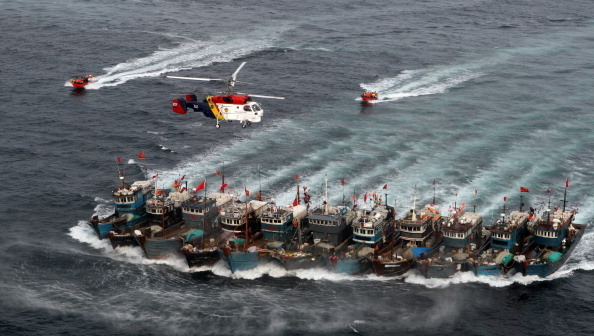
Recently, the South Korean Maritime Police Agency has significantly intensified law enforcement efforts near the Northern Limit Line (NLL) in the Yellow Sea (West Sea), targeting illegal fishing by Chinese fishing vessels and achieving multiple successes.
On Saturday (September 12), the Central Regional Maritime Police Agency in South Korea announced that from September 10 to 11, in a joint deployment with the navy, 20 patrol ships seized a 70-ton Chinese fishing vessel named “Vessel A” that illegally crossed the NLL line 0.4 kilometers east of Daechong Island, and evacuated 91 fishing vessels from the scene.
The detained vessel had 10 crew members and was found with illegally caught items such as snow crabs and abalones. The maritime police indicated that they have seized 13 illegal Chinese fishing vessels so far this year, more than double the number from the same period last year (6 vessels). The number of Chinese fishing vessels engaged in illegal operations across the West Sea border has decreased from around 200 to approximately 150 vessels.
To encourage law enforcement officers to continue to curb illegal fishing activities, the South Korean authorities have introduced a reward system. On Friday (September 11), the South Korean Maritime Police Agency announced the award of a prize of 18 million Korean Won (approximately $13,348) to commend 6 law enforcement officers from the Special Guard Team of the West Sea Five Islands.
This team successfully seized 8 illegal Chinese fishing vessels and evacuated 24 vessels during a cross-department joint operation on August 11, setting a record for the highest amount awarded since the implementation of the special performance bonus system by the maritime police this year.
Acting Chief Jang In-sik from the South Korean Maritime Police Agency and Chief Park Jae-hwa from the Central Regional Maritime Police Agency emphasized that they will continue to strengthen patrols and preventive law enforcement in the Northern Limit Line area during the autumn fishing season. They also aim to deepen bilateral cooperation through the South Korea-China Fisheries Law Enforcement Meeting to ensure the safety of domestic fishermen and protect marine resources.
The autumn season is a peak fishing period for snow crabs and high-value seafood in the Yellow Sea, with the area near the Northern Limit Line known as a “golden fishing ground” due to its abundant marine resources. However, as the area is a military-sensitive zone between South Korea and North Korea, Chinese fishing vessels often exploit the vague jurisdiction of both sides to engage in illegal fishing activities, causing damage to the local ecosystem and sparking maritime law enforcement friction repeatedly.
In order to avoid inspections by maritime police, Chinese fishing vessels often resort to aggressive tactics when confronted with capture. Common methods include coordinating dozens of fishing vessels with steel cables to form a large resistance formation to prevent evacuation, or installing iron nets and decking on both sides of the vessels with iron spikes and steel pipes to prevent special forces from boarding. There have been numerous instances of Chinese fishermen resorting to violence, including wielding iron rods, sickles, and even ramming maritime police patrol boats directly, resulting in casualties.
Against the backdrop of frequent patrols and crackdowns by the maritime police, another incident of a Chinese fishing vessel sinking was reported in the area this week.
On the morning of September 9, South Korean maritime police and navy discovered a partially submerged wooden fishing boat about 3.4 nautical miles off Yeonpyeong Island, with no one on board upon inspection. Since the incident area is less than 1 nautical mile south of the Northern Limit Line and a frequent location for Chinese fishing vessels, authorities suspect that the boat originates from China and have broadcasted a radio message for passing ships to be alert to missing crew members.
China’s extensive distant water and near shore fleet has long been engaged in illegal fishing activities in surrounding waters and worldwide. According to global data analysis by the international marine conservation organization Oceana, China has the world’s largest distant water fishing fleet, with an estimated 57,000 industrial fishing vessels accounting for 44% of visible marine fishing activities globally.
Based on the evaluation of the Illegal, Unreported, and Unregulated (IUU) Fishing Risk Index, China consistently ranks the lowest (last) among 152 coastal countries globally. Apart from the Yellow Sea and East China Sea, from the waters around the Galapagos Islands in South America to the coastal areas of West Africa, Chinese fishing vessels frequently engage in behavior such as shutting off automatic identification systems (AIS) to “disappear,” crossing borders, or fishing without licenses, arousing widespread concern from governments and the international community.
(Reference: Yonhap News Agency and Asia News Communication Agency AJP)