
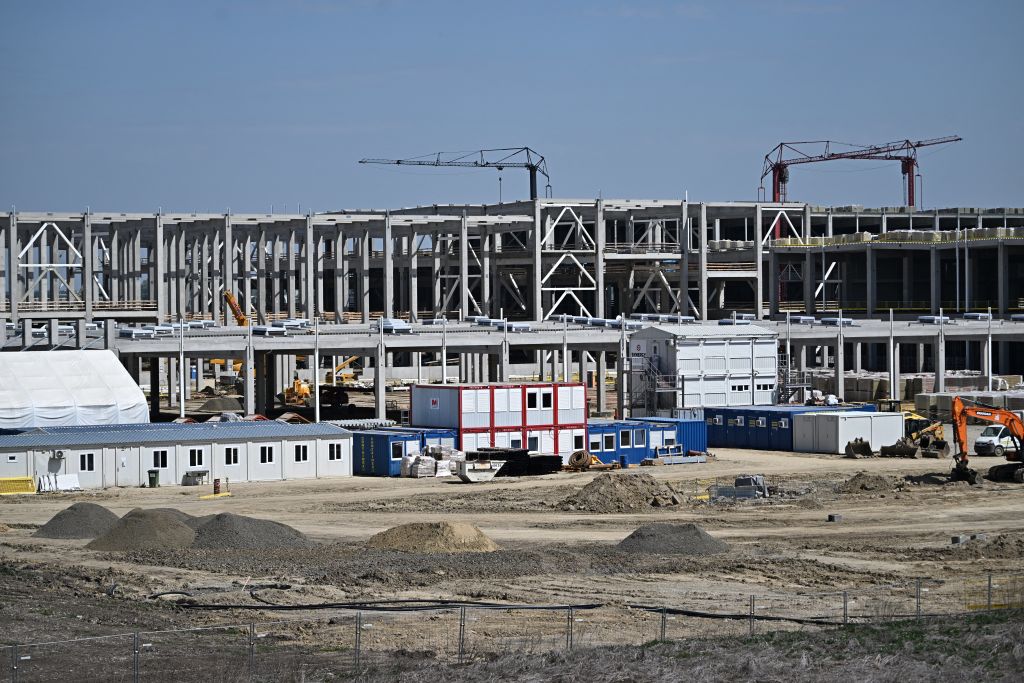
After the new government took office in Hungary in May this year, they began scrutinizing opaque financing and investment agreements between the previous government and Chinese enterprises, tightening factory environmental regulations, and increasing pressure on Chinese companies such as BYD and CATL. This has posed challenges for companies like BYD and CATL.
According to a report by Nikkei Asia, Peter Magyar, who became Prime Minister of Hungary in May, has made restoring relations with the European Union a top priority, signaling a departure from the pro-China policy pursued by former Prime Minister Viktor Orban.
The new government has promised to strengthen environmental and labor standards, as well as increase transparency in government subsidies. Prime Minister Magyar stated that they will review all specific investment projects with China and other countries.
One of the named companies is the Chinese electric vehicle giant BYD. The company has established its European headquarters in Hungary and plans to start operations at an electric vehicle factory in the southern city of Szeged this year.
In late July, officials from the Hungarian Ministry of Foreign Affairs revealed that the previous government had secretly promised significant subsidies to BYD and agreed to accept around 10,000 Chinese workers.
Labor issues during the construction of the BYD factory have also been questioned, including allegations of long working hours and unpaid overtime. According to a report by the labor rights organization China Labor Watch, BYD used a complex network of subcontractors to airlift Chinese migrant workers to Hungary for factory construction, subjecting them to long hours, seven-day work weeks, withheld wages, and fear of retaliation.
These allegations prompted a chain reaction from Hungarian authorities. The Csongrád-Csanád County government office where the BYD factory is located confirmed to the US nonprofit network platform Public Radio Exchange’s The World that penalties have been imposed on three subcontracting companies involved in the factory construction, with fines issued to one of them.
Orban’s close ally, former Foreign Minister Peter Szijjarto, joined BYD as an executive immediately after resigning from his parliamentary position in July. As he was the one who negotiated investment conditions with BYD on behalf of Hungary, the new government announced on July 20 that they would review all decisions, negotiations, and national commitments related to BYD’s investment projects in Hungary made by Szijjarto.
The previous Hungarian government actively sought Chinese investments as a driver of economic growth. Critics have pointed out that Hungary provided opaque subsidy arrangements and favorable regulatory treatments, especially concerning environmental issues, to Chinese enterprises.
Given that the new government has begun carefully reviewing agreements made by the previous government, the impact on Chinese enterprises in the environmental regulatory field may be particularly severe.
David Vitezy, Hungary’s Minister of Transport and Investment, stated in August that for battery factories violating environmental regulations, the government would stop offering preferential treatment like simplified approval processes.
In June of this year, the Hungarian government revoked the operating license of Semcorp, China’s largest battery separator manufacturer. Prior to this, samples of groundwater collected by inspectors at the company’s factory in Debrecen, eastern Hungary, showed aluminum concentrations far exceeding legal limits.
Operation of a battery factory run by CATL also raised environmental concerns, leading to increasing local opposition. The Hajdú-Bihar County government initiated legal proceedings against CATL on June 5 after the factory violated regulations by directly discharging “green liquid waste” into the local municipal sewage system on the evening of May 5.
The state government announced on August 31 that CATL must complete safety rectification work in Debrecen before commencing commercial battery production. Regulatory authorities ordered the suspension of operations in three key processing workshops on August 25.
In August of this year, the Hungarian government fined CATL for non-compliance with hazardous waste storage and other environmental regulations.
The Hungarian government plans to establish a new institution as early as this month to oversee the environmental compliance of battery factories. This institution is expected to have the authority to conduct on-site inspections and order production halts. Minister of the Environment Laszlo Gajdos stated that factories failing to comply with regulations will be shut down.
Magyar has gained considerable support from environmental groups in eastern Hungary. Many Chinese companies have heavily invested in this region in recent years, and Magyar has criticized Orban’s former government for its “radical industrial policy”.
In 2024, the EU imposed tariffs on electric cars manufactured in China, citing unfair low-price sales that threatened the European automobile industry. Chinese car manufacturers using Hungary as a manufacturing base within the EU are now forced to make adjustments.
BYD and CATL chose Hungary as a primary industrial foothold to enter the EU market, avoiding trade tariffs on directly imported cars by the EU, while supplying European car manufacturers locally.
According to East Asia Brief, regulatory authorities in Hungary stated on September 2 that mandatory safety shutdown measures and environmental permit reviews have delayed the commercial production of the factories being constructed by CATL and BYD in Hungary.
Regarding the future trade relationship between Hungary and China, Nikkei Asia quoted Hungarian economist Bernadett Szel as saying, “China will remain an important partner, but will no longer enjoy a special status; the role China plays in the future is likely to be subject to clearer political and regulatory constraints.”
“Szel emphasized that the Tisza Party led by Magyar stresses reconnecting with Western economic networks and value chains, indicating that Hungary’s policy in the Indo-Pacific region will move towards diversification,” she said, “meaning reduced unilateral reliance on China.”