
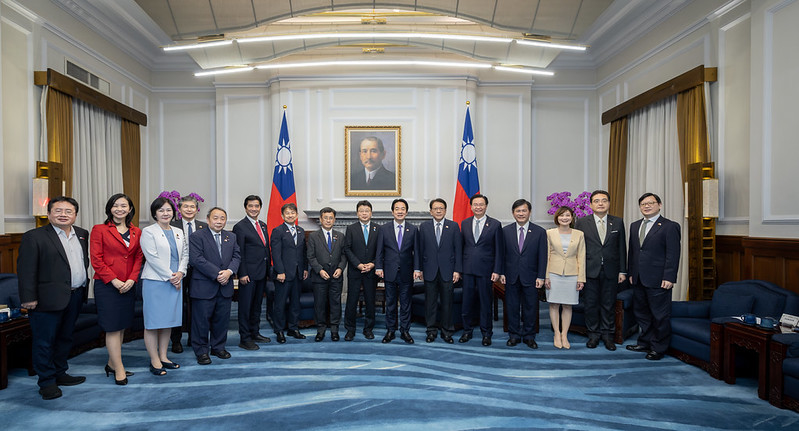
On September 8, President of the Republic of China, Lai Ching-te, met with a delegation from the “Consideration of Taiwan Strait Peace and Stability Parliament Members Association.” The association’s chairman, Kitamura Haruo, expressed the intention to promote the formulation of the Japanese version of the “Taiwan Travel Act” and “Taiwan Relations Act” to enhance high-level government exchanges and defense cooperation between Taiwan and Japan. President Lai Ching-te hopes for deeper cooperation between Taiwan and Japan to maintain peace and stability in the Taiwan Strait.
The delegation of the “Consideration of Taiwan Strait Peace and Stability Parliament Members Association” included Japanese senators Kitamura Haruo, Yamada Yoshihiko, Ishihira, Meimura Mizuho, and members of the lower house, Nishida Kaoru, Yokota Mitsuhiro, and Miki Kei. They were accompanied by the Minister of Foreign Affairs of the Republic of China, Joseph Wu, the Deputy Representative of the Taiwan Office of the Japan-Taiwan Exchange Association, Masato Mizobuchi, and the Secretary-General of the Taiwan-Japan Relations Association, Hong Yingjie, to meet with President Lai Ching-te at the Presidential Office.
On the afternoon of the 8th, President Lai Ching-te met with the delegation composed of Japanese parliament members. Chairman Kitamura Haruo, in his address, expressed gratitude to President Lai for taking the time to meet despite his busy schedule. The primary purpose of this visit is to translate the friendship between Taiwan and Japan into concrete actions and to continue advancing bilateral relations. Just as life is enriched with sincere friends, the same applies to relationships between nations and peoples. Taiwan is a sincere friend of Japan, and Kitamura Haruo hopes that both Japanese and Taiwanese people will once again recognize the profound friendship and keep it close to their hearts.
Kitamura Haruo mentioned that when Japan experienced the Great East Japan Earthquake, Taiwan immediately sent a rescue team, and the government and private sector raised 25 billion yen in disaster relief donations, a gesture unmatched by any other country in the world. If Taiwan, their sincere friend, faces challenges, Japan will spare no effort to face them together.
Kitamura Haruo believes that it is crucial for Japan and the Japanese people to continuously demonstrate their firm determination to support and defend their friends in times of need to help resolve crises. Future actions will include promoting the Japanese versions of the “Taiwan Travel Act” and “Taiwan Relations Act” to facilitate high-level exchanges between the two governments and promote various defense cooperation initiatives.
He noted that while the power of each parliament member may be limited, he will remain determined to unite like-minded individuals and actively lobby the Japanese government to fulfill former Prime Minister Shinzo Abe’s expectations of establishing a strong relationship with Taiwan. He also aims to promote peace and stability in the Taiwan Strait and hopes that Taiwan and Japan will work together to create a brighter future for both countries.
In his speech, President Lai Ching-te mentioned that the “Consideration of Taiwan Strait Peace and Stability Parliament Members Association” was established in mid-June of this year and, within less than three months, expressed strong concerns and support for the peace and stability of the Taiwan Strait through concrete actions. He admired the association’s establishment, believing it would not only elevate the Japanese parliament’s attention to the Taiwan Strait situation but also help seek the best strategy to maintain peace and stability in the Indo-Pacific, realizing former Prime Minister Shinzo Abe’s vision of a “free and open Indo-Pacific.”
President Lai Ching-te pointed out that over the past month, the people of Taiwan have been closely following the recovery from the Kumamoto earthquake in Japan. Over the years, Taiwan and Japan have always helped each other during natural disasters, showing true friendship in times of adversity, leading to a stronger and more stable Taiwan-Japan relationship.
Facing ongoing military actions, gray zone intrusions, and transnational repression by China, escalating tensions in the Taiwan Strait, East China Sea, and South China Sea, disrupting regional peace and stability, global democratic nations, including Taiwan and Japan, must unite and cooperate to enhance defense capabilities continuously and jointly deter threats to safeguard the democracy, peace, and prosperity that Taiwan relies on for survival.
Taiwan’s defense budget for this year has accounted for 3% of its GDP, and President Lai Ching-te stated that next year’s defense budget will exceed 3% and continue to increase proportionally, with a goal of reaching 5% of the GDP by 2030. The government will strongly promote defense autonomy, enhance asymmetric warfare capabilities such as artificial intelligence and unmanned vehicles, actively construct a resilient national defense system to achieve the goal of safeguarding the country.
President Lai Ching-te expressed great anticipation for Taiwan and Japan to enhance cooperation in national strategy, economic security, high-tech industries, and strengthening social resilience in fields such as semiconductors, artificial intelligence, quantum computing, unmanned aerial vehicles, and robotics. Lastly, he extended his gratitude to the visitors for their efforts in promoting Taiwan-Japan relations and peace and stability in the Taiwan Strait, wishing for a successful and fruitful outcome of their visit.