
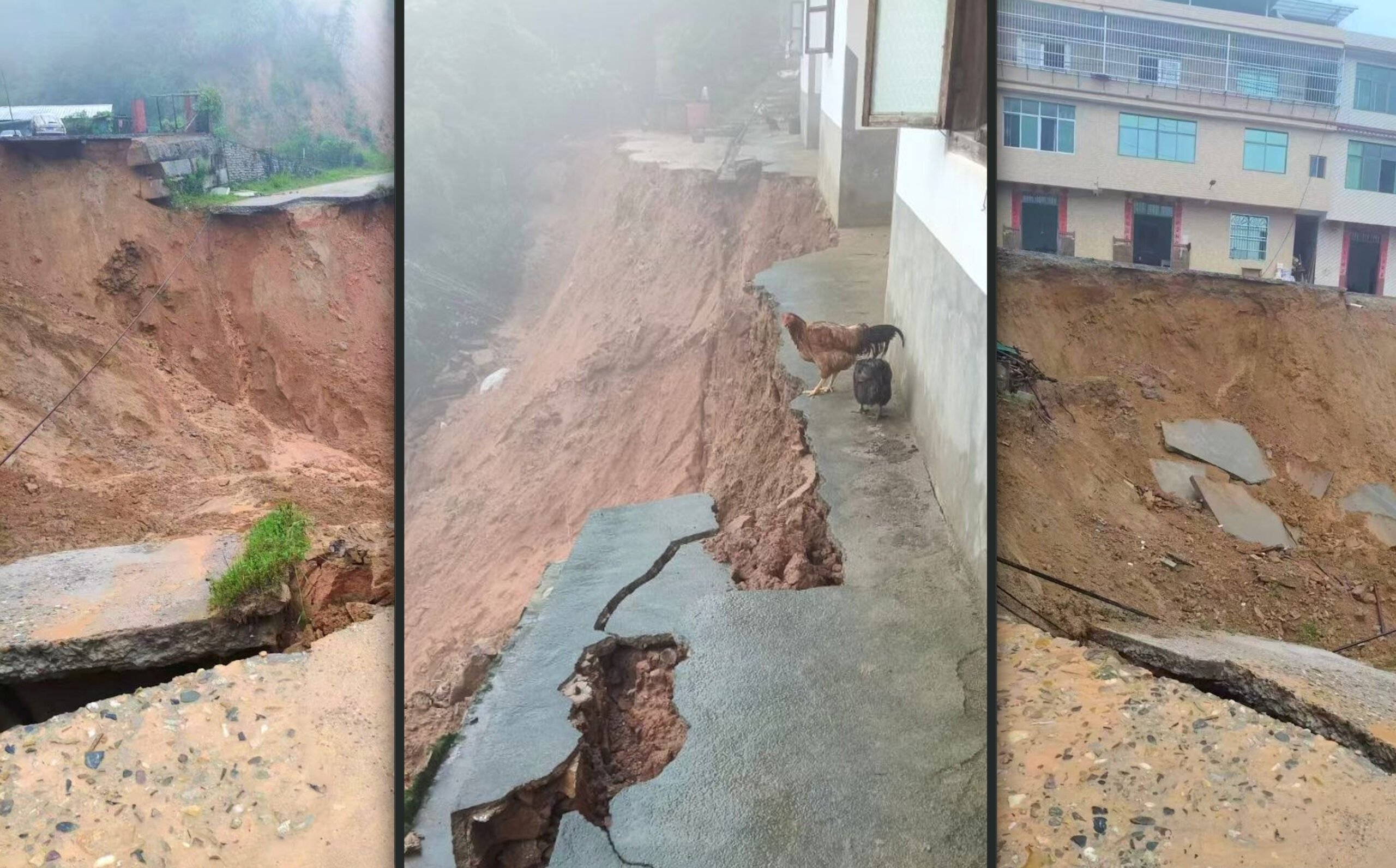
Due to the impact of Typhoon No. 18, “Shadell,” southern China recently experienced record-breaking heavy rainfall, leading to landslides and mudslides in many areas. The casualties and missing persons are continuously increasing. Several affected villagers revealed to the Epoch Times that local houses collapsed, roads were blocked, and villages were temporarily isolated and without aid, while the local government was strict about preventing information leakage about the disaster.
From September 3rd to 5th, residual circulation from Typhoon Shadell affected provinces such as Hunan, Jiangxi, Fujian, and Guangdong, causing historical extreme weather events. Secondary geological disasters triggered by heavy rainfall also spread to several areas, with the situation of the affected areas still dynamically changing.
Hunan province was one of the most severely affected provinces during this round of heavy rainfall, with flash floods, landslides, and mudslide disasters occurring one after another, especially in cities like Chenzhou and Shaoyang. According to official reports, as of September 5th, the number of affected population in Guidong County, Chenzhou City, Hunan Province exceeded 10,000, with at least 2 people dead and 1 injured.
Guidong County has been experiencing heavy rainfall since the evening of August 28, marking the longest-lasting and most severe regional torrential rain process in the area since 1961. Prolonged heavy rain has resulted in severe oversaturation of the soil, leading to landslides and mudslides in many areas.
Daiping Village in Oujiang Town is one of the most severely affected villages in Guidong County, where villager Zhang Jianping recounted the harrowing experience of the disaster.
On September 1st at noon, a severe landslide and mudslide disaster occurred in Daiping Village, Oujiang Town, Guidong County, Hunan Province. Local villager Zhang Jianping stated, “There are over a thousand people in Daiping Village, and almost all of them were affected by the disaster. Dangmu Group, with over a hundred households, was one of the most severely affected areas within the village.”
Zhang Jianping recalled that around 12 p.m. on September 1st, he was having lunch when he suddenly heard abnormal noises. “When I heard the sound, the landslide came down from behind.” The disaster struck suddenly, causing him to abandon his meal and run outside.
After fleeing, Zhang Jianping made a phone call to the village and then went to temporarily stay at other villagers’ homes. He mentioned that his own house had been destroyed by the landslide and mudslide and was no longer habitable.
He explained that the disaster didn’t occur in just one location but multiple places experiencing landslides simultaneously. He estimated that there were dozens of locations in the village affected by landslides.
Meanwhile, access roads to the village were severely impacted as well. “Many roads in the village are now blocked by mudslides,” he said. Due to the roads being impassable, some villagers had to evacuate on foot. During this evacuation, many villagers had almost no time to gather their belongings.
Zhang Jianping mentioned that the disaster had already caused casualties among the local residents: “2 people dead, 1 injured.” He told reporters that his family members had not encountered any accidents so far, but due to the damage to their house, they could not return to their original residence.
Apart from damaged houses and disrupted roads, local infrastructure has also been affected. Zhang Jianping stated that currently, the village is “without power or network,” and roads are almost impassable, affecting communication with the outside world and entry and exit from the village.
Now, after this disaster, dozens of households in the village have homes that are uninhabitable. “Many people in our village are still very poor,” he said.
For many local families, rebuilding their homes is not an easy task. Therefore, the reality facing them after the destruction of their homes is how to resettle and rebuild.
He mentioned that his own house was built in 2015, costing tens of thousands of yuan at that time. Personally, the economic pressure to rebuild the house is significant for him.
“It’s impossible to build a new house again,” Zhang Jianping said. “Local residents hope for some compensation from the government, but there is no official statement yet.”
In addition to Guidong, Shaoyang City in Hunan Province also saw landslides, with local villager Chen Juan sharing her experience of farmland being buried and limited information dissemination about the disaster.
Affected by the typhoon and continuous rainfall, parts of the mountainous areas in Xinning County, Shaoyang City, Hunan Province have recently experienced landslides.
Chen Juan, a resident of Hengpu Village, Huanglong Town, Xinning County, recounted on the Epoch Times that on September 4th, a landslide occurred in her village, and a large amount of soil rushed into farmland, burying dozens of acres of rice fields. Moreover, the rice had already matured and was ready for harvest.
She mentioned that the piled-up soil from the landslide was very deep, only a few meters away from the house of a nearby villager.
Chen Juan pointed out that over ten years ago, the same location had experienced a landslide, leading to houses being washed away. She stated that her maternal home collapsed due to a landslide at that time.
What worries the local villagers more is that this is not the first time a landslide has occurred here.
Hengpu Village has hundreds of residents, and there has been no overall evacuation. After the landslide, a small stream passing through the village was blocked by mud, making it impossible for residents on both sides of the road to pass normally.
She particularly mentioned that in some areas, the soil has loosened, and besides the locations of the landslides, there are evident cracks appearing elsewhere.
In her view, areas where landslides have occurred in the past and new cracks have appeared still face the risk of further landslides. If appropriate measures are not taken promptly, the housing and travel safety of nearby residents could still be at risk.
Interestingly, the dissemination of information about the disaster in the area seems to be restricted. Chen Juan stated, “We’re just a small county here, and the government doesn’t allow reporting.”
Chen Juan’s brother had previously posted related videos on Douyin that quickly gained high viewership. “It seems like the video broke 120,000 views in two to three hours, and soon official personnel called to ask him to delete it.”
Chen Juan mentioned that in recent days, she has not seen any further handling of the situation on-site. Her cousin also expressed helplessness of local farmers in a WeChat group message: “We farmers have no say and can only wait for instructions.”
From neighboring Jiangxi Province to Fujian Province, the continuous heavy rainfall has also caused severe flooding. According to official reports, Fujian Province, including Quanzhou, Zhangzhou, Ningde, Putian, and other areas, experienced flood disasters due to the impact of Typhoons Jialawi and Shadell, as well as heavy rainfall.
On September 4th, the PuTian National Meteorological Observatory recorded an hourly rainfall of 41.4 millimeters and a six-hour accumulated rainfall of 174.7 millimeters, ranking among the top in the country at that time.
Guo Haitao, a resident of Changtai Town in Putian City, recounted to the Epoch Times how the flood persisted, besieging them and how the villagers engaged in self-rescue and mutual assistance.
“We’re from Lingxia Village, and our house was flooded for three days. During these three days, we couldn’t go out or come in; there was no food or water. It was only on the fourth day today that the flood subsided,” he said. Guo mentioned that the flood was more severe this time, and villagers mainly relied on themselves for self-rescue.
He pointed out that most people in the village remained in their homes, “because many are elderly people in their seventies or eighties.” Only two households in the village were not flooded, while many families were affected by the flood.
Under conditions where the roads were impassable, and supplies couldn’t enter, villagers could only rely on mutual help among neighbors.
Guo Haitao mentioned that he had sought help through official complaint telephone numbers. “I called, and they said they would arrange it, but in the end, the village cadres called me and said there was no way.” He mentioned that because the government did not provide corresponding assistance promptly, he chose to publish the local disaster online, hoping to attract attention from the outside world.
From Hunan, Jiangxi to Fujian, the continuous heavy rainfall has led to ongoing flash floods, landslides, and mudslides. Many villagers are facing challenges such as damaged houses, shortages of supplies, and the difficult task of cleaning up their homes, while the Chinese authorities are blocking the dissemination of disaster information.
(The names Zhang Jianping, Chen Juan, Luo Yaqin, Wang Jiahui, and Guo Haitao mentioned above are pseudonyms.)