
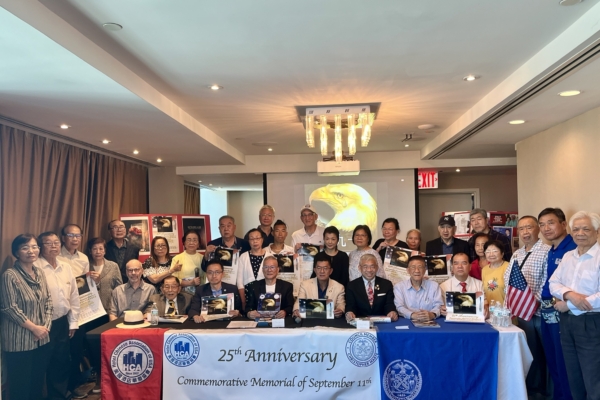
On September 7th, a poignant poetry recital transported the audience back to the morning 25 years ago that changed New York. In Manhattan’s Chinatown, a press conference was held for a photo exhibition commemorating the 25th anniversary of “9/11”. Shi Yi Zhen, in her eighties, reminisced about 9/11 through her poetry. On the screen, historical images of the plane crashes, twin tower collapses, and the dust engulfing Manhattan were once again vividly shown. Subsequently, several eyewitnesses recounted the moments of life and death on that day, some with tears in their eyes, as memories of that fateful day remain haunting.
The Chinese American Hotel Association announced that they would host a “Remembering 9/11 Terrorist Attacks 25th Anniversary Photo Exhibition” at Wyndham Garden Chinatown on Bowery Street #93, from 10 am to 6 pm on Thursday, September 10. This exhibition aims to honor the victims through photos and videos, and to educate the younger generation who did not experience 9/11 about this historical event.
Shi Yi Zhen is not only a reciter but also a witness of 9/11. On the morning of September 11, 2001, she stood with colleagues in the company’s meeting room, watching one of the towers of the World Trade Center burning, followed by the appearance of the second plane.
“As the plane got closer, my heart was in my throat,” she said. “When it hit, there was immediately a raging fire.”
While others were still in shock looking out the window, she, responsible for financial tasks, suddenly thought, if there was a power outage, employees might not get their wages. “While others were still watching, I was thinking: what should I do? My priority was to make sure the salaries were paid,” she promptly returned to the office to handle payroll and shortly after, the power went out.
“No matter when, you have to think about what your responsibility is,” Shi Yi Zhen said. After 9/11, she once “dared not go home” because every time she turned on the TV, it was filled with disaster scenes. She went to Union Square day after day after work, looking at photos of the missing, flowers, and families waiting for news of their loved ones. Reciting “We Must Not Forget” 25 years later, it is not just a poem for her but a memory of life that she personally experienced.
Former New York City police officer and state senator Chen Xue Li rushed to the World Trade Center on 9/11, working for about 36 hours straight. When the North Tower collapsed, he managed to shelter behind a large dumpster, dodging the shards of glass flying around. “At that moment, I didn’t have time to be afraid. I just knew I had a job to do.”
However, he stated that what he remembers is not just September 11. “I will not forget September 12, 13, 14, 15, or the following months.” Many businesses in Chinatown had already been severely affected, yet they still provided food, water, and supplies to frontline rescuers. “I will never forget these acts.”
Democratic District Leader Richard Corman, from the 66th Assembly District, who was living in Tribeca at that time, recounted hearing the first plane flying low and running to the rooftop to witness the second plane crashing into the World Trade Center.
“At that moment, I knew this was not an accident,” he said. As the twin towers collapsed one after another, and a huge dust cloud swept in, his wife kept shouting, “Get off the rooftop, get off!” But he said, “I just couldn’t leave.”
After 25 years, what Corman misses most is post-disaster New York. “At that time, everyone was like a family,” he said. “We shouldn’t have to rely on a tragedy to come together again. But at that moment, we truly united.”
Huang Huaqing, founder of the Chinese American Hotel Association, lost his job near Wall Street post-9/11, settled his family, then immediately became a Red Cross volunteer. He later worked for the Federal Emergency Management Agency (FEMA), assisting disaster-affected residents and businesses in English, Mandarin, and Cantonese. “I felt that as an American citizen, when the country is in trouble, we should fulfill our responsibilities.”
Years later, Huang Huaqing developed health issues such as pulmonary fibrosis related to 9/11 and continues to undergo health monitoring. He said that the disaster is something that “will never be erased” from his life.
State Assembly Member Zheng Yongjia, teary-eyed while watching the 9/11 footage, recalled living near Confucius Plaza in Chinatown, witnessing the collapse of the World Trade Center. “When I see this footage again today, my tears start flowing. Some of the people that I remember from that day never returned.”
Zheng Yongjia mentioned that the impacts of 9/11 on Chinatown go beyond just the pain, as the neighborhood has endured lasting effects on transportation and commerce for 25 years. He pointed out the prolonged vehicle restrictions on Park Row post-9/11 and urged the city to reassess. “We must not forget that the previous generation built Chinatown,” he said. “We cannot let it disappear.”
25 years have passed, the dust of Lower Manhattan has long dissipated, but for those who witnessed the planes hitting the towers, participated in rescue operations at the rubble, or waited on the streets for news of loved ones, that day has never truly faded away.
On September 10, historical photos will be displayed once again. Beyond the photos, these eyewitnesses continue to remind the next generation with their stories: remember 9/11, not just how the twin towers fell, but also how people helped each other after the disaster, standing up again.