
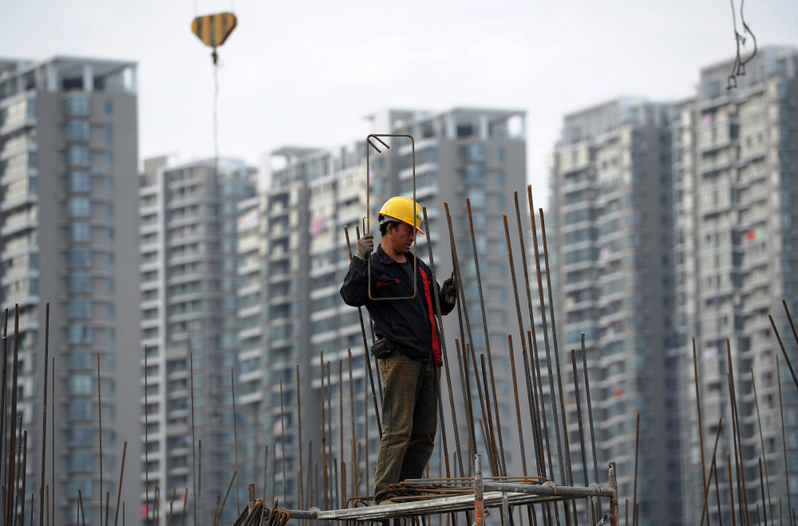
China’s real estate market data for the first half of the year shows clear signs of differentiation. While property prices in first-tier cities remain relatively stable, lower-tier cities are still working on reducing inventory. Analysts point out that with the development of “K-shaped differentiation,” the recovery of the real estate market remains challenging.
The National Bureau of Statistics of the Communist Party of China recently released data on the real estate market performance from January to June and the housing price data for 70 major cities in June. The data indicates that the four first-tier cities are performing well, there is an increasing differentiation among second-tier cities, and third and fourth-tier cities are still in the bottoming stage. As of the end of June, the nationwide area of unsold commercial housing decreased by 0.9% year-on-year, but the overall inventory level remains relatively high.
An article published by the China Real Estate Report under the supervision of the Ministry of Housing and Urban-Rural Development of the Communist Party on July 26 mentioned that in June, prices of new residential properties in 70 cities increased in 20 cities compared to the previous month, with a rise of 4 cities, the highest since May 2025. In first-tier cities with good data, prices of high-quality properties in core areas stabilized early on, but demand for affordable homes in the outskirts is still being driven by price adjustments.
The article highlighted that the nationwide area of new construction decreased by 23.4% year-on-year in the first half of the year, real estate development investment dropped by 18.0% year-on-year, indicating a reduction in the supply side contributing to the decline in inventory.
Data shows that the biggest pressure on the Chinese property market remains the high inventory. The real estate data application and consulting service platform, CRIC, stated that a safe inventory turnover cycle is within 18 months; however, as of the end of June 2026, the overall inventory turnover cycle in third and fourth-tier cities remains high at 31.6 months, with some cities facing more severe conditions such as Zhuhai with a cycle of 46.9 months, Dongguan 41.4 months, Kunshan 45.2 months, Xining 53.1 months, and Shantou 49.6 months.
Regarding the current state of the Chinese real estate market, Professor Zheng Changzhong from the School of International Relations and Public Affairs at Fudan University expressed in an article on July 26 that the real estate development operation model characterized by “high debt, high leverage, and high turnover” is becoming unsustainable, which was one of the significant incentives for the risk of unfinished projects in some properties in previous years.
Lian Ping, Chairman of the China Chief Economists Forum, stated in an article that the real estate market in the first half of 2026 remains in a downward trend, with prominent characteristics of K-shaped differentiation in the market, significant differences at different city levels based on factors such as population, industry, and inventory.
The article suggests that in the second half of the year, the structural characteristics of the real estate market will be further highlighted. Due to the lack of willingness for long-term leverage in households, the continuous decline in housing prices leading to shrinking asset value, residents’ precautionary savings have significantly increased, and there is a common phenomenon of early loan repayments, making it unlikely for a large-scale surge in property purchases in the latter half of the year. Additionally, the debt repayment pressure on real estate enterprises remains significant. Estimated calculations show that commercial bank loans, domestic credit bonds, and offshore US dollar bonds due for repayment by real estate enterprises account for approximately 30% of the total funds. Particularly for privately-owned real estate enterprises with relatively weak qualifications, relying solely on seeking non-bank financing channels with interest rates exceeding 10% from the market is challenging.
According to S&P Global Ratings, Chinese real estate developers hold $22 billion in offshore bonds set to mature this year.
One of China’s largest property developers, Vanke, has reached an agreement with bondholders to extend the repayment deadline for some of the 10 bonds maturing in the first half of the year.
Zhang Xiaoxi, a financial analyst at Gavekal Dragonomics, told Reuters that it has become evident that “the debt restructuring plans of real estate companies are based on overly optimistic assumptions about the recovery of the Chinese property market. Many developers and creditors underestimated the continued sluggishness of the real estate industry when formulating their plans, and expectations for improved sales, cash flow, and asset value have largely not materialized.”