
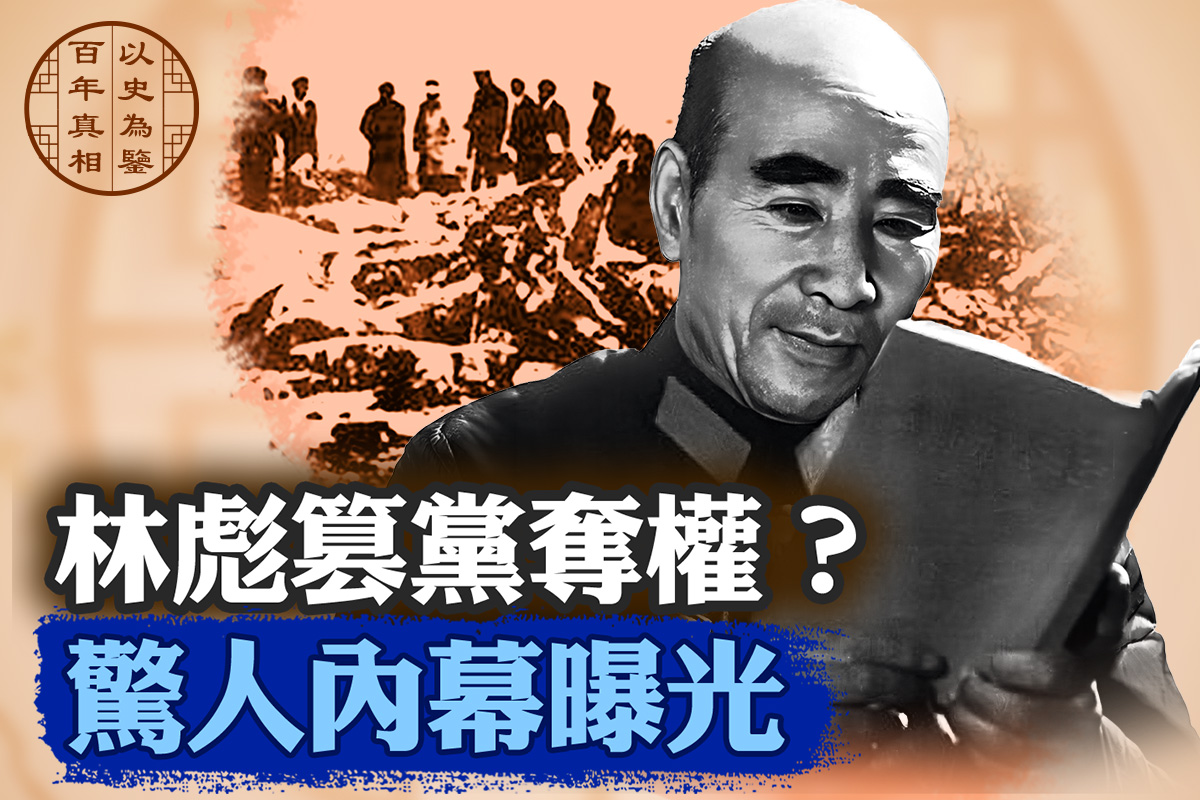
Hello audience, welcome to watch “The Century Truth”.
Late at night on September 13, 1971, a Trident aircraft secretly took off from Shanhaiguan Airport in China and crashed a few hours later in the Gobi Desert of Mongolia. On board were Lin Biao, designated as “Mao Zedong’s successor” by the CCP Party Charter, along with his wife and children.
After the incident, Lin Biao was accused by the CCP of “attempting to seize power”. It was alleged that he was eager to usurp the position of power, aiming to become the President of the country. Failing to do so, he allegedly conspired to overthrow the government and eventually fled to the Soviet Union.
This narrative was repeatedly publicized and seemed to have become the accepted version of events over the decades.
However, with the CCP’s credibility now at a negative value, we cannot help but question: Was Lin Biao’s “power seizure” true? Or was it another fabricated dark chapter by the CCP?
Today, let’s revisit this significant historical event and examine what really happened at that time.
Lin Biao was one of the top ten marshals of the CCP, who played a crucial role in the CCP’s rise to power, capturing two-thirds of the territory. After the CCP came to power, he held positions such as Vice Chairman of the CCP Military Commission, Minister of National Defense, and Vice Chairman of the Central Military Commission. During the Cultural Revolution, he was officially designated as Mao Zedong’s successor in the party charter.
At that time, Lin Biao seemed poised to reach the peak of his career. However, in Mao Zedong’s political landscape, no one was truly secure, and Lin Biao was no exception.
Let’s rewind to 1970 and revisit the proposition Mao Zedong put forward regarding the establishment of the position of “President of the country”.
Lin Biao’s trusted aide, the then Commander of the CCP Air Force Wu Faxian, recalled in the “Interview Record with Wu Faxian” that on March 8, 1970, Mao Zedong in Wuhan sent the then Director of the Central Security Bureau Wang Dongxing back to Beijing to convey a message to Lin Biao.
Mao stated that preparations should be made for the Fourth National People’s Congress to elect national leaders and to amend the Constitution. However, regarding the issue of whether to establish the position of the President of the country, Mao made an intriguing remark: “It seems that if the position of President were to be established, only Lin Biao could take on the role. But in my opinion, it’s still best not to establish it.”
The message reached Beijing, and Wu Faxian, Lin Biao’s wife Ye Qun, and the then Chief of the General Staff of the PLA Huang Yongsheng specifically went to Wang Dongxing’s house to confirm. Wang Dongxing said that was Mao’s exact words. Ye Qun, upon hearing this, was very pleased. She thought that Lin Biao was going to become the President of the country.
However, the hints Lin Biao received from Mao were not as straightforward.
Scholar Wang Zhaojun revealed in the book “Who Killed Lin Biao?” that on the eve of the September 13 incident, Lin Biao reportedly told Huang Yongsheng, Wu Faxian, Li Zuopeng, and Qiu Huizu: “Before the Lushan Conference, Mao Zedong personally mentioned to me at least twice that he no longer wanted to be the Party Chairman, wanted to become the President of the country, travel internationally to expand China’s influence, and reminded me to initiate this proposal. I was just following orders.”
While publicly stating “Let’s not have a President, but if we must, let Lin Biao take the role,” privately Mao hinted to Lin Biao, “You should nominate me for the position.” What kind of play was this? Lin Biao found himself in a dilemma: Supporting the establishment of the President’s position could easily be seen as his own ambition. Opposing it, however, would be defying Mao’s instructions. It was a trap from both sides.
On the night of April 11, 1970, in Suzhou, Lin Biao called the Political Bureau through his secretary, conveying his opinions.
First, regarding the President’s position, he suggested that Mao should hold the position concurrently. This would be more suitable for public opinion both inside and outside the party; second, whether to establish the position of Vice President was not a significant issue. In essence, he was throwing the ball back to Mao.
The next day, Premier Zhou Enlai chaired a meeting of the Central Political Bureau to discuss Lin Biao’s opinions. Many members of the bureau supported the idea of letting Mao Zedong become the President. Zhou Enlai reported this situation to Mao. Mao immediately responded, “I cannot do this anymore, this suggestion is not appropriate.”
This was Mao’s second public statement – he would not become the President of the country.
By late April, at a meeting of the Political Bureau, Mao Zedong raised the issue for the third time, firmly stating that he would neither become the President nor have the position established. Moreover, he also shared a story.
He said, “Sun Quan advised Cao Cao to become an emperor. Cao Cao said that Sun Quan was like someone preparing to roast him over charcoal. I advise you not to treat me like Cao Cao, and you should not be like Sun Quan.”
This statement, directed at Lin Biao, likened him to Sun Quan, implying that Lin Biao was setting a trap for him.
CCP historian Xin Zilin mentioned in the book “The Fall of the Red Sun” that in mid-May 1970, Lin Biao told Wu Faxian that the position of President should still be established. Without a President, the country would lack a “head,” which was not appropriate.
During the constitutional group meeting, Wu Faxian and Li Zuopeng continued to advocate for the establishment of the President’s position. After learning about this, Mao Zedong, at a full meeting of the Constitution Amendment Drafting Committee convened in mid-July, reiterated that Wu Faxian proposed establishing the President’s position, while Zhang Chunqiao suggested otherwise. Mao emphasized that having a President was just a formality, not something to revolve around personalities.
This was Mao’s fourth public stance, opposing the establishment of the President’s position.
If Mao didn’t want to become the President, did Lin Biao want to?
In the book “Who Killed Lin Biao?” author Wang Zhaojun documented a conversation between Lin Biao and his son Lin Liguo.
Lin Biao said, “Son, let me tell you something, remember this: I cannot govern this country. It’s not just the current situation being full of problems, even under normal circumstances, I wouldn’t know how to manage the country… I do not enjoy political affairs, I don’t like socializing, my health is not good, I cannot manage the country. That’s why I feel aggrieved. I realize my limitations; I have never considered being the President. I only understand military matters, and I have a great passion for the unity of the country, development of production, and improvement of people’s lives, but my abilities are limited. I hope to maintain the power to participate in political life and ensure the normal functioning of the military.”
In Lin Biao’s view, Mao Zedong, after writing his name into the Party Charter during the Ninth Congress following the defeat of Liu Shaoqi, even discussed the issue of succession with him on two occasions during the election of the Presidium. Lin Biao believed Mao’s actions were sincere, and he never thought Mao would set him up.
However, with a series of back-and-forths, Lin Biao gradually realized that Mao Zedong did not trust him and might not intend to let him succeed. He appeared more like a pawn on Mao’s chessboard.
From that point on, whatever Mao said or promised, Lin Biao was already wary.
The conflicts between Mao and Lin became prominent at the Lushan Conference.
On the afternoon of August 22, 1970, Mao Zedong convened a meeting of the Central Politburo Standing Committee to address the issue of establishing the President’s position.
At this meeting were five Standing Committee members: aside from Mao Zedong, Lin Biao, Zhou Enlai, then CCP Central Committee Standing Committee member Chen Boda, and during the Cultural Revolution responsible for party internal security and intelligence work, Politburo Standing Committee member Kang Sheng. Four of them advocated for the establishment of the President’s position and also suggested merging the positions of Party Chairman and President.
Their statements indicated a lack of clarity on what Mao truly wanted.
At the meeting, Mao once again declared that the establishment of the President’s position was a formality, and if they wanted it, they could take it, but he would not.
The following day, on August 23, a real political storm erupted.
On that day, during the Second Plenary Session of the Ninth Central Committee held in Lushan, Lin Biao delivered a speech lasting over an hour, focusing on the amendment of the Constitution and Mao’s leadership position, emphasizing the need to clearly establish Mao’s position in the Constitution and maintaining the view that “Chairman Mao is a genius.”
On the morning of August 24, Ye Qun called Wu Faxian, Li Zuopeng, and Qiu Huizu together to convey Lin Biao’s four-point opinions.
Firstly, they were to express full support for Lin Biao’s speech and firmly endorse the praise of Mao’s “genius theory.”
Secondly, they were to insist on establishing the President’s position and have Mao Zedong take the role.
Thirdly, they could give prior notice to the Air Force, Navy, and Rear Services, with some Central Committee members coming forward to speak in alignment, but without specifying who organized it.
Fourthly, they were to direct the main contradictions towards Zhang Chunqiao. This was because he opposed the establishment of the President’s position, and attacking him would not enlarge the conflict too much.
Soon, the groups began discussing Lin Biao’s speech. A briefing from the North China Group mentioned that some representatives, after hearing Chen Boda’s speech, expressed the “greatest and strongest indignation” because there were individuals within the party who denied that Mao was the “greatest genius of the time.” During the discussions, some individuals went so far as to label those denying the “genius theory” as ambitious, conspiratorial, counter-revolutionary revisionists, advocating for identifying and struggling against these individuals.
The nature of the discussion had changed. Originally, the focus was on constitutional matters, but it had shifted to targeting those not in support of the “genius theory,” potentially leading to labeling and criticism.
Upon seeing the briefing, Mao sensed the situation and immediately took action. He was well aware of how personal worship could lead to the formation of independent political forces. Furthermore, the momentum was centered around Lin Biao’s speech, which Mao felt threatened by. He decided to act swiftly.
Mao first had a private conversation with Lin Biao. He said, “Chen Boda is leading this. On one hand, he advocates establishing the President’s position, and on the other hand, insists on the genius theory. Inciting some people, deceiving others, this trend is akin to destroying Lushan or stopping the rotation of the earth. I will not become the President, and I advise you not to either.” “If this continues, I will step down and let you all stir things up; alternatively, I will resign as the Chairman of the Central Committee.”
Lin Biao responded, “My original suggestion to establish the President’s position was for the Chairman to assume the role, not because I desired it.”
Mao continued, “Both you and Chen Boda insist on the genius theory, but your situations are different. Chen is a counter-revolutionary infiltrator into the Communist Party, you should distance yourself from him.”
Simultaneously, Mao intentionally framed the conflict as a struggle between Chen Boda and Zhang Chunqiao, telling Lin Biao, “This man Zhang Chunqiao, observe him for the next two years. After two years, when I step down, leave it to you to handle.”
This was a typical Maoist tactic: while applying pressure in his words, he also made you feel that his main target was someone else, maintaining some level of trust in him.
Following this, Mao held discussions with Zhou Enlai, Chen Yun, and Kang Sheng. All the Standing Committee members agreed not to establish the President’s position. Shortly afterward, Mao called for an expanded meeting of the Central Political Bureau Standing Committee to announce that the issue of establishing the President’s position should no longer be raised.
The meeting decided to cease discussions on Lin Biao’s speech, retrieve the briefing, and requested Chen Boda and others to carry out self-examinations.
On September 6, the Second Plenary Session of the Ninth Central Committee concluded, announcing an investigation of Chen Boda. Chen Boda became the scapegoat, and Lin Biao was not directly named.
The Lushan incident appeared to have calmed down superficially, but the matter was far from over.
By the end of September 1970, Mao Zedong sent Wang Dongxing to meet Lin Biao in Maojiawan. Mao instructed Wang to have a good conversation with Lin Biao, urging him to write a self-criticism. If he could recognize his mistakes, Mao would welcome him. It was optimal if this self-criticism could link back to historical errors.
With a heavy heart, Wang Dongxing went as requested. Amidst his attempts at persuasion, he advised Lin Biao, “To take the initiative, it would be better to write a self-criticism for the Chairman’s consideration.”
Lin Biao looked at him and said, “Are you trying to give me a handle? Are you personally concerned for me, or were you sent here as a mouthpiece by someone else?”
He continued, “If I write a self-criticism, the Chairman would immediately distribute it throughout the party. This would mean I would admit to the so-called errors in front of the entire party and the people nationwide. I will not fall into that trap. I have done nothing wrong, and I will not write a criticism against my beliefs.”
Mao Zedong hit a nail with Lin Biao. He realized that Lin Biao was more difficult to handle compared to Liu Shaoqi and Peng Dehuai.
On October 8, Mao sent a brief message to Lin Biao, saying, “Autumn wind is blowing, take care of yourself.”
Lin Biao replied, stating that he couldn’t keep up with Chairman Mao’s teachings in terms of ideology and routes, and he wasn’t suitable to be the successor. He requested Chairman Mao to decide at his discretion.
However, Mao did not accept this sort of response. Lin Biao found himself trapped in the position of the successor, unable to move, with no sense of security.
This brings us to a crucial question: Why did Lin Biao agree to become the “successor” in the first place?
Let’s go back to the early days of the Cultural Revolution.
During the Eighth Eleventh Plenum of the CCP in 1966, while a new list of leaders was being prepared, placing Lin Biao second as the successor to Liu Shaoqi, who Mao wanted to confront, Lin Biao initially did not participate in the meeting. He was in Dalian for rest and had planned to return to Beijing two months later. However, Mao had already decided to expose Liu Shaoqi, necessitating Lin Biao’s immediate return. Convincing Lin Biao to come back took quite an effort.
According to records in the Cultural Revolution History by Yang Jisheng, on August 4, Mao had Lin Biao’s secretary call him, seeking his support. When Lin Biao’s secretary called back, he expressed support for Mao’s opinion but mentioned his poor health, making it difficult to attend the meeting. On August 5, Mao relayed the contents of his big-character poster to Lin Biao over the phone. On August 6, Mao had his secretary inform Lin Biao of this via a telephone conversation.
Despite this, Lin Biao was reluctant to step up and be this “successor.”
On the morning of August 7, Lin Biao arrived in Beijing, with Mao specifically waiting to see him and telling him face to face: “The situation is changing rapidly, and you must return to participate in the meeting.”
Lin Biao still cited health issues and incapability as reasons. Mao scolded him on the spot, saying, “Do you want to become Emperor Ming?” Ming Emperor referred to Jiajing Emperor of the 16th century, who was known for neglecting his duties and being engrossed in alchemy. By using the historical figure of Ming Emperor, on one hand, Mao was mocking Lin Biao, and on the other hand, he was warning him not to defy orders or consider himself an “Emperor.”
Under Mao’s firm pressure, Lin Biao had no choice but to come out and assume the role of this “successor.”
Let’s recap: Lin Biao never initially wanted to become the “successor”; confided in his son about being unable to govern the country; and after Mao posed the question of establishing the President’s position, he opted to advocate for Mao to take on the role while avoiding suspicions as much as possible. Does this sound like the ambition of someone seeking to “seize power”?
Zhou Enlai later mentioned at the CCP’s Tenth Congress: “Before the Ninth Congress, Lin Biao and Chen Boda drafted a political report. They opposed the continued revolution under proletarian dictatorship, believing that after the Ninth Congress, the main task should be production development.”
Zhou Enlai’s words hinted at Lin Biao’s real intentions back then: to finish the Cultural Revolution, focus on production development rather than continuing the revolution. This contrasted with Mao’s insistence on “class struggle as the key,” especially the necessity of “continuing the revolution under proletarian dictatorship.”
Perhaps this was the actual reason for his downfall.
Well, today’s program ends here. Thank you for watching. If you enjoyed our program, don’t forget to like, subscribe, and share. See you next time.
Production Team of “The Century Truth”